
How Travel Companies Can Scale Customer Support Without Hiring During Peak Seasons
Peak season is where travel businesses make their money and often where they lose their customers. In fact, studies show that over 60% of customers switch brands after poor support experiences, making peak season service quality a direct revenue driver.
From holiday surges to long weekends and flash sales, demand spikes can overwhelm even the most prepared teams. For most travel companies, the instinctive solution is to hire more agents. But hiring during peak season is expensive, time-consuming, and often inefficient. By the time new agents are trained and onboarded, the surge is already over.
So how do modern travel companies handle this? They don’t hire more. They scale smarter.
In this blog, you’ll explore how travel customer support outsourcing and seasonal support BPO models help businesses scale travel support efficiently during peak seasons without compromising on customer experience or operational efficiency.
Why Peak Season Breaks Traditional Support Models
Travel is one of the most volatile industries when it comes to customer demand. A sudden weather disruption, flight cancellations, or a viral travel deal can lead to a massive surge in support queries within hours.
The Problem with In-House Scaling
Most in-house teams are built for steady-state demand, not spikes. When peak season hits ticket volumes can increase by 2-3x, response times slow down, customer satisfaction drops, and internal teams burn out.
Hiring temporary staff sounds like a solution, but it comes with challenges due to long hiring and training cycles, high onboarding costs, inconsistent service quality, and limited flexibility once demand drops. This is why many companies are rethinking how they scale travel support.
Travel Customer Support Outsourcing: A Smarter Way to Scale
Instead of building large in-house teams for temporary demand, travel companies are turning to travel customer support outsourcing. In fact, industry reports suggest that over 70% of travel companies outsource to reduce costs and improve efficiency, making it one of the most widely adopted scaling strategies.
What Makes This Model Effective?
- On-demand scalability: Quickly ramp up support during peak periods
- Cost efficiency: Pay only for the support you need
- Faster response times: Pre-trained agents reduce onboarding delays
- Operational flexibility: Scale down seamlessly after peak season
For travel companies dealing with unpredictable demand, this approach provides the agility that traditional hiring simply cannot.
Read more: 24/7 Customer Support Strategy: Building Always-On Support Without Breaking the Bank
How Seasonal Support BPO Helps Travel Companies Handle Demand Spikes
A seasonal support BPO model is specifically designed for industries like travel, where demand fluctuates significantly. Instead of maintaining a large full-time team, companies rely on outsourcing partners to handle peak loads.
Key Benefits of Seasonal Support BPO
1. Rapid Ramp-Up Without Hiring Delays
During peak seasons, time is everything. A seasonal support BPO partner can deploy trained agents within days, not weeks. This eliminates lengthy hiring cycles and ensures you’re ready to handle demand exactly when it spikes.
2. Consistent Customer Experience
Unlike temporary hires, BPO agents are already trained in customer support processes, ensuring consistent quality across interactions. This means your brand voice, response standards, and customer experience remain intact, even during high-pressure periods.
3. Multi-Channel Support Coverage
Travel customers reach out across multiple channels including voice calls, chat support, emails, and social media. A strong outsourcing partner ensures seamless support across all channels without overwhelming your internal team. This unified approach prevents gaps in communication and improves overall response efficiency.
4. Cost Optimization During Off-Season
Once peak season ends, you can scale down instantly without worrying about layoffs or underutilized staff. This ensures you’re only paying for what you use, keeping operations lean and cost-efficient year-round. This flexibility is one of the biggest advantages of hiring a seasonal support BPO.
How to Scale Travel Support Without Compromising Customer Experience
Scaling support is not just about handling volume, it’s about maintaining quality. Here’s how leading travel companies successfully scale travel support while keeping customer experience intact:
Combine AI with Human Support
In 2026, customer support is no longer purely human-driven. In fact, AI can handle up to 60–70% of repetitive customer queries, significantly reducing the burden on support teams
AI tools like chatbots and automated workflows handle FAQs and repetitive queries, booking confirmations, and status updates. This reduces the load on human agents, allowing them to focus on complex issues. When combined with travel customer support outsourcing, this creates a hybrid model that is both efficient and scalable.
Prioritize High-Impact Queries
Not all support tickets are equal. During peak season, companies that succeed are those that prioritize urgent queries (cancellations, refunds, delays), automate low-priority interactions, and route complex cases to experienced agents. A structured support system ensures faster resolution and better customer satisfaction.
Build a Flexible Support Infrastructure
Rigid systems break under pressure. To scale effectively, travel companies need cloud-based support platforms, integrated CRM systems, and real-time analytics and reporting. Outsourcing partners often bring this infrastructure, enabling faster and more efficient scaling.
Use Data to Predict Demand Spikes
Peak seasons are predictable to an extent. Historical data can help identify high-demand periods, common customer issues, and channel-specific spikes. By working with a seasonal support BPO, travel companies can proactively plan capacity instead of reacting to demand.
Read more: How a Customer Experience Strategy Impacts Revenue, Customer Retention, and Brand Loyalty
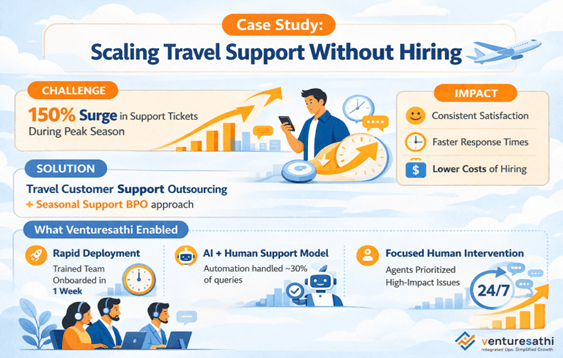
Case Study: Scaling Travel Support Without Hiring
A US-based travel company expected a 150% surge in support tickets during peak season but lacked the capacity to handle it. Hiring would take 4-6 weeks which is too slow for immediate demand.
The Solution
- Rapid Deployment: A trained support team was onboarded within a week, eliminating hiring delays
- AI + Human Support Model: Automation handled ~30% of repetitive queries, reducing ticket load
- Focused Human Intervention: Agents prioritized complex and high-impact customer issues
- Multi-Channel Coverage: Seamless support across chat, email, and voice
What Venturesathi Enabled
The Impact
- Maintained consistent customer satisfaction levels despite a 150% surge in volume
- Improved response times during peak periods
- Avoided the cost and inefficiencies of temporary hiring
- Enabled seamless scale-down post-season with zero layoffs or excess overhead
Result
By leveraging a seasonal support BPO model, the company was able to scale efficiently, maintain service quality, and optimize costs, all without disrupting internal operations.
Common Mistakes Travel Companies Make While Scaling Support
Even with the right intent, many companies struggle to scale effectively often due to reactive decisions rather than structured planning.
Over-Hiring for Temporary Demand
Leads to unnecessary costs and inefficiencies post-peak season. Once demand drops, businesses are left with underutilized teams, increasing operational overhead and impacting profitability.
Ignoring Technology
Relying only on human agents increases costs and slows down response times. Without automation, teams get overwhelmed with repetitive queries, reducing efficiency and impacting overall customer experience.
Delaying Outsourcing Decisions
Waiting until the surge hits leaves no time for proper onboarding and planning. This results in rushed implementations, misaligned expectations, and inconsistent service quality during critical periods.
Not Defining SLAs Clearly
Without clear expectations, service quality can become inconsistent. Lack of defined SLAs makes it difficult to track performance, enforce accountability, or ensure a consistent customer experience.
Avoiding these mistakes is critical when trying to scale travel support efficiently while maintaining quality and cost control.
Read more: Using Customer Data Platforms (CDPs) to Improve CX
The Future of Travel Customer Support Outsourcing
The role of outsourcing in travel is evolving rapidly. In 2026 and beyond, we’re seeing a shift toward:
- AI-powered support ecosystems
- Integrated CX + back-office operations
- Outcome-based outsourcing models
- Hyper-personalized customer experiences
Travel companies are no longer outsourcing just to reduce costs, they are outsourcing to build smarter, more scalable operations. This makes travel customer support outsourcing a strategic decision, not just an operational one.
Final Thoughts: Scaling Smart Is the New Competitive Advantage
Peak season doesn’t have to mean chaos. Travel companies that succeed are those that move away from reactive hiring and adopt flexible, scalable support models.
At the end of the day, scaling customer support is not about adding more people, it’s about building systems that can grow with your business. That’s where the right outsourcing approach makes all the difference.
At Venturesathi, the focus is on helping travel companies build scalable, tech-enabled support systems that can handle peak demand without operational stress. By combining trained support teams with modern tools and flexible models, the goal is simple: help businesses scale efficiently while delivering consistent customer experiences.
FAQs
1. What is the cost of travel customer support outsourcing?
The cost of travel customer support outsourcing depends on factors like support channels, volume, and service complexity, as well as the level of expertise required. It is generally more cost-efficient than maintaining large in-house teams, especially during fluctuating demand periods.
2. How quickly can a seasonal support BPO team be deployed?
A seasonal support BPO partner can usually deploy trained agents within a few days to a couple of weeks, depending on the scale and complexity of operations. Faster deployment is possible when workflows, tools, and processes are clearly defined in advance.
3. Is outsourcing customer support suitable for small travel startups?
Yes, outsourcing is especially beneficial for startups as it allows them to scale travel support without large upfront hiring costs. It also gives them access to trained teams and structured processes that would otherwise take time to build internally.
4. How do outsourced teams handle peak season quality control?
Outsourcing partners use defined SLAs, QA frameworks, and performance monitoring tools to ensure consistent service quality even during high-volume periods. Regular reporting and feedback loops help maintain accountability and continuous improvement.
5. Can outsourced support teams integrate with existing travel platforms?
Most modern BPO providers can seamlessly integrate with CRMs, booking systems, and customer support tools, ensuring smooth workflows and real-time data access. This integration helps maintain continuity in customer interactions and internal operations.
6. What types of queries can be handled through outsourced travel support?
Outsourced teams can manage a wide range of queries, including booking assistance, cancellations, refunds, itinerary changes, and general customer inquiries. They can also handle escalations and complex cases with the right training and process alignment.