How to Build the Business Case for Outsourcing (With a Simple ROI Framework)
When founders and operators consider outsourcing, the first question is rarely “Should we outsource?”. In reality, it’s “Will this actually save us money?” and that’s where most outsourcing decisions get stuck.
In fact, studies show that over 70% of companies outsource primarily to reduce costs and improve efficiency, yet many struggle to clearly quantify the actual outsourcing ROI before making the decision.
Without a clear business case for outsourcing, teams find it difficult to justify the move internally. Leadership wants numbers. Finance wants predictability. Operations want reliability. And everyone wants to understand the real return before committing. The truth is, outsourcing is no longer just about cutting costs. In 2026, it’s about building scalable, efficient operations that can grow without increasing complexity.
In this blog, you’ll explore how to build a strong business case for outsourcing, compare outsourcing vs in-house cost, and use a simple framework to calculate outsourcing ROI effectively.
Why You Need a Strong Business Case for Outsourcing
Outsourcing decisions impact multiple parts of your business including costs, customer experience, operational efficiency, and scalability. Without a structured approach, it’s easy to underestimate both the benefits and the risks.
The Problem with In-House Scaling
A well-defined business case for outsourcing helps you:
- Align stakeholders across finance, operations, and leadership
- Clearly compare outsourcing vs in-house cost
- Quantify potential cost savings outsourcing can deliver
- Identify operational efficiencies beyond just cost
Most importantly, it shifts the conversation from “Is outsourcing cheaper?” to “Is outsourcing smarter for our growth?”
Outsourcing vs In-House Cost: What Are You Really Paying For?
One of the biggest mistakes companies make is comparing outsourcing costs directly with salaries. The real outsourcing vs in-house cost comparison goes much deeper.
| Cost Factor | In-House Teams | Outsourcing Model |
|---|---|---|
| Recruitment & Hiring | High cost and time-intensive hiring cycles | Managed by provider, no direct cost |
| Training & Onboarding | Requires time, resources, and ongoing investment | Pre-trained agents ready to deploy |
| Infrastructure | Office space, tools, software, IT setup required | Shared infrastructure included |
| Employee Costs | Salaries, benefits, retention, attrition management | Bundled into predictable pricing |
| Management Overhead | Requires internal managers and supervision | Reduced oversight needed |
| Scalability | Slow and costly to scale up or down | Flexible, on-demand scalability |
| Pricing Model | Fixed and increases with team size | Flexible (pay-per-use, per agent, outcome-based) |
Thus, in-house costs scale linearly with growth, while cost savings outsourcing enables a more flexible, efficient, and predictable cost structure, making it easier to optimize operations as you scale.
Read more: Outsourcing in Hybrid Teams: Future of Work Trends 2026
A Simple Outsourcing ROI Framework for Businesses
To build a compelling business case for outsourcing, you need a structured way to calculate ROI. Here’s a simple framework you can implement:
Step 1: Calculate Current In-House Costs
Start by identifying your total cost of running operations internally. Consider salaries and benefits, hiring and onboarding costs, technology and infrastructure, and management and overheads.
Studies show that hidden overheads can increase in-house costs by 20-30% beyond base salaries, making this step critical for an accurate comparison. Thus,this gives you your baseline for outsourcing vs in-house cost comparison.
Step 2: Estimate Outsourcing Costs
Next, calculate what outsourcing would cost for the same scope of work. Consider vendor pricing (per agent, per ticket, or fixed model), transition or onboarding costs, and any additional tools or integrations.
Many companies find that outsourcing provides more predictable and controlled cost structures, especially compared to fluctuating in-house expenses.This gives you a clear view of your outsourcing investment.
Step 3: Identify Cost Savings
Now compare both models to calculate direct savings.
Formula: Cost Savings = In-House Cost – Outsourcing Cost
Businesses typically see meaningful cost savings outsourcing delivers, especially when factoring in reduced hiring and infrastructure expenses. This is the most straightforward part of your cost savings outsourcing analysis.
Step 4: Factor in Efficiency Gains
This is where most ROI calculations fall short. Outsourcing often improves response times, process efficiency, error rates, and team productivity.
Research indicates that outsourcing can improve operational efficiency by up to 25–30%, which significantly impacts overall outsourcing ROI beyond just cost savings. Thus, assigning even conservative value to these improvements can dramatically increase your ROI calculation.
Step 5: Calculate ROI
Use a simple formula: Outsourcing ROI = (Total Benefits – Total Costs) / Total Costs × 100
Companies that take a structured approach to ROI calculation are far more likely to see outsourcing as a strategic investment rather than just a cost decision. This gives you a percentage that clearly shows the value of outsourcing.
Beyond Cost: Strategic Benefits of Outsourcing
While cost savings are important, the real value of outsourcing lies in long-term impact and operational agility.
Combine AI with Human Scalability Without Complexity
Outsourcing allows you to scale operations quickly without hiring, training, or infrastructure challenges. This is especially critical for high-growth businesses where demand can fluctuate rapidly and requires immediate capacity expansion.
Access to Specialized Talent
Instead of building capabilities in-house, you gain access to trained professionals with domain expertise. This not only improves quality but also reduces the learning curve and accelerates execution across functions.
Faster Time to Execution
Outsourcing partners already have processes, tools, and teams in place, reducing setup time significantly. This enables businesses to go live faster and respond quickly to market opportunities or operational needs.
Focus on Core Business Functions
By outsourcing operational tasks, internal teams can focus on growth, product, and strategy. This shift allows leadership to allocate time and resources toward innovation and long-term business priorities.
These factors play a critical role in strengthening your business case for outsourcing, making it a strategic lever rather than just a cost decision.
Read more: How Founders Should Think About Outsourcing in Their First 3 Years
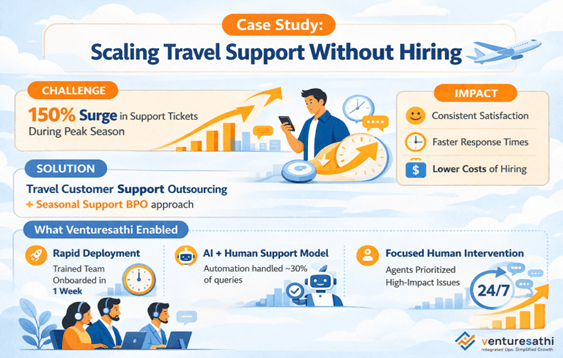
Case Study: Understanding Outsourcing ROI in Action
A growing SaaS company was managing customer support in-house at a monthly cost of $50,000, with limited scalability and rising inefficiencies.
The Solution
The company partnered with Venturesathi to transition to an outsourced model at $35,000 per month.
What Venturesathi Enabled
The Impact
- Immediate savings of $15,000 per month
- Faster response times and improved customer experience
- Higher productivity through better resource allocation
Result: Outsourcing shifted from a cost-cutting move to a strategic growth decision.
Result
By leveraging a seasonal support BPO model, the company was able to scale efficiently, maintain service quality, and optimize costs, all without disrupting internal operations.
Common Mistakes in Building a Business Case for Outsourcing
Even with the right intent, companies often miscalculate ROI, leading to weak justification and missed opportunities.
Focusing Only on Cost Savings
Ignoring efficiency and scalability undervalues outsourcing. This narrow view overlooks long-term gains like improved productivity, faster execution, and better customer experience. It can also lead to choosing vendors based on price rather than capability, impacting overall outcomes.
Underestimating In-House Costs
Hidden costs like management and infrastructure are often overlooked. Studies suggest that overhead and indirect costs can add 20-30% to base salaries, significantly increasing the true cost of in-house teams over time.
Not Defining Clear Metrics
Without KPIs, it’s difficult to measure success or ROI. In fact, companies that define clear performance metrics are far more likely to achieve expected outsourcing outcomes. Without visibility, even strong results can go unrecognized or underreported.
Choosing the Wrong Pricing Model
Different outsourcing models impact cost and flexibility differently. Research shows that flexible or outcome-based pricing models often deliver better cost efficiency compared to rigid fixed-cost structures, especially for scaling businesses.
Avoiding these mistakes ensures your business case for outsourcing is both realistic and compelling.
How to Present Your Outsourcing Business Case Internally
Building a solid ROI framework is only half the job. The real challenge is getting internal stakeholders aligned and confident in the decision.
To make your case compelling, focus on presenting it in a clear, structured way:
Key Steps to Present Your Business Case
- Compare outsourcing vs in-house cost clearly: Present a side-by-side breakdown that includes not just salaries, but total operational costs to highlight the true financial impact.
- Quantify cost savings outsourcing delivers: Use realistic projections and scenarios to show measurable savings, making your argument data-backed and credible.
- Highlight operational and strategic benefits: Emphasize scalability, faster execution, and access to specialized talent to position outsourcing as a growth enabler.
- Address risks and showcase flexibility: Include SLAs, exit clauses, and scalability options to reassure stakeholders that the model is controlled and adaptable.
A strong narrative supported by clear data and structured thinking makes it significantly easier to secure stakeholder buy-in and move forward with confidence.
Read more: The 30-Day Ramp Framework: How SaaS Startups Can Scale Ops Fast
Final Thoughts: Building a Smarter Outsourcing Strategy
A strong business case for outsourcing is not just about proving cost savings, it’s about demonstrating long-term value. When done right, outsourcing helps businesses reduce costs, improve efficiency, scale faster, and deliver better customer experiences.
At Venturesathi, the focus is on helping companies build outsourcing strategies that go beyond cost savings, combining operational expertise with scalable, tech-enabled solutions to maximize outsourcing ROI.
FAQs
1. How long does it take to see outsourcing ROI?
Most businesses start seeing measurable outsourcing ROI within 2-3 months, once operations stabilize and efficiency gains begin to reflect in performance metrics. This timeline can vary depending on the complexity of processes and the speed of onboarding.
2. What industries benefit the most from outsourcing ROI models?
Industries like SaaS, e-commerce, travel, fintech, and healthcare benefit significantly due to high support volumes and the need for scalable operations. These sectors typically see faster ROI due to recurring workflows and customer interaction-heavy processes.
3. How do I choose the right outsourcing pricing model for better ROI?
The right model depends on your use case, per-agent works for steady demand, while pay-per-use or outcome-based models are better for fluctuating workloads. Choosing the right structure ensures cost efficiency without limiting scalability.
4. Can outsourcing ROI improve over time?
Yes, outsourcing ROI typically improves as processes become more optimized, teams gain experience, and automation is integrated into workflows. Over time, this leads to higher efficiency and lower cost per transaction.
5. What risks can impact outsourcing ROI?
Common risks include unclear SLAs, poor vendor selection, lack of communication, and inadequate performance tracking, all of which can reduce expected returns. Proactively addressing these risks is key to maintaining consistent ROI.
6. How does outsourcing impact customer experience in the long term?
When executed well, outsourcing can improve consistency, response times, and overall service quality, leading to better customer retention and satisfaction. A strong partner can also help standardize processes and enhance customer journeys over time.