
How to Reduce Support Costs With AI Without Compromising Customer Experience
Support costs can scale faster than revenue if left unchecked. For growing businesses, this creates a constant tension between delivering great customer experience and maintaining healthy margins.
Customer support has traditionally been one of the largest operational cost centers, often increasing with every new customer, query, or expansion into new markets. But in 2026, that equation is changing rapidly where organisations have started to reduce support costs with AI.
The numbers are compelling. Studies indicate AI is expected to generate $80 billion in contact center cost savings by 2026, while 65% of customer queries are already being resolved without human intervention. At the same time, 90% of CX leaders report positive ROI from AI investments, showing that cost reduction and experience improvement can go hand in hand.
However, there’s a catch. Many companies still struggle to reduce support costs with AI without damaging customer experience. That’s because the goal isn’t just automation, it’s smart CX cost optimization.
In this blog, we break down how to use AI the right way to reduce support costs while improving customer experience at scale.
Why “Reduce Support Costs With AI” Is a Strategy, Not a Shortcut
For many businesses, the real challenge isn’t just high support costs, it’s unpredictable scaling, where sudden spikes in demand lead to rushed hiring, inconsistent service quality, and rising operational inefficiencies.
The biggest misconception is that AI automatically lowers costs by replacing agents. In reality, the data shows a more nuanced picture.
According to a Gartner report, only 20% of organizations have actually reduced headcount due to AI, while most are using it to handle higher volumes more efficiently. At the same time, over 50% of customer service organizations are increasing technology spend as they invest in AI capabilities.
This reveals a critical insight: AI doesn’t reduce costs by replacing humans. It reduces costs by optimizing how support is delivered. That’s the foundation of effective CX cost optimization.
Read more: How AI Is Transforming Contact Centres in 2026
Where AI Customer Service Automation Actually Reduces Costs
Most support teams struggle with rising ticket volumes, repetitive queries, and increasing pressure to deliver faster responses without expanding teams. This is where it is helpful to reduce support costs with AI.
1. Automating High-Volume, Repetitive Queries
A significant portion of support volume comes from repetitive questions like order status, refunds, account access, and FAQs. AI customer service automation can handle these instantly with chatbots resolving up to 70–80% of routine queries, reduced dependency on human agents for Tier 1 support, and lower cost per interaction compared to human handling.
This reduces workload without sacrificing quality because customers often prefer instant answers over waiting.
2. Reducing Cost Per Interaction
Traditional support scales linearly, more queries mean more agents and higher costs. AI breaks that model.
AI-driven interactions can cost significantly less than human interactions, while handling thousands of queries simultaneously. This is where reducing support costs AI strategies create real impact with lower marginal cost per ticket, higher efficiency per agent, and improved cost-to-revenue ratio.
A recent example is Uber integrating with Claude to enable booking through simple prompts, making interactions faster and more intuitive while reducing cost per interaction at scale.
3. Improving First-Contact Resolution (FCR)
AI enhances resolution speed by providing agents with real-time suggestions, accessing knowledge bases instantly, and routing queries intelligently. This reduces repeat queries and escalations, which are major cost drivers in support operations.
The result is fewer tickets, faster resolution, and better CX.
4. Enabling 24/7 Support Without Linear Costs
Providing round-the-clock support traditionally requires night shifts, global teams, and higher operational overhead. AI enables 24/7 support without proportional cost increases, allowing businesses to serve global customers, capture after-hours revenue, and improve satisfaction without expanding teams.
How to Reduce Support Costs Without Hurting CX
This is where most companies get it wrong. Over-automation can damage customer experience and increase churn. Many businesses implement AI purely to cut costs, only to see customer satisfaction drop due to poor experiences, creating a new problem instead of solving the original one.
Here’s how to reduce support costs with AI:
Use AI for Speed, Humans for Complexity
The most effective model in 2026 is a hybrid AI + human support system. AI handles FAQs, order tracking, and basic troubleshooting. Humans handle escalations, emotional situations, and complex decision-making.
This balance ensures cost efficiency without compromising experience.
Design AI Around Customer Journeys, Not Just Tickets
AI works best when integrated into the entire customer journey, not just support channels.
For example, proactive notifications reduce incoming queries, AI recommendations prevent issues before they occur, and smart routing eliminates unnecessary handoffs. This reduces overall support demand, which is the most effective way to cut costs.
Optimize, Don’t Over-Automate
One of the biggest risks in AI customer service automation is overuse.
According to industry insights, customers still prefer human support for complex or sensitive issues, and over-reliance on AI can reduce trust.The goal is not maximum automation, it’s optimal automation.
Use AI to Augment Agents, Not Replace Them
AI tools like agent assist, knowledge suggestions, and automation workflows can significantly improve agent productivity.
This allows businesses to handle more volume with the same team, reduce burnout, and improve service quality. That’s true CX cost optimization, doing more without increasing costs.
Read more: How AI Chatbots Will Transform Customer Service in 2026
Key Benefits of Reducing Support Costs with AI
1. Lower Operational Costs
AI reduces reliance on large support teams while maintaining service levels, improving overall efficiency. By automating repetitive queries and streamlining workflows, businesses can significantly lower cost per interaction without compromising service quality. This makes reducing support costs AI strategies highly effective for long-term cost control.
2. Higher Productivity Per Agent
Agents handle more complex issues while AI manages repetitive tasks, increasing overall output. With AI-powered tools like real-time suggestions and automated workflows, agents can resolve queries faster and more accurately. This leads to better utilization of resources and higher efficiency across support teams.
3. Improved Customer Experience
Faster responses and better resolution lead to higher satisfaction and retention. AI ensures instant replies and consistent service, reducing wait times and frustration for customers. When combined with human support for complex cases, it creates a seamless and high-quality customer experience.
4. Scalable Support Without Headcount Growth
Businesses can grow without proportionally increasing support costs, improving margins. AI enables companies to handle rising query volumes during peak periods without hiring additional agents. This scalability ensures consistent service levels while supporting business growth efficiently.
Challenges of AI Cost Optimization (And How to Overcome Them)
1. High Initial Investment
AI implementation requires upfront investment in tools, data, and training. For many businesses, this can seem like a barrier, especially when immediate ROI is not visible.
Solution: Start with high-impact use cases like FAQ automation and scale gradually, ensuring quick wins that justify further investment.
2. Rising AI Costs
AI infrastructure and compute costs are increasing, and ROI is not always immediate. Without proper planning, businesses may end up overspending on tools that are underutilized.
Solution: Focus on efficiency gains and long-term value, not just short-term cost cuts, and continuously optimize AI usage for better ROI.
3. Poor Implementation Strategy
Deploying AI without proper workflows leads to poor CX and wasted investment. Misaligned automation can create friction instead of improving efficiency.
Solution: Align AI with customer journeys and business goals, ensuring that automation enhances rather than disrupts the support experience.
4. Loss of Human Touch
Over-automation can make interactions feel impersonal. This is especially risky in scenarios that require empathy, judgment, or nuanced communication.
Solution: Maintain a balanced AI + human model, where automation handles routine queries while human agents manage complex and emotionally sensitive interactions.
Read more: Will AI Replace Call Center Agents or Make Them Better?
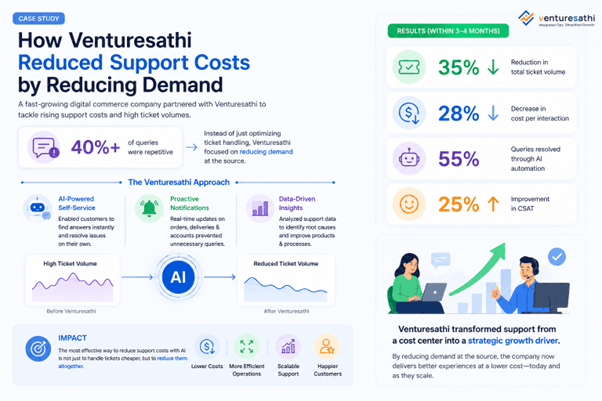
Case Study: How Venturesathi Reduced Support Costs with AI by Reducing Demand
A fast-growing digital commerce company partnered with Venturesathi to tackle rising support costs and high ticket volumes, with over 40% of queries being repetitive. Instead of just optimizing ticket handling, Venturesathi implemented an AI-led hybrid support model focused on reducing demand at the source.
By introducing AI-powered self-service, proactive notifications, and data-driven insights, the company was able to significantly cut unnecessary support queries.
Results (Within 3-4 Months)
- 35% reduction in total ticket volume
- 28% decrease in cost per interaction
- 55% queries resolved through AI automation
- 25% improvement in CSAT
Impact
This shows that the most effective way to reduce support costs with AI is not just to handle tickets cheaper, but to reduce them altogether, turning support into a more efficient, scalable, and growth-driven function.
Why AI Customer Service Automation Is a Competitive Advantage in 2026
The shift toward AI is no longer optional, it’s being driven by both customer expectations and competitive pressure. In fact, 91% of customer service leaders report increasing pressure to adopt AI, as speed, personalization, and efficiency become baseline expectations rather than differentiators.
Businesses that successfully implement AI customer service automation are not just improving operations, they are fundamentally reshaping how customer experience is delivered. They can respond instantly, scale support across regions without friction, and optimize costs without compromising on quality. More importantly, they use AI-driven insights to continuously improve processes, reducing future support demand and enhancing overall CX.
On the other hand, companies that delay adoption risk slower response times, higher operational costs, and inconsistent customer experiences. In a market where experience is a key driver of loyalty and revenue, falling behind on AI is no longer just a technology gap, it’s a competitive disadvantage.
Read more: AI-Powered Last Mile Delivery Transforming Quick Commerce Logistics
Final Thoughts
Reducing support costs with AI is not about replacing people or cutting corners. It’s about fundamentally rethinking how customer support operates in a world where speed, scale, and experience matter equally. The real challenge businesses face today is not just cost reduction, but doing it without breaking the customer experience that drives retention and revenue.
The most successful companies in 2026 are not using AI just to cut expenses. They are using it to build smarter, more efficient support ecosystems where automation reduces friction, insights drive continuous improvement, and customer experience remains at the center of every interaction. This approach enables businesses to improve efficiency, enhance CX, and scale sustainably without constantly increasing operational costs.
The real advantage lies in a balanced model. AI customer service automation delivers speed, consistency, and scalability, while human agents bring empathy, judgment, and problem-solving to complex interactions. Together, they create a support system that is both cost-efficient and experience-driven.
This is exactly the direction modern CX partners like Venturesathi are evolving toward by combining AI-led automation with trained support teams to help businesses reduce costs, improve resolution quality, and build more resilient, scalable customer support operations. That’s how you truly reduce support costs with AI, not by doing less, but by doing it smarter, faster, and better.
FAQs
1. What is an AI contact center and how does it work?
An AI contact center uses automation, chatbots, and AI tools to handle customer interactions across channels like chat, voice, and email. It works by resolving repetitive queries instantly while routing complex issues to human agents, creating a hybrid support model.
2. Is AI in customer support suitable for small businesses and startups?
Yes, AI in customer support is increasingly accessible for startups through scalable, cost-effective models. It helps smaller teams handle high volumes of queries without significantly increasing headcount.
3. How does AI improve customer experience in contact centers?
AI improves customer experience by reducing wait times, providing instant responses, and ensuring consistent support across channels. It also enables personalization through data insights, making interactions more relevant and efficient.
4. What is the difference between chatbot vs human support in customer experience?
Chatbots are ideal for handling repetitive, high-volume queries quickly, while human agents are better suited for complex, emotional, or high-value interactions. The best CX strategies combine both for optimal results.
5. How do businesses ensure data privacy in AI contact centers?
Businesses ensure data privacy by using secure, compliant systems aligned with regulations like GDPR and local data protection laws. Regular audits, encryption, and access controls also play a key role in maintaining data security.
6. How long does it take to implement an AI contact center?
Implementation timelines can vary depending on complexity, but many businesses can deploy a basic AI contact center within a few weeks. More advanced integrations with workflows and systems may take a few months for full optimization.