
AI Contact Centre Myths vs. Reality: What the 2026 Data Actually Shows
Customer experience is evolving faster than ever, and AI is at the center of that transformation. Yet, despite rapid adoption, confusion and misconceptions about the AI contact center remain widespread.
The data tells a different story. According to Gartner, 80% of customer service and support organizations will be applying generative AI in some form by 2026. Meanwhile, a report by McKinsey suggests that AI can reduce customer service costs by up to 30% while improving response times and consistency. So why does skepticism still exist? Because many businesses are still operating on outdated assumptions about AI in customer support.
In this blog, we break down the biggest myths vs. reality, backed by data, to help you understand what AI contact centers actually deliver in 2026 and how they’re reshaping customer experience.
Why AI Contact Centers Are Gaining Momentum in 2026
The rise of the AI contact center is driven by a simple reality: customer expectations have outpaced traditional support models.
- 88% of customers expect faster responses than ever before (Salesforce)
- 74% expect 24/7 support availability (HubSpot)
- 73% say experience is a key factor in purchasing decisions (PwC)
Meeting these expectations manually is nearly impossible at scale. This is where AI in customer support becomes essential enabling speed, personalization, and scalability without exponential cost increases.
Read more: How AI Is Transforming Contact Centres in 2026
Myth vs. Reality: AI Contact Center Edition
Myth 1: AI Will Replace Human Agents Completely
Reality: AI Enhances Humans, It Doesn’t Replace Them
One of the biggest misconceptions is that AI will eliminate human roles entirely. In reality, the most effective AI contact center models combine automation with human expertise. AI handles repetitive queries like order status, FAQs, and ticket routing, while human agents focus on complex, emotionally nuanced interactions.
According to IBM, AI can automate up to 80% of routine inquiries, but human intervention remains critical for high-value conversations.
What this means for businesses: AI doesn’t reduce the need for humans, it makes them more effective and allows them to focus on what truly matters.
Myth 2: Chatbots Deliver Poor Customer Experience
Reality: Modern AI Chatbots Are Smarter and Context-Aware
Early chatbots were rigid and frustrating. That perception still lingers. However, modern AI in customer support uses natural language processing (NLP), machine learning, and contextual understanding to deliver far more accurate responses. Here’s how:
- AI chatbots now resolve up to 70% of queries without human intervention
- First-contact resolution rates improve significantly with AI-enabled systems
The key difference? Today’s AI understands intent, not just keywords.
What this means for businesses: A well-implemented chatbot vs human support strategy enhances CX rather than harming it.
Myth 3: AI Contact Centers Feel Impersonal
Reality: AI Enables Hyper-Personalization at Scale
There’s a belief that automation removes the human touch. In reality, AI makes personalization more scalable than ever before. By analyzing customer data, behavior, and past interactions, AI can tailor responses in real time. According to Salesforce, 66% of customers expect companies to understand their unique needs and expectations. Thus, AI enables personalized recommendations, context-aware responses, and seamless omnichannel experiences.
What this means for businesses: AI doesn’t make interactions generic, it makes them more relevant.
Myth 4: AI Is Too Expensive for Growing Businesses
Reality: AI Reduces Costs While Improving Efficiency
Many companies assume that implementing an AI contact center requires massive investment. While initial setup costs exist, the long-term savings are substantial. Here’s how:
- Significant reduction in customer support costs, handling time and agent workload
- Lower cost per interaction due to automation
For startups and SMBs, AI actually levels the playing field by enabling enterprise-grade support without enterprise-level budgets.
What this means for businesses: AI is not just a cost center, it’s a cost optimization strategy.
Myth 5: AI Can’t Handle Complex Customer Issues
Reality: AI + Human Hybrid Models Solve Complex Problems Faster
AI alone is not designed to handle every scenario, and it doesn’t need to. The most effective AI customer experience trends in 2026 revolve around hybrid models such as AI identifies, categorizes, and routes issues instantly and humans step in with full context for resolution. This reduces escalation delays, repetition for customers, and resolution time. Companies using hybrid models often see faster turnaround and higher CSAT scores.
What this means for businesses: AI improves complexity handling by making human intervention smarter and faster.
Read more: 5 Ways You Can Adapt to AI in Contact Centers
Chatbot vs Human Support: The Real Answer Is Both
The debate around chatbot vs human support is often framed as an either-or decision. That’s the wrong approach. The real value lies in combining both:
Where AI Excels
AI contact center systems excel in delivering speed, scale, and consistency across customer interactions. They provide instant responses that reduce wait times and improve first impressions, while also handling high volumes of repetitive queries simultaneously without performance drops.
Their ability to operate 24/7 ensures customers receive support at any time, regardless of time zones, which is critical for global businesses. Additionally, AI in customer support generates powerful data-driven insights by analyzing large volumes of interactions, helping businesses optimize processes, predict customer needs, and improve overall efficiency.
Where Humans Excel
Human agents bring depth and nuance that AI cannot replicate, particularly through emotional intelligence and empathy during sensitive or high-stress situations. They are better equipped for complex problem-solving, where judgment, flexibility, and contextual understanding are required beyond predefined rules.
Humans also play a crucial role in building long-term customer relationships through personalized interactions that foster trust and loyalty. In chatbot vs human support scenarios, humans are essential for handling escalations effectively, ensuring that complex or critical issues are resolved with care and precision.
Thus, the future of AI contact center strategy is not replacement, it’s collaboration.
Key Benefits of AI Contact Centers in 2026
1. Faster Response Times
AI eliminates waiting queues by providing instant replies, improving both speed and customer satisfaction. Businesses leveraging AI report significantly reduced response times across channels, especially in high-volume environments like chat and email. This immediacy not only enhances customer experience but also reduces drop-offs during critical interactions such as bookings or issue resolution.
2. Scalable Customer Support
AI enables businesses to handle thousands of interactions simultaneously without increasing headcount, making it ideal for peak demand periods. This scalability ensures consistent service levels even during seasonal spikes or unexpected surges in customer queries. As a result, companies can grow without constantly expanding support teams or operational costs.
3. Improved First-Contact Resolution
With better routing, context, and automation, AI helps resolve issues faster, reducing repeat queries and improving efficiency. By accessing historical data and customer context in real time, AI can provide more accurate and relevant responses. This leads to higher first-contact resolution rates, which directly impact customer satisfaction and operational efficiency.
4. Consistent Customer Experience
AI ensures standardized responses, reducing variability and improving overall service quality across teams and regions. This consistency is particularly valuable for global customer support, where maintaining uniform service standards can be challenging. It also helps reinforce brand voice and ensures customers receive the same quality of support regardless of channel or time.
Challenges of AI Contact Centers (And How to Overcome Them)
1. Poor Implementation Strategy
AI without proper workflows can lead to frustrating experiences. When deployed without clear intent or structure, it may create more confusion than efficiency for customers.
Solution: Combine AI with clearly defined CX processes, well-mapped customer journeys, and clear escalation paths to ensure smooth and effective interactions.
2. Over-Automation
Relying too heavily on AI can reduce the human touch, making interactions feel impersonal or robotic. This can negatively impact customer trust, especially in sensitive or complex situations.
Solution: Maintain a balanced AI + human model where automation handles routine tasks while human agents step in for complex or emotional interactions.
3. Data Privacy and Compliance
Handling customer data requires strict compliance, especially in industries like BFSI, healthcare, and e-commerce where data sensitivity is high. Any lapse can lead to legal risks and loss of customer trust.
Solution: Use secure, compliant systems aligned with regulations like GDPR and data protection laws, and ensure regular audits and monitoring to maintain data security standards.
AI Customer Experience Trends Shaping 2026
The evolution of the AI contact center is driven by several key trends:
- Generative AI in support: More conversational, human-like interactions that improve engagement and reduce the gap between chatbot vs human support experiences.
- Predictive support: Anticipating issues before customers raise them, enabling proactive resolutions that prevent churn and improve satisfaction.
- Voice AI advancements: More natural, real-time voice interactions that closely mimic human conversations, enhancing accessibility and usability.
- Hyper-personalization: Tailored experiences using real-time data, allowing businesses to deliver highly relevant and context-aware support at scale.
These trends highlight a clear shift from reactive to proactive customer support, where businesses don’t just respond to issues but actively prevent them and deliver more intuitive, seamless experiences.
Read more: Top 10 AI Contact Center BPOs in 2026
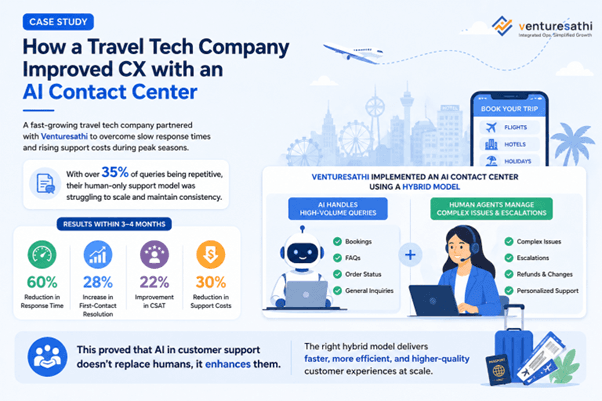
Case Study: How a Travel Tech Company Improved CX with an AI Contact Center
A fast-growing travel tech company partnered with Venturesathi to overcome slow response times and rising support costs during peak seasons. With over 35% of queries being repetitive, their human-only support model was struggling to scale and maintain consistency.
Venturesathi implemented an AI contact center using a hybrid model, where AI handled high-volume queries like bookings and FAQs, while human agents managed complex issues and escalations.
Results within 3-4 months include:
- 60% reduction in response time
- 28% increase in first-contact resolution
- 22% improvement in CSAT
- 30% reduction in support costs
This proved that AI in customer support doesn’t replace humans, it enhances them. The right hybrid model delivers faster, more efficient, and higher-quality customer experiences at scale.
Final Thoughts
The conversation around AI in customer support is shifting from hype to reality. The data is clear: businesses that adopt AI thoughtfully are delivering faster, smarter, and more scalable customer experiences. The real takeaway is this, AI is not here to replace humans. It’s here to redefine how customer support operates.
In 2026, the most successful companies are those that embrace the AI contact center as a hybrid model, combining automation with human expertise to deliver seamless, high-quality experiences at scale. This is exactly where modern CX partners like Venturesathi are evolving, integrating AI-driven automation with trained support teams to deliver faster resolutions, better accuracy, and more personalized customer interactions.
By aligning technology with human insight, Venturesathi is helping businesses move from reactive support to proactive, intelligent customer experience models, ensuring they stay competitive in an increasingly AI-driven landscape.
FAQs
1. What is an AI contact center and how does it work?
An AI contact center uses automation, chatbots, and AI tools to handle customer interactions across channels like chat, voice, and email. It works by resolving repetitive queries instantly while routing complex issues to human agents, creating a hybrid support model.
2. Is AI in customer support suitable for small businesses and startups?
Yes, AI in customer support is increasingly accessible for startups through scalable, cost-effective models. It helps smaller teams handle high volumes of queries without significantly increasing headcount.
3. How does AI improve customer experience in contact centers?
AI improves customer experience by reducing wait times, providing instant responses, and ensuring consistent support across channels. It also enables personalization through data insights, making interactions more relevant and efficient.
4. What is the difference between chatbot vs human support in customer experience?
Chatbots are ideal for handling repetitive, high-volume queries quickly, while human agents are better suited for complex, emotional, or high-value interactions. The best CX strategies combine both for optimal results.
5. How do businesses ensure data privacy in AI contact centers?
Businesses ensure data privacy by using secure, compliant systems aligned with regulations like GDPR and local data protection laws. Regular audits, encryption, and access controls also play a key role in maintaining data security.
6. How long does it take to implement an AI contact center?
Implementation timelines can vary depending on complexity, but many businesses can deploy a basic AI contact center within a few weeks. More advanced integrations with workflows and systems may take a few months for full optimization.