Call Center Outsourcing Cost in 2026: The Honest Pricing Guide
You can find a call center agent for $6 an hour or $45 an hour in 2026 — and both numbers are honest. The difference isn’t quality. It’s geography, complexity, and the chunk of cost that never shows up in the headline rate.
Most pricing guides stop at “Philippines is cheaper than the US.” That’s true and useless. This one goes deeper: what each region actually costs, where the hidden fees live, what AI deflection saves you, and when outsourcing is the wrong move entirely.
TL;DR
Call center outsourcing in 2026 typically runs $6–$45 per hour depending on where the agent sits. Offshore (India, Philippines) is cheapest. Onshore (US, Canada) is the most expensive. Nearshore (LatAm, Caribbean) sits in the middle.
The trap: the headline rate is only about 75% of true spend. Setup fees, QA, integrations, 24/7 premiums, and turnover add 15–25% on top.
The smart 2026 play is rarely pure outsourcing or pure in-house. It’s hybrid: AI handles routine calls cheaply, humans handle the rest, and outsourced teams absorb spikes. That mix typically delivers 40–70% cost savings vs. pure in-house.
What You’ll Actually Pay: Quick Snapshot
| Region | Hourly Rate | Best For |
| India (Tier-2 & Tier-3 cities) | $6–$10 | Back office, fintech ops, mid-market CX |
| India (Tier-1 metros) | $10–$16 | Tech support, enterprise CX |
| Philippines | $8–$14 | US-accent voice, omnichannel CX |
| LatAm / Caribbean | $10–$22 | Bilingual, US time-zone overlap |
| Eastern Europe | $12–$25 | EU multilingual, GDPR-native |
| US / Canada (onshore) | $25–$45 | Regulated industries, premium brands |
| AI Voice Agents | $0.40 per call avg | Tier-1 deflection, 24/7 baseline |
The takeaway: A US agent costs roughly 4–6 times an Indian agent for the same work. That’s the single biggest cost lever you’ll ever pull.
The 6 Pricing Models — and Which One to Pick
Choose your pricing model before evaluating any vendor. The wrong model can add 30–50% to your spend even with the same vendor.
| Model | How It Works | Best For |
| Per minute | Pay only for talk time, around $0.50–$1.75/min | Predictable inbound, short calls |
| Per hour | Pay for all agent hours including hold and wrap-up | Stable volume, outbound campaigns |
| Per call / ticket | Fixed fee per completed interaction | Short, repetitive interactions |
| Dedicated FTE | Monthly cost per full-time agent | Brand-trained agents, complex products |
| Per resolution | Pay only when an issue is solved | Outcome-focused contracts |
| Hybrid retainer | Base monthly + variable overage | Seasonal or unpredictable volumes |
The takeaway: Per-hour pricing is the default for a reason — it’s simple. But you’ll pay for agent idle time. If your volume swings hard, push for per-call or hybrid.
The Regional Breakdown: What Each Geography Buys You
India — Lowest cost, biggest scale
Roughly $6–$10/hour in Tier-2 cities like Bhubaneswar, Indore, and Coimbatore. Tier-1 metros (Bangalore, Pune, Mumbai) run $10–$16. India’s deepest strength is back office, technical support, and software-adjacent work. Tier-2 cities also have meaningfully lower attrition than Tier-1 — roughly half the turnover.
Best for: Back office, finance and accounting, healthcare RCM, fintech ops, tech support. Watch out for: Accent variability for US voice CX; time-zone gap for synchronous work.
Philippines — The voice CX capital
Around $8–$14/hour. Strong English proficiency, neutral US-influenced accent, and massive scale (over a million BPO workers). The Philippines is still the default for US-customer-facing voice support.
Best for: US voice CX, chat, omnichannel programs. Watch out for: Wages are rising fast — the cost gap to nearshore is narrowing every year.
Nearshore (LatAm + Caribbean) — Time zone match
Around $10–$22/hour. Mexico, Colombia, Costa Rica, Jamaica, and Trinidad offer US time-zone overlap plus stronger bilingual Spanish-English than any other region. Caribbean providers in particular have low attrition.
Best for: US business-hours coverage, Spanish-English bilingual, premium voice quality. Watch out for: More expensive than offshore; limited European language depth.
Eastern Europe — EU coverage
Around $12–$25/hour. Poland, Romania, Bulgaria, and Ukraine offer strong European multilingual depth (German, French, Polish, Russian) with EU regulatory alignment.
Best for: EU customer base, GDPR-native delivery. Watch out for: Limited US time-zone fit.
Onshore (US / Canada) — Premium tier
Around $25–$45/hour at the rate card. When you load in management, software, and overhead, the true cost is often $65–$100/hour. Worth it only when compliance or brand sensitivity demands it.
Best for: Regulated industries (healthcare, financial services), premium B2C brands. Watch out for: 4–6 times more expensive than offshore for equivalent work.
What a Real 10-Agent 24/7 Team Costs Each Month
Here’s where the headline rate becomes the actual bill. A 10-agent team running 24/7, with all the realistic add-ons:
| Region | Monthly All-In Cost | Annual Cost |
| India (Tier-2) | ~$17,000 | ~$200,000 |
| Philippines | ~$24,000 | ~$290,000 |
| LatAm Nearshore | ~$32,000 | ~$385,000 |
| US Onshore | ~$66,000 | ~$795,000 |
The takeaway: Going from US to India for a 10-agent 24/7 team saves roughly $600,000 per year — enough to fund an entire mid-market product team. That’s the real reason offshore exists.
The Hidden Cost Stack: What Vendors Won’t Quote Upfront
The headline hourly rate is about 75% of true spend. The other 25% lives in fees most providers don’t volunteer.
Here’s where it shows up:
| Hidden Cost | Typical Impact |
| Setup and onboarding | One-time, $1K–$25K depending on tier |
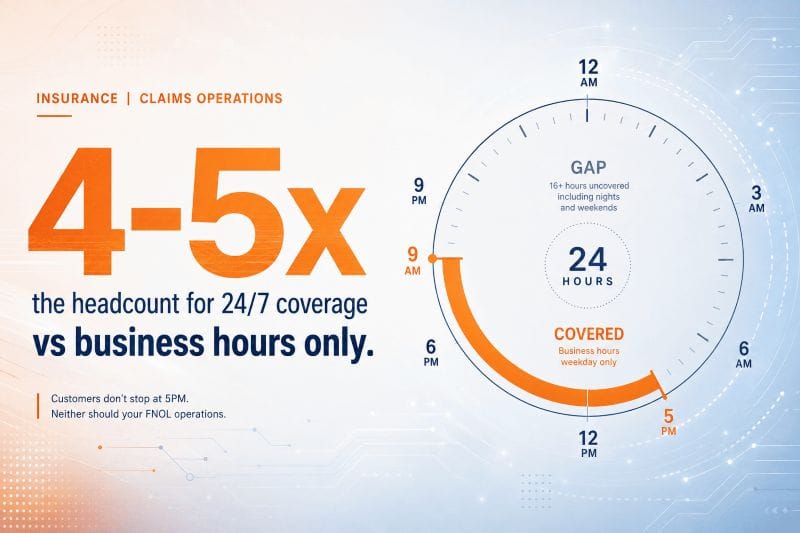
| 24/7 coverage premium | 15–30% above standard business-hours rates |
| Multilingual support | 20–40% premium per added language |
| Technology integration | $1K–$15K setup + ongoing platform fees |
| Quality assurance | 5–10% of contract value |
| Annual escalations | 3–5% per year in multi-year contracts |
| Minimum monthly commitments | You pay even when volume drops |
| Non-talk time billing | 30–40% of hours billed isn’t talk time |
| Compliance overhead | 10–15% premium for HIPAA, PCI, GDPR |
| Early termination penalties | 3–6 months of fees |
The takeaway: Whatever the vendor quotes, budget 20–25% on top. And the single most powerful question in a vendor call is: “What’s NOT included in this quote?”
In-House vs Outsourced vs AI Hybrid: 3-Year Math
For a 25-agent contact center serving a US mid-market brand, here’s how the three options compare over 3 years:
| Model | 3-Year Total | Savings vs In-House |
| Pure in-house (US) | ~$5.7 million | — |
| Outsourced (India Tier-2) | ~$800,000 | ~85% |
| AI Hybrid (40% deflection + offshore) | ~$850,000 | ~85% |
The takeaway: Both outsourced and AI hybrid save roughly the same amount versus in-house. The hybrid often wins on quality because AI handles routine tickets faster and more consistently than a human ever could.
The AI Deflection Math
This is the single biggest shift in call center economics in 2026.
A human agent costs $7–$12 per call. An AI voice agent handles the same call for about $0.40. Gartner projects that conversational AI will save the global contact center industry around $80 billion in labor costs in 2026. Forrester found that companies deploying voice AI agents achieved 3-year ROI between 331% and 391%.
How much volume can AI actually take?
- Best-in-class deployments: 60%+ of tier-1 tickets deflected before they reach a human
- Typical mid-market deployments: 30–45% deflection
- Floor for any serious deployment: 25%
The takeaway: If 40% of your call volume is routine (password resets, order status, basic FAQs), AI can handle that volume at roughly 5% of the human cost. The other 60% — the genuinely complex stuff — still needs people. Optimize for the mix, not the maximum.
Cost by Service Type
Not all support work costs the same. Here’s what each function typically runs:
| Service Type | Offshore Rate | Onshore Rate |
| Customer support (voice) | $7–$14 | $25–$40 |
| Customer support (chat/email) | $6–$12 | $22–$35 |
| Technical support L1 | $9–$16 | $30–$50 |
| Technical support L2/L3 | $14–$22 | $50–$75 |
| Back office / data entry | $5–$10 | $20–$35 |
| Finance & accounting | $10–$18 | $40–$60 |
| Healthcare RCM | $10–$18 | $45–$70 |
| Trust & Safety / moderation | $8–$15 | $30–$50 |
The takeaway: Technical support and finance functions cost roughly 2x basic customer support. Don’t let a BPO quote you their general rate when 70% of your work is L2 tech support.
What Each Buyer Persona Should Budget
Series A–B SaaS Startup
10–25 agents, chat-heavy with some tier-1 voice. India Tier-2 BPO is usually the right fit. Budget around $100K–$400K annually.
Avoid: Enterprise BPOs that lock you into 50+ seat minimums before you’ve hit product-market fit.
D2C / eCommerce Brand
Peak season elasticity is the constraint, not steady-state volume. Philippines or India for baseline, plus AI deflection for the BFCM surge. Budget $250K–$1M annually with a 30–40% peak uplift built in.
Avoid: Cheap providers without flex capacity. They scramble during peak and customer experience crashes when it matters most.
Healthcare Provider / HealthTech
HIPAA compliance is non-negotiable. India works for back office RCM; onshore is often required for patient-facing voice. Budget $500K–$3M annually.
Avoid: Any provider that can’t produce a current HIPAA + HITRUST audit report within 48 hours.
Fintech / NBFC
KYC, AML, dispute handling. India Tier-2 BPOs with PCI DSS + GLBA compliance are the typical fit. Budget $200K–$1.5M annually.
Avoid: Providers that skip India DPDP Act 2023 compliance for US-facing engagements. You’ll find out at audit time.
When NOT to Outsource
Outsourcing isn’t always cheaper, and it isn’t always better. Five situations where in-house wins:
Sub-$50K annual engagements. Below this floor, freelance platforms and part-time contractors are cheaper and faster than any BPO.
Products that ship new features weekly. Outsourced agents are always one training cycle behind. The knowledge gap creates escalations, and escalations cost more than you saved.
VIP customer interactions. Brand-sensitive escalations need empowered in-house judgment, not script-bound agents.
Cross-functional resolution. If solving a ticket requires Slack-pinging engineering and checking deploy logs, that workflow doesn’t survive the outsourcing boundary.
Quarterly compliance changes. Internal teams stay current faster than external partners on shifting regulations.
The takeaway: Outsourcing works when volume is high and complexity is bounded. The moment complexity outruns volume, in-house starts looking better.
How to Get a Real Quote (Not a Sales Pitch)
A vendor’s first quote is rarely their best price. Here’s how to negotiate down to the real number:
- Document your monthly volume, average handle time, and channel mix before talking to anyone. Vague RFPs get vague pricing.
- Define your tech stack upfront — CRM, dialer, chatbot. Vendors need this to scope accurately.
- Request fully itemized quotes — line items for labor, training, setup, software, QA.
- Ask: “What is NOT included in this quote?” — the single most powerful question in any vendor call.
- Get at least 3 competing quotes simultaneously. Comparison-shopping saves 20–30% on average.
- Negotiate the pricing model, not just the rate. Switching from per-hour to per-resolution can swing total cost more than negotiating a 10% rate cut.
- Demand a 60–90 day pilot at full pricing. Vendors that refuse pilots are optimizing for their revenue, not your outcome.
- Negotiate exit clauses before signing. Auto-renewal opt-out, 90-day notice, transition support included.
Frequently Asked Questions
How much does it cost to outsource a call center in 2026?
Roughly $6–$45 per agent hour depending on geography. Offshore (India, Philippines) is cheapest at $6–$16. Nearshore (LatAm) sits at $10–$22. Onshore (US) runs $25–$45. AI voice agents cost about $0.40 per call. A 25-agent team typically runs $1M–$8M over 3 years depending on where they sit.
What’s the cheapest country for call center outsourcing?
India and the Philippines. India Tier-2 cities run $6–$10/hour with lower attrition than the metros. Philippines runs $8–$14/hour with stronger US-accent voice quality.
What hidden costs should I expect?
Setup fees, 24/7 premium (15–30%), multilingual surcharge (20–40%), technology integration, QA programs, annual escalations, minimum commitments, non-talk time billing, compliance overhead, and early termination penalties. Budget 20–25% on top of any quoted rate.
How much does AI deflection actually save?
A lot. Human calls cost $7–$12 each; AI handles the same call for around $0.40. Gartner projects $80 billion in global savings in 2026 alone. Forrester found 331–391% 3-year ROI for typical deployments. The catch: deflection rates vary from 25% (basic) to 60%+ (best-in-class), so model conservatively.
Should the BPO own my toll-free number or should I?
You should own it. If the BPO owns it and you exit the contract, your customers can’t reach you anymore. Negotiate ownership of all customer-facing telephony before signing.
How much does 24/7 coverage add to the cost?
About 15–30% above standard business-hours rates. Evening, overnight, weekend, and holiday staffing all carry differential pay. Many companies use AI for overnight tier-1 coverage to cut this premium.
The Bottom Line
The hourly rate is the easiest number to compare and the least useful.
A $6/hour offshore agent isn’t cheap if hidden costs add 30% and the engagement breaks at month 9. A $45/hour onshore agent isn’t expensive if compliance violations would cost you more than the labor premium.
The real questions aren’t about the rate. They’re:
- What’s the total 3-year cost, hidden fees included?
- What’s the right tier of provider for my engagement size?
- How much of my volume should AI deflect?
- What does my hybrid stack actually need to look like?
Answer those before you compare quotes. The vendors will reward the discipline.