The Corporate Transparency Act Compliance Burden Nobody Prepared For
If you handle compliance at a community bank, credit union, or digital small business bank, the Corporate Transparency Act (CTA) has probably given you a headache over the past two years. It was passed in 2021, went into effect in January 2024, got blocked by courts, brought back by FinCEN, and then almost completely rewritten in March 2025 when the government exempted 32 million US companies from having to file directly.
But here is the uncomfortable truth: your bank still does the work. Even though most US businesses no longer file Beneficial Ownership Information (BOI) with FinCEN, banks still have to collect that same information every time a business opens an account. That obligation comes from a separate rule from 2018 called the Customer Due Diligence (CDD) Rule. On top of that, states like New York have started passing their own versions of the law. So banks are still collecting, still verifying, still documenting, just with a smaller in-house team, less regulatory clarity, and more pressure than they have ever had.
This piece walks through what banks are actually facing in 2026. What FinCEN requires now, what the CDD Rule still demands regardless of the CTA, and why most community banks are quietly falling behind on BOI compliance. It builds on our companion piece on SAR filing outsourcing, our work on KYC, reconciliation, and fraud monitoring for BFSI, and our Banking and Financial Services practice.
TL;DR
The Corporate Transparency Act is stuck in legal limbo, but the compliance burden on banks has actually gotten worse. In March 2025, FinCEN issued a new rule that exempted all 32 million US-formed companies from filing BOI directly. The Federal Register notice confirmed the change. But that exemption only removed the direct filing obligation on businesses. It did nothing to reduce the work on banks, who continue to collect and verify beneficial ownership at every account opening under the 2018 CDD Rule.
Here is what banks are actually dealing with in 2026:
- A mid-sized community bank generates 200-400 new business account openings per month. Each one requires 12-18 steps of BOI collection, verification, and documentation.
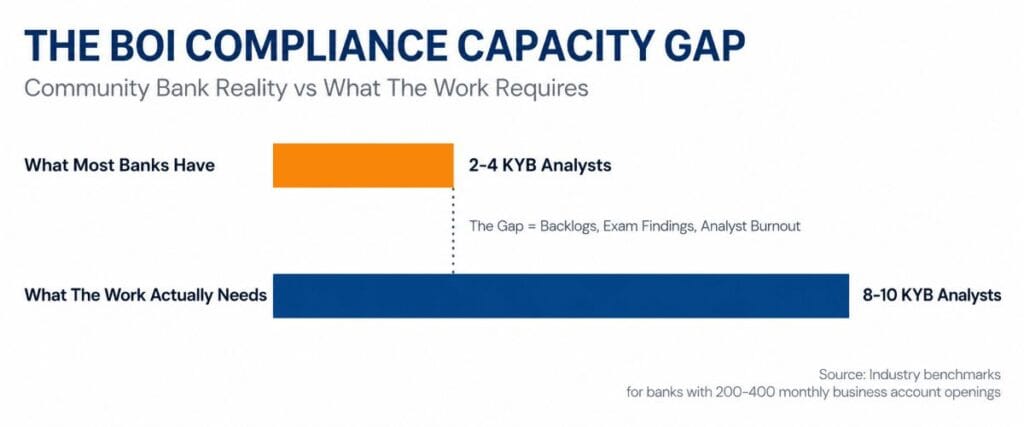
- Most banks have 2-4 in-house KYB analysts. They need 8-12 to keep up.
- In-house BOI operations cost $180K to $650K per year and take 8-14 days per account, up from 3 days before the CDD Rule.
- State-level BOI laws are multiplying. New York’s LLC Transparency Act took effect January 2026. More states are following.
- Regulators are finding BOI gaps in exams. Incomplete beneficial ownership documentation is now a top-three BSA/AML deficiency in community bank exams.
The Corporate Transparency Act put community banks in an impossible position. They became unpaid deputies for the government, enforcing ownership rules on 32 million businesses without any extra funding, staff, or clear guidance. Even after the March 2025 exemption, that deputy role has not gone away. It has just gotten harder to staff, more expensive to run, and riskier to ignore.
What Is the Corporate Transparency Act? A 60-Second Primer
Before we get into the compliance headache, a quick explainer for readers new to this.
The Corporate Transparency Act was passed by Congress in January 2021 as part of a broader defense bill. The idea was simple: too many criminals were hiding money in anonymous shell companies, and the government wanted a way to identify who actually owned those companies. The law required most US companies (corporations, LLCs, and similar entities) to report their real owners to FinCEN, the Financial Crimes Enforcement Network within the US Treasury Department.
The report is called a BOI, or Beneficial Ownership Information filing. Each report identifies:
- Every person who owns 25 percent or more of the company
- One senior officer with real control over the company (even if they own less than 25 percent)
- The person who filed the paperwork to form the company
FinCEN estimated the law would apply to about 32.6 million existing companies plus millions of new ones every year. The government’s own cost analysis put first-year compliance at over $21.7 billion across all affected businesses.
The law went into effect on January 1, 2024. Then the legal fight started. Multiple federal courts blocked the law. FinCEN issued and cancelled enforcement guidance multiple times. On March 21, 2025, FinCEN announced a new rule (officially published on March 26, 2025) that changed the definition of “reporting company” to include only foreign companies registered to do business in the US. Every US-formed company was exempted, no matter who owned it.
For the businesses being regulated, this was a huge win. For the banks serving those businesses, nothing changed. The 2018 CDD Rule kept every BOI collection obligation in place, and banks were left holding the compliance workload without the regulatory clarity that the CTA was originally supposed to provide.
Why Do Banks Still Carry BOI Obligations Under the CDD Rule?
The March 2025 exemption removed the entity-to-government filing requirement. It did not touch the older 2018 rule that requires banks to collect this same information at account opening. Most compliance officers understand this, but the operational implications hit harder than they expect.
The Customer Due Diligence (CDD) Rule, officially known as 31 CFR 1010.230, took effect on May 11, 2018. It requires all banks, credit unions, broker-dealers, and mutual funds to:
- Identify and verify the identity of the people who own their business customers
- Collect information on anyone owning 25 percent or more of the business
- Collect information on one senior officer with real control
- Keep records for five years after the account closes
- Maintain proper procedures for verification
Here is the key point: the CDD Rule and the CTA run on parallel tracks. The CTA is about companies reporting to the government. The CDD Rule is about customers reporting to their bank at account opening. When FinCEN issued its March 2025 exemption, it only changed the first track. The second track works exactly the same as it did before the CTA existed.
So every time a community bank opens a business checking account, a credit union onboards a new small business member, or a fintech verifies a business customer, the CDD Rule still requires beneficial ownership collection. The 32 million companies that no longer file with FinCEN are still customers whose banks must collect this information at account opening.
The bank’s real job was never the FinCEN filing itself. The real job has always been collection, verification, and ongoing monitoring, which continues under the CDD Rule no matter what happens with the CTA. This is why banks that treated CTA as a “wait and see” issue got caught underprepared. The work never stopped, and now the pressure to do it correctly has grown.
The State-Level BOI Landscape: More Rules, More Work, No Extra Staff
States are creating their own BOI laws to fill the gap left by FinCEN’s exemption. Banks operating across multiple states now face a growing patchwork of rules that no in-house team was originally staffed to handle.
New York was the first big state to pass a CTA-equivalent law. The New York LLC Transparency Act took effect on January 1, 2026 and requires LLCs formed or registered in New York to file BOI directly with the New York Department of State. Unlike the federal CTA (which now exempts most US entities), the New York law still applies to LLCs of all sizes with only limited exceptions.
Other states with active or pending BOI legislation as of 2026 include California, Massachusetts, New Jersey, Illinois, and Washington. Each state has its own rules on scope, deadlines, penalties, and update requirements. None of them coordinate with FinCEN or with each other.
For banks serving customers across multiple states, this creates real operational pain. A community bank in the tri-state area now has to verify BOI compliance status against three or more different state registries, each with different requirements, different filing windows, and different penalty structures. That work was not part of any BOI compliance plan built before 2026.
The banks facing the most pressure right now share three traits. They serve customers across multiple states. They built their BOI compliance teams for federal CTA scope and cut back after the March 2025 exemption. They are now rebuilding capacity to handle state-level verification on top of the CDD Rule work that never went away. Every one of these banks is understaffed, and hiring in this specialty is genuinely hard.
The BOI Collection Workflow: What Actually Buries a Bank
Collecting BOI at account opening involves 12 to 18 distinct steps. Industry data shows that small business account onboarding time has grown from about 3 days before the CDD Rule to 8-14 days in 2026. For most community banks, this is the single slowest, most compliance-heavy workflow in the entire institution.
Here is what BOI collection actually looks like inside a modern community bank, step by step:
Steps 1 to 3: Entity identification and formation verification. The bank confirms the type of legal entity, verifies formation documents with the relevant Secretary of State, and confirms the entity is in good standing. This alone can take 4-6 hours if the entity was formed in a state with slow public records systems.
Steps 4 to 6: Identifying beneficial owners. The person opening the account completes a certification form listing everyone who owns 25 percent or more of the entity, plus one senior officer with significant control. For a straightforward single-owner LLC, this is quick. For an LLC owned by another LLC that is owned by a trust, an analyst must trace ownership through multiple layers to find the actual individual owners at the top. That tracing takes 2-4 hours per case.
Steps 7 to 9: Verifying each beneficial owner. Each identified owner must be verified using a government-issued ID, address proof, and often additional screening. Third-party platforms like Middesk, Baselayer, and Signzy help automate parts of this workflow, but they do not eliminate the need for manual review. An experienced analyst spends 30-60 minutes per owner on verification alone.
Steps 10 to 12: Documentation and record-keeping. All the information collected must be documented, dated, and stored in a way that can be quickly pulled up during a regulatory exam. Records must be kept for five years after the account closes. Poor documentation is where most exam findings originate.
Steps 13 to 15: Screening and risk assessment. Beneficial owners are screened against OFAC (Office of Foreign Assets Control) sanctions lists, PEP (Politically Exposed Persons) databases, adverse media, and the bank’s own risk criteria. Any hit triggers enhanced due diligence, which can add 4-8 hours per case.
Steps 16 to 18: Ongoing monitoring. Once the account is open, changes to beneficial ownership must be captured and reverified. This includes ownership transfers, senior officer changes, and any material change in the entity’s structure. Most banks do this poorly because it depends on customer self-reporting, which happens inconsistently.
Now do the math. For a simple single-owner LLC, this workflow takes 2-3 business days by an experienced KYB (Know Your Business) analyst. For a complex corporate structure, 2-3 weeks. A community bank opening 200 new business accounts per month needs approximately 1,200 to 1,600 analyst hours dedicated to BOI work every month. That is 8-10 full-time KYB analysts at a healthy utilization rate.
Most community banks have 2-4. That gap is where regulatory findings, backlogs, and analyst burnout start.
Our detailed analysis of efficient banking operations and back-office outsourcing in BFSI covers the workflow economics in depth.
What Is the Real Cost of In-House BOI Compliance?
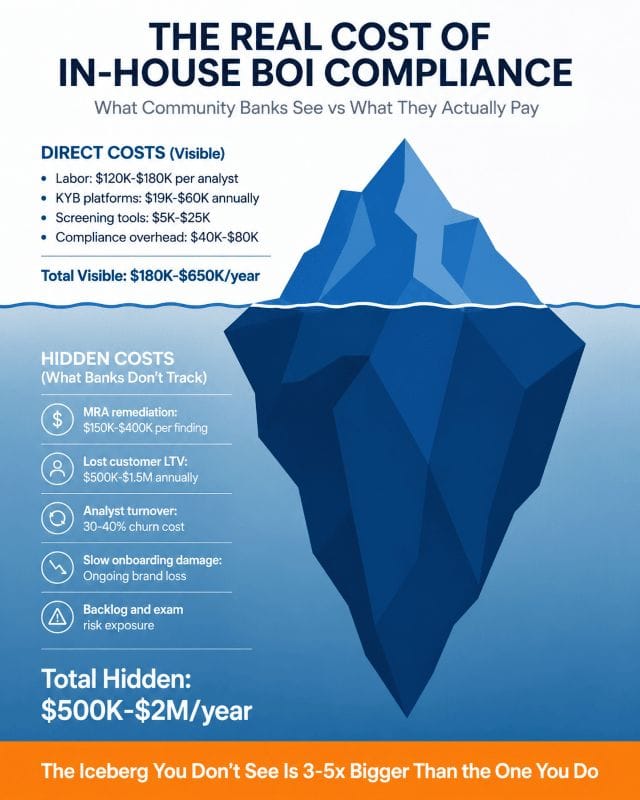
A mid-sized community bank with $1B in assets typically spends $180K to $650K per year on BOI compliance. But the bigger cost is what happens when in-house teams cannot keep up: regulatory findings, backlogs, slow onboarding, and customer defections.
Here is how the direct cost breaks down for a bank opening 200 new business accounts per month:
Labor costs. A trained KYB analyst experienced in beneficial ownership verification and CDD Rule compliance earns $65,000-$95,000 per year in base salary. Fully loaded with benefits, training, and overhead, that becomes $120,000-$180,000 per analyst. Most community banks need 2-3 dedicated KYB analysts. Many operate with 0-1 and absorb the shortfall into general compliance capacity, which shows up later as backlogs and exam findings.
Technology costs. KYB platforms like Middesk, Baselayer, or Signzy charge $8-$25 per verification. At 200 accounts per month, that adds up to $19,200-$60,000 per year just for platform verification, not counting the cost of integration and data enrichment.
Sanctions screening. OFAC and PEP screening tools charge $5,000-$25,000 per year depending on volume and screening depth.
Compliance program overhead. Policy documentation, training, testing, and the capacity to respond to regulator questions typically add another $40,000-$80,000 per year, spread across BSA/AML (Bank Secrecy Act / Anti-Money Laundering), KYC, and BOI compliance activities.
Audit and testing. The FFIEC (Federal Financial Institutions Examination Council) requires independent third-party BSA/AML testing. About 15-25 percent of this testing budget goes to CDD Rule and BOI compliance, or roughly $12,000-$30,000 per year.
The direct total is $180K-$650K per year. But that number understates the real cost, because it assumes the in-house team can actually keep up with the workload. Most cannot.
The hidden costs show up in three places:
Regulatory findings. When an examiner tests a random sample of business accounts and finds incomplete BOI files, the bank gets a Matter Requiring Attention (MRA). MRAs are formal exam findings that consume the compliance team’s attention for months, require documented remediation plans, and follow the bank into future exams. One MRA on BOI compliance can cost a community bank $150K-$400K in remediation labor, consulting, and lost operational capacity.
Slow onboarding costs customers. When BOI collection takes 8-14 days instead of 2-3, small business customers get frustrated. Many switch to competitors, particularly digital SB banks that have built faster onboarding into their operating model. A community bank losing 15-20 potential business customers per month to slow onboarding is quietly bleeding $500K-$1.5M in annual customer lifetime value.
Analyst burnout and turnover. KYB work is high-pressure, detail-intensive, and mentally exhausting when under-staffed. Analysts who feel buried leave, and replacement takes 4-6 months of ramp time. Turnover in BSA/AML roles at understaffed banks runs 30-40 percent annually, which pushes true labor cost meaningfully above the $120K-$180K sticker price per analyst.
Add it all together and a mid-sized community bank quietly loses $500K-$2M per year to BOI compliance friction beyond the direct compliance spend. That is the real cost most banks are absorbing without recognizing it.
Where Are Banks Falling Behind on BOI Compliance?
Regulators are finding BOI gaps in almost every community bank exam in 2026. The most common failures cluster in three areas, and each one traces back to the same root cause: not enough trained analysts to do the work correctly at volume.
Tracing Complex Ownership Chains
The CDD Rule requires banks to identify the actual individual people who own a business, not just the intermediate companies in between. When a business customer is an LLC owned by another LLC that is owned by a trust that is owned by three individuals, the bank has to trace ownership through every layer to identify those three individuals.
This tracing is where most exam findings come up. Regulators consistently identify incomplete beneficial ownership documentation as one of the top three BSA/AML deficiencies. The problem is not that banks refuse to trace. It is that KYB analysts under time pressure accept ownership certifications at face value without independently verifying the underlying structure. Complex ownership takes hours to trace correctly. Most in-house teams do not have those hours.
Keeping Records Updated Over Time
The CDD Rule requires banks to capture and reverify changes to beneficial ownership during the account relationship. In practice, most banks rely on the customer to self-report changes. This happens inconsistently. When examiners test files, they frequently find beneficial ownership records that have not been updated for years, even for accounts where public filings show ownership has changed. Every stale record is a potential exam finding.
Reconciling Federal Versus State Requirements
With state-level BOI laws now in effect in New York and pending in other states, banks are operating without a clean framework for reconciling federal CDD Rule collection with state-level reporting. Does a bank need to verify a New York LLC Transparency Act filing before opening an account for a New York LLC? The technical answer is nuanced, and most banks are simply adding manual state registry checks to their workflow to be safe. That is more work that no in-house team was staffed to handle.
The common thread across all three gaps is the same. Banks did not staff their in-house teams for the actual scale of BOI compliance work in 2026. And in most US metro areas, hiring qualified KYB analysts fast enough to close the gap is genuinely difficult. This is the moment banks start looking at outsourcing seriously.
What Are the 3 Operational Models Banks Use for BOI Compliance?
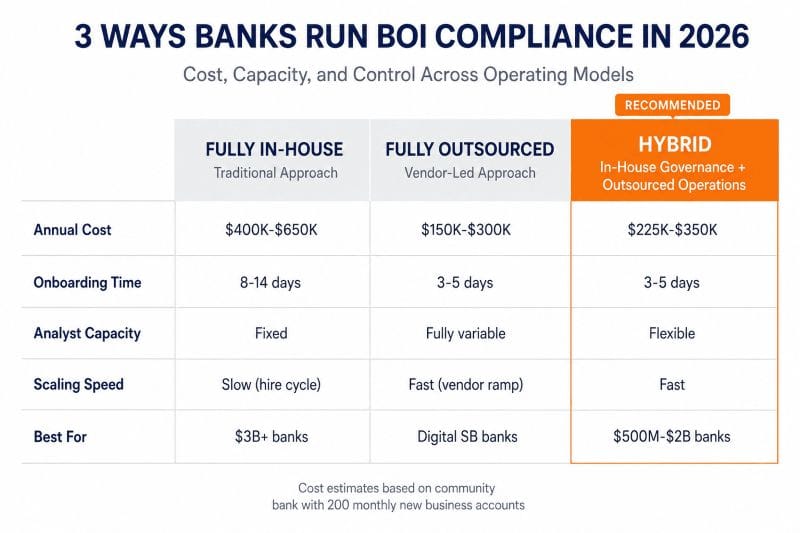
Community banks currently run BOI compliance under one of three models: fully in-house, fully outsourced, or hybrid. In 2026, the hybrid model is winning because it solves the capacity problem without giving up the accountability control.
Model 1: Fully In-House
The bank hires and trains KYB analysts, purchases KYB platform access, and manages the entire BOI collection workflow internally.
Why it can work: Full control, direct access to the team, no vendor dependency risk, clear accountability.
Why most banks are moving away from it: Hiring qualified KYB analysts in most US metro areas is genuinely hard. Base salaries are high. Analyst turnover is high. Fixed costs continue during volume dips. And when the team is undersized (which is most of the time), exam findings pile up. This model works cleanly only for banks with predictable moderate volume and mature compliance depth already in place.
Best fit: Larger community banks ($3B+ in assets) with existing BSA/AML depth and stable business account volume.
Model 2: Fully Outsourced
The bank contracts a specialized vendor to handle the entire BOI collection workflow, from initial customer intake through completed documentation. The bank retains final approval authority on account opening and full regulatory accountability. Our guide to choosing the right BPO contract clauses covers the contract structure that makes this compliant.
Why it works: Variable cost that scales with actual account volume. Access to specialized talent pools that community banks cannot recruit into their own city. Faster ramp for growth. Established quality assurance frameworks that most in-house teams cannot afford to build. Banks can start with a 5-10 analyst engagement and grow to 50+ without a vendor switch or a two-year hiring cycle.
The trade-off: Third-party risk management overhead (see OCC Bulletin 2023-17) requires a proper governance framework. Our companion piece on cybersecurity audits as the backbone of successful outsourcing covers the audit protocols required.
Best fit: Digital SB banks (like Mercury, Bluevine, and Novo-tier institutions), high-growth fintechs, and community banks with volatile or fast-growing new account volumes.
Model 3: Hybrid (The Winning Approach in 2026)
The bank keeps senior KYB analysts and the BSA officer role in-house. It outsources initial collection, verification, documentation, and ongoing monitoring to a specialized vendor. The in-house team handles final review, escalations, complex cases, and regulator communication.
Why this model is now winning: It solves the capacity problem (outsourced team handles the volume) without giving up the accountability control (in-house team keeps decision authority). The bank gets the analyst capacity of a much larger institution without the fixed cost lock-in, and without the recruiting problem.
How the economics work. A community bank spending $400K per year on an under-resourced in-house team can shift to a hybrid model where in-house senior staff cost $150K-$200K and outsourced BOI operations cost $75K-$150K annually. Total spend drops to $225K-$350K, analyst capacity roughly doubles, and exam findings typically drop within the first two exam cycles.
Best fit: Community banks under $2B in assets with growing small business banking volume, credit unions serving small business members, and fintechs scaling past their initial team’s capacity. Our detailed analysis of why fintech outsourcing fails without PCI DSS and GDPR compliance covers the security requirements common to all three models.
At Venturesathi, we run this hybrid model for several community bank and fintech clients. The in-house BSA officer keeps final signing authority. Our Bhubaneswar team handles the volume work: initial collection, ownership tracing, KYB platform verification, sanctions screening, documentation, and ongoing monitoring, all with ACAMS-informed process design and SOC 2 Type II controls. Clients typically see BOI processing time drop from 8-14 days to 3-5 days, exam findings drop meaningfully within the first year, and total BOI compliance cost drop by 40-60 percent versus in-house equivalents.
What Happens Next in CTA Enforcement?
A final FinCEN rule is expected in 2026. Congress may pass legislation to formalize the exemption. State-level BOI laws are still expanding. For banks, the uncertainty itself is a reason to build flexibility into BOI operations now.
Three specific developments are worth tracking closely:
The FinCEN Final Rule
On June 5, 2026, FinCEN submitted a final rule on BOI reporting to the OMB (Office of Management and Budget). The final rule has not yet been published, but it is expected to essentially finalize the March 2025 IFR (Interim Final Rule) framework, keeping US-formed entities exempt and limiting BOI filing to foreign reporting companies. FinCEN publishing the final rule would close the “interim” status that currently makes the exemption legally vulnerable to reversal.
Congressional Legislation
In April 2026, Senators Mike Lee and John Kennedy introduced Senate Bill 4419, which would codify the FinCEN rule into permanent law. The bill would limit BOI reporting to foreign-owned entities and delete BOI records the government has already collected on US persons. The bill has not moved beyond committee, but it represents the direction some congressional Republicans want to take the statute.
State-Level Expansion
New York’s LLC Transparency Act is the most prominent state law, but California, Massachusetts, Illinois, and other states have active or pending BOI legislation. The state-level fragmentation is where banks face the most operational risk in 2027 and beyond. Banks operating across multiple states will need to build compliance capacity against each state’s regime, or default to the strictest (typically New York) as a common denominator.
Here is what this uncertainty means for banks operationally. In-house teams cannot easily flex up and down as regulatory conditions change. When the CTA scope shrank in March 2025, banks that had built full in-house capacity got stuck with expensive capacity they no longer needed. When state-level laws expanded in 2026, banks that had cut back suddenly needed capacity they no longer had.
The banks navigating this well have moved to structures that let them scale up or down without hiring or laying off. That is the fundamental advantage of a well-designed outsourced or hybrid model: capacity moves with the workload, not with the fixed cost.
Frequently Asked Questions
What is the Corporate Transparency Act?
The Corporate Transparency Act (CTA) is a US federal law passed in January 2021. It originally required most US companies (corporations, LLCs, and similar entities) to report who really owns them to FinCEN, the Financial Crimes Enforcement Network. The goal was to stop criminals from using anonymous shell companies to hide money. In March 2025, FinCEN exempted all US-formed companies from filing. Today, only foreign companies registered to do business in the US still need to file this Beneficial Ownership Information (BOI) with FinCEN.
When did the CTA go into effect?
The CTA started on January 1, 2024. After many court battles and legal challenges, FinCEN issued a new rule on March 26, 2025 that removed the filing requirement for all US-formed companies and US persons. As of August 2026, only foreign companies registered to do business in the US must file BOI. FinCEN sent a final version of this rule to the Office of Management and Budget in June 2026, but it has not yet been published.
Which entities must file BOI reports in 2026?
Only foreign reporting companies must file BOI with FinCEN in 2026. A foreign reporting company is any entity formed under the laws of another country that has registered to do business in a US state. US-formed entities (including corporations, LLCs, and limited partnerships) are exempt, even if their owners are foreign nationals. However, some states have their own BOI laws. New York’s LLC Transparency Act took effect on January 1, 2026 and requires most LLCs formed or registered in New York to file separately with the state.
What is the bank’s role vs FinCEN’s under current rules?
FinCEN operates the government database where foreign reporting companies file their BOI. Banks are not required to check this database. However, banks still have their own separate obligation under the 2018 Customer Due Diligence (CDD) Rule to collect information about who owns their business customers when opening accounts. This applies to every business customer, regardless of what the CTA says. The CTA is about what companies must tell the government. The CDD Rule is about what customers must tell their bank. They run on separate tracks.
What are the penalties for CTA non-compliance?
For foreign reporting companies that fail to file BOI with FinCEN, penalties can reach $591 per day (adjusted yearly for inflation) with total caps over $10,000. Willful violations can bring criminal fines up to $10,000 and up to two years in prison. For banks that fail to meet CDD Rule requirements, penalties come from federal banking regulators (the OCC, FDIC, Federal Reserve, or NCUA) and can include formal exam findings called MRAs (Matters Requiring Attention), consent orders, and civil money penalties that vary based on severity.
How do banks integrate BOI into KYC workflows?
Banks add BOI collection to their business account opening process. When a business customer opens an account, the bank collects information on any individual who owns 25 percent or more of the business, plus one senior officer with significant control over the business. This information is verified using government-issued ID, address proof, and often third-party verification platforms like Middesk, Baselayer, or Signzy. Records must be kept for five years after account closure. Banks typically call this workflow KYB (Know Your Business), which runs alongside the standard KYC (Know Your Customer) checks for individual customers.
Can BOI collection be outsourced?
Yes. Banks can outsource the operational work of collecting, verifying, and documenting beneficial ownership information under the CDD Rule. This is allowed under standard third-party risk management rules outlined in OCC Bulletin 2023-17. The bank still keeps final approval authority on account opening and remains fully accountable to regulators. Outsourcing works particularly well for community banks and digital small business banks handling large volumes of business account openings without enough in-house staff to keep up. Well-structured outsourced BOI teams cost 40-60 percent less than in-house equivalents and can scale up or down with account volume changes.
The Bottom Line
The Corporate Transparency Act was supposed to make beneficial ownership simpler by moving the reporting burden to the government. Instead, it created two years of regulatory whiplash, moved the reporting burden back to banks through the CDD Rule, and created a state-level patchwork on top of everything.
Community banks and credit unions are the ones absorbing the cost. In-house KYB teams are undersized. Onboarding is slow. Exam findings are up. Customers are frustrated. Analysts are burning out. And every trend line (state expansion, complex ownership structures, regulatory scrutiny) is pointing toward more work, not less.
The banks that have already solved this share one common decision. They stopped trying to hire their way out of the problem. They moved to a hybrid model where in-house senior staff keep decision authority and outsourced specialist teams handle the volume work. The result: cleaner exam outcomes, faster onboarding, lower total compliance cost, and BOI operations that can scale up or down as the regulatory landscape shifts.
At Venturesathi, this is the model we run for our BFSI clients. Our Bhubaneswar-based KYB and BOI operations teams give community banks and fintechs analyst capacity they cannot economically build in-house. Clients typically see BOI processing time drop from 8-14 days to 3-5 days, exam findings drop meaningfully within the first year, and total BOI compliance cost drop by 40-60 percent versus in-house equivalents. Our teams work under ACAMS-informed process design, SOC 2 Type II controls, and OCC Bulletin 2023-17 governance frameworks. The bank keeps signing authority and regulatory accountability. We handle the operational load.
The Corporate Transparency Act may or may not survive in its current form. What we know for certain is that beneficial ownership collection is not going away. The 2018 CDD Rule will remain in force regardless of what happens to the CTA. State-level BOI regimes will continue to expand. Banks that build the operational capacity to handle this at scale, cost-effectively, and with clean regulatory accountability will be the ones that turn compliance from a burden into a competitive advantage.
If your community bank, credit union, or digital SB bank is quietly falling behind on BOI compliance, or if you are looking at a $400K-plus annual in-house spend that is still not enough, our Banking and Financial Services team can walk you through the numbers for your specific situation. Most engagements start with a 5-10 analyst pilot within 30-60 days.
Sources Cited
External regulatory sources referenced in this piece:
- FinCEN Beneficial Ownership Information Reporting, fincen.gov/boi
- Federal Register: BOI Reporting Requirement Revision and Deadline Extension (March 26, 2025), federalregister.gov
- FinCEN Customer Due Diligence Requirements for Financial Institutions, fincen.gov/resources/statutes-regulations/cdd-final-rule
- 31 CFR 1010.230 (Customer Due Diligence Rule), ecfr.gov
- OCC Bulletin 2023-17: Third-Party Risk Management, occ.gov
- FFIEC BSA/AML Examination Manual, bsaaml.ffiec.gov/manual
- FinCEN (Financial Crimes Enforcement Network), fincen.gov
About the Author
Rohit Gupta is a Chartered Accountant and the Founder of Venturesathi, on a mission to prove that world-class global operations aren’t defined by geography, but by discipline, systems, and intent.
In 2016, Rohit launched his first BPO in Rourkela, Odisha, mastering the complexities of global delivery from the ground up. Today, he leads Venturesathi, a team of 300+ professionals delivering high-tier CX, software development, and back-office operations that bridge the gap between tier-3 economics and tier-1 execution standards.
With over a decade of experience, Rohit specializes in building “audit-ready” scalable models. His background in finance (ISA) and deep technical expertise in data tools (Power Query, DAX, Automation) allow him to design operations that are as measurable as they are efficient. At Venturesathi, the philosophy is simple: don’t just provide a service, act as a Sathi (partner), helping global clients scale without the chaos.
Connect with Rohit on LinkedIn.
Related Reading on Venturesathi
- Can You Actually Outsource SAR Filing? What FFIEC and FinCEN Actually Say
- KYC, Reconciliation & Fraud Monitoring: Why BFSI Needs Specialized Ops
- Why Fintech Outsourcing Fails Without PCI DSS / GDPR Compliance
- Efficient Banking Operations: Back-office Outsourcing in BFSI
- Cybersecurity Audits: The Backbone of Successful Outsourcing
- What Makes a Good BPO Contract? 7 Clauses Every Founder Must Negotiate
- The Hidden Financial Risk in Your BPO Contract
- Banking & Financial Services (Service Page)
- Security & Trust