Can You Actually Outsource SAR Filing? What FFIEC and FinCEN Actually Say
If you work at a community bank, credit union, or fintech, this question has probably come up in your compliance meetings: can we outsource SAR filing to a specialized third party, or is that something regulators would frown on?
The short answer is yes. US regulators have explicitly permitted this for over a decade. But you’d be forgiven for not knowing that. The industry has treated SAR outsourcing as taboo for so long that most compliance officers still assume it’s forbidden, which keeps banks trapped between growing alert backlogs and in-house teams they can’t afford to expand.
This piece is the regulatory truth about outsourcing SAR filing. What FFIEC and FinCEN actually say, what the bank retains, what the vendor supports, and the compliance framework that makes it work. It sits alongside our broader work on KYC, reconciliation, and fraud monitoring for BFSI, and connects directly to our Banking and Financial Services practice.
TL;DR
Yes, banks can legally outsource SAR filing. Under FFIEC BSA/AML Examination Manual guidance and OCC Bulletin 2023-17, banks and credit unions are permitted to outsource SAR investigation and narrative preparation to qualified third parties. FinCEN does not restrict outsourcing arrangements. However, the regulated financial institution retains 100% of the regulatory accountability. The bank must sign every SAR, review vendor work quality, conduct due diligence, and maintain audit rights.
The oversight framework is not optional. Banks that outsource without proper governance risk Matters Requiring Attention (MRAs), consent orders, and civil money penalties regardless of vendor competence. Banks that outsource with proper governance access analyst capacity, ACAMS-certified expertise, and coverage they cannot economically build in-house.
SAR Filing: What It Is and Why It Matters
Before we get into the outsourcing question, a quick primer for readers new to this space.
A SAR (Suspicious Activity Report) is a confidential report banks file with FinCEN, the Financial Crimes Enforcement Network within the US Treasury Department, when they detect transactions that may indicate money laundering, fraud, terrorist financing, or other financial crimes. The Bank Secrecy Act requires this reporting, and failing to file when required triggers regulatory enforcement.
The scale is significant. According to FinCEN’s public SAR statistics, US financial institutions file roughly 4 million SARs annually, with depository institutions (banks and credit unions) accounting for approximately 2.5 million of those. That volume has grown 30% over the past five years as monitoring systems have gotten more sensitive and typology coverage has expanded.
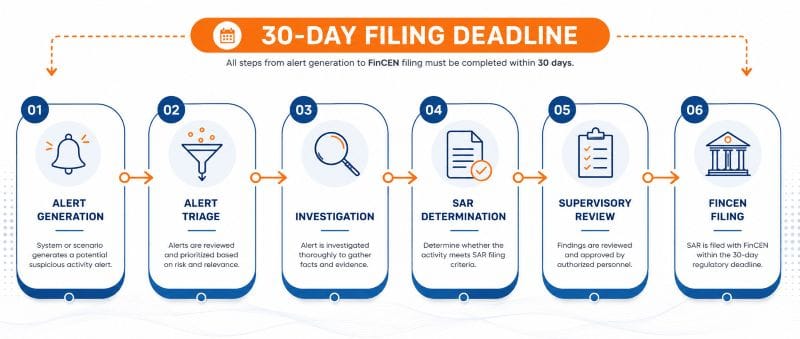
The process runs through five stages: transaction monitoring software generates alerts, analysts triage and investigate them, suspicious cases get written up as narratives, supervisors review and sign, and the bank submits the SAR to FinCEN within 30 days (60 if no suspect is identified). The whole workflow is confidential, the customer is never notified.
Here is where the outsourcing conversation begins. A typical community bank with $1B in assets generates 300-600 monthly alerts based on industry benchmarks. Investigating them properly requires 10-15 trained analysts. Most community banks have 2-4. In-house analysts cost $180K-$450K annually loaded, and finding ACAMS-certified talent in most US markets is difficult. Specialized vendors close this gap at 40-60% lower cost while adding analyst capacity that in-house hiring simply cannot match. Our broader analysis of back-office outsourcing in BFSI covers the operational economics in more depth.
That’s the operational context. Now the regulatory question.
What Does the FFIEC BSA/AML Manual Actually Permit?
The FFIEC BSA/AML Examination Manual explicitly permits outsourcing of BSA/AML functions. The industry treats it as taboo despite clear regulatory permission.
The FFIEC BSA/AML Examination Manual is the primary reference document federal banking regulators use when examining banks and credit unions for BSA/AML compliance. Every BSA officer at a US financial institution should have read it. The manual is jointly maintained by the OCC, FDIC, Federal Reserve, and NCUA.
What the manual actually permits banks to outsource:
- Alert triage and initial investigation
- Enhanced due diligence on flagged accounts
- SAR narrative drafting and supporting documentation preparation
- Ongoing customer monitoring
- Currency Transaction Report (CTR) preparation
- Sanctions screening and OFAC compliance support
What the manual explicitly reserves to the bank:
- Board oversight of the BSA/AML program
- Designation of a BSA Officer accountable to regulators
- Final review and signing of every SAR
- Regulatory reporting and communication
- Accountability for program adequacy
The distinction matters. The bank cannot delegate its regulatory obligations, but it can delegate the operational work of investigation and narrative preparation to qualified vendors. This is the fundamental structure that makes SAR filing outsourcing both legal and practical.
What Is FinCEN’s Position on Third-Party SAR Filing?
FinCEN permits third-party involvement in SAR investigation and preparation. The regulated bank must file the SAR itself under 31 CFR 1020.320.
FinCEN, the Financial Crimes Enforcement Network, is the US government agency that receives SARs and enforces the Bank Secrecy Act. Their position on third-party involvement is more nuanced than most compliance officers realize.
Under 31 CFR 1020.320, only the regulated financial institution can file a SAR. This is the non-delegable core of the regulation. A BPO vendor cannot submit a SAR directly to FinCEN. The filing must come from the bank’s designated employee through the bank’s authenticated FinCEN portal access.
But what happens before the filing, the investigation, narrative preparation, supporting documentation, and escalation review, is not restricted by FinCEN regulation. FinCEN’s published guidance confirms that banks may use third parties to support SAR preparation, provided:
- The bank retains final review and approval authority
- SAR quality meets regulatory standards regardless of who prepared it
- Confidentiality of SAR information is maintained (SARs cannot be disclosed to the subject or unauthorized parties)
- Data security controls protect the sensitive information involved
FinCEN has been consistent on this point for over 15 years. Banks that treat SAR filing as “un-outsourceable” are operating on industry mythology rather than regulatory guidance.
Who Signs the SAR, Bank or Vendor?
The bank signs the SAR. Always. This is the single most important governance principle in SAR outsourcing.
There is no scenario in US federal regulation where a third-party vendor signs and files a SAR on behalf of a bank. The BSA Officer, or a designated employee within the bank’s BSA/AML program, must:
- Review the vendor’s completed investigation
- Assess the adequacy of the narrative and supporting documentation
- Make the final determination that a SAR filing is warranted (or not)
- Sign the SAR
- Submit it through the bank’s authenticated FinCEN filing access
The vendor’s role ends at “we have prepared a case for your review and signing.” The bank’s role includes everything that follows.
This structure is not a formality. It is the regulatory accountability structure. If a SAR is filed with errors, missing information, or in violation of the 30-day filing deadline (60 days if no suspect is identified), the bank bears the enforcement consequences. The vendor may face contractual liability under the outsourcing agreement, but not regulatory liability with FinCEN or the OCC.
Well-structured engagements make this crystal clear from day one. Weak engagements blur the line and create both operational confusion and regulatory risk. Our guide to what makes a good BPO contract covers the specific clauses that formalize this accountability split.
What Oversight Framework Must Banks Maintain?
Banks must maintain a five-layer oversight framework for SAR outsourcing. Skip any layer and regulatory risk becomes structural.
The oversight framework required for SAR filing outsourcing is not a checklist of nice-to-haves. It is the regulatory scaffolding that makes the entire arrangement compliant. Based on FFIEC guidance and OCC Bulletin 2023-17 (which superseded the earlier Bulletin 2013-29), the five layers include:
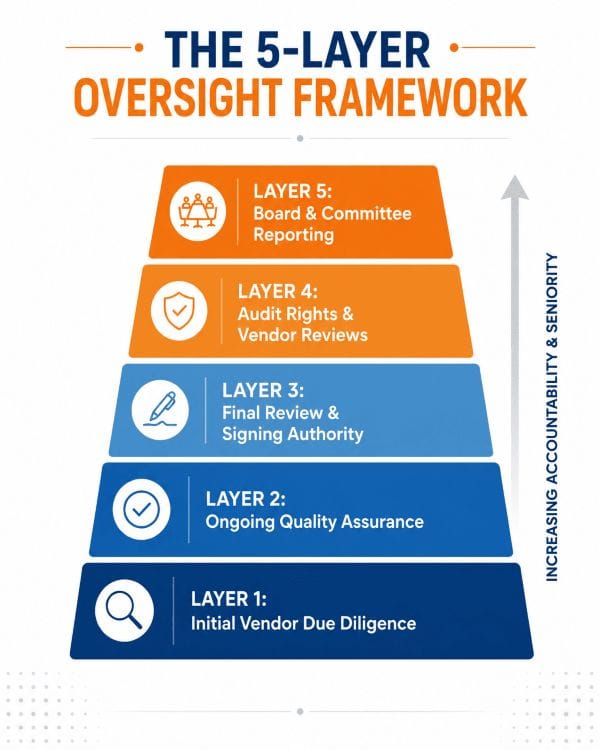
Layer 1: Initial Vendor Due Diligence
Before signing any outsourcing contract, the bank must conduct documented due diligence covering the vendor’s financial stability, information security controls (SOC 2 Type II is now considered baseline), BSA/AML program adequacy, analyst qualifications and training, business continuity plans, insurance coverage, and prior audit results. The due diligence file becomes part of the bank’s examination record. Our piece on cybersecurity audits as the backbone of successful outsourcing covers the technical portion of this diligence in more depth.
Layer 2: Ongoing Quality Assurance
The bank must review vendor work product on an ongoing basis. This typically means sampling SAR investigations (5-10% is common), scoring narrative quality against defined criteria, and tracking accuracy metrics over time. Quality assurance is not a one-time onboarding activity. It is a continuous process that produces documentation the bank presents to examiners.
Layer 3: Final Review and Signing Authority
Every SAR generated by vendor investigation must be reviewed and signed by a designated bank employee before submission to FinCEN. This is non-negotiable. Some banks structure this as a formal SAR Review Committee; others assign specific supervisors. The mechanism matters less than the discipline.
Layer 4: Audit Rights and Vendor Performance Reviews
The bank must have contractual audit rights, the ability to enter vendor facilities, review vendor processes, and inspect vendor documentation. These rights are exercised annually at minimum, with more frequent review during the first year of engagement. Vendor performance reviews translate audit findings into contract adjustments and process improvements.
Layer 5: Board and Committee Reporting
The bank’s board and audit committee must receive periodic reporting on outsourced BSA/AML activities, typically quarterly. Reporting includes vendor performance metrics, quality assurance findings, any regulatory concerns, and material changes to the vendor relationship. This oversight documents that the board is genuinely governing the arrangement, not delegating governance to management.
What Certifications Should Outsourced SAR Analysts Have?
ACAMS certification is not legally required, but it is examiner-preferred and represents industry best practice for lead investigators.
The regulatory framework does not mandate specific certifications for outsourced BSA/AML analysts. However, examiners consistently look for evidence that vendor staff are qualified for the work they perform. In practice, this means:
ACAMS (Association of Certified Anti-Money Laundering Specialists)
The CAMS certification is the industry-standard credential for AML professionals. Well-run outsourced engagements typically deploy CAMS-certified analysts for lead investigation roles, SAR narrative supervision, escalation handling, and client-facing BSA officer interactions. Newer analysts working under CAMS-certified supervision may handle triage, initial documentation, and lower-risk alert investigation. This creates a career progression pathway within outsourced BSA teams while maintaining certified oversight at all critical decision points.
CFE (Certified Fraud Examiner)
The Certified Fraud Examiner credential from the Association of Certified Fraud Examiners is complementary to ACAMS and particularly valuable for fraud-adjacent investigations, first-party fraud alerts, and cases involving elder financial exploitation.
The Practical Ratio
In our experience running BSA/AML engagements from Bhubaneswar, the operational sweet spot is roughly one ACAMS-certified analyst for every five to six team members. This ratio ensures every case has certified oversight without making the engagement uneconomic. Banks evaluating vendors should ask specifically what percentage of the deployed team holds ACAMS credentials. The honest answer separates serious BSA/AML vendors from generalist BPOs claiming AML capability.
Beyond certifications, buyers should verify data protection certifications too. Our detailed piece on why fintech outsourcing fails without PCI DSS and GDPR compliance explains why regulated financial buyers should treat these as non-negotiable. Venturesathi’s own security and trust posture is documented publicly.
Common Misconceptions About SAR Outsourcing
Five misconceptions dominate community bank thinking about SAR outsourcing. Each one has cost banks significant operational capacity.
Misconception 1: “Regulators Frown on SAR Outsourcing”
Neither the FFIEC, OCC, FDIC, Federal Reserve, nor NCUA has issued guidance suggesting regulators disapprove of properly structured SAR outsourcing. The opposite is true. Recent OCC guidance (Bulletin 2023-17) provides clearer third-party risk management standards than have existed in years, precisely because outsourcing is expected to grow. Banks maintaining a structured approach see this reflected in cleaner exam outcomes.
Misconception 2: “The Vendor Will Sign the SAR”
No vendor signs a SAR. The regulatory structure prohibits it. Any vendor claiming otherwise is either misrepresenting capability or misrepresenting the regulation. The bank always signs.
Misconception 3: “Offshore Investigation Isn’t Allowed”
FinCEN and the OCC do not prohibit offshore analyst locations. What they require is adequate oversight, data security controls, and audit rights, all achievable with offshore delivery when properly structured. Community banks currently outsourcing to India, the Philippines, and Poland for BSA/AML work are operating within regulatory permissions, not outside them. Our case study on multilingual compliance support for a scaling fintech illustrates how offshore delivery works in practice.
Misconception 4: “SAR Quality Will Suffer With Outsourcing”
Quality depends on operational discipline, not location. In-house SAR narratives fail regulatory review just as often as outsourced narratives, sometimes more often, because in-house teams often lack the volume experience that specialized vendor teams accumulate. Vendors filing hundreds of SARs monthly develop pattern recognition and narrative quality that low-volume in-house teams struggle to match.
Misconception 5: “It Costs More Than Building In-House”
For community banks under $2B in assets, in-house BSA/AML teams typically cost $180K-$450K per analyst annually when you include salary, benefits, training, ACAMS certification, turnover replacement, and management overhead. Outsourced equivalents from Tier-2 Indian cities like Bhubaneswar deliver comparable capability at 40-60% lower loaded cost. The math favors outsourcing at almost every community bank scale.
The Compliance Officer’s Checklist for SAR Outsourcing
Before signing any SAR filing outsourcing contract, work through this checklist. Missing items become regulatory findings later.
Vendor Selection
- SOC 2 Type II certification (current, not expired)
- ISO 27001 certification for information security
- Named ACAMS-certified staff assigned to your account (not just company-wide claims)
- References from at least three community banks or credit unions of similar size
- Financial stability evidence (audited statements from past two years)
- Business continuity and disaster recovery plans with tested recovery times
Contract Essentials
- Clear statement that bank retains SAR signing authority
- Vendor’s role explicitly described as “investigation and narrative preparation”
- Audit rights language (physical access, documentation review, staff interviews)
- SLA definitions (turnaround times, quality metrics, escalation timelines)
- Data security requirements (encryption at rest and in transit, access controls, retention periods)
- Indemnification for vendor errors (recognizing this doesn’t transfer regulatory liability)
- Termination clauses and data return/destruction provisions
Our piece on the hidden financial risk in your BPO contract covers the specific clauses that most banks miss during initial contract review.
Governance Structure
- Designated bank employee(s) with SAR review and signing authority
- Documented sampling plan for ongoing quality assurance
- Reporting cadence to BSA Officer, audit committee, and board
- Annual vendor performance review process
- Documented process for regulator inquiries about vendor arrangement
Banks that build this checklist into their vendor evaluation process rarely have regulatory findings related to outsourcing. Banks that skip it usually have findings within the first two examination cycles.
Frequently Asked Questions
Is it legal to outsource SAR filing?
Yes. Under FFIEC BSA/AML Examination Manual guidance and OCC Bulletin 2023-17 on third-party risk management, banks and credit unions are permitted to outsource SAR investigation and narrative preparation to qualified third parties. The regulated financial institution retains full accountability for the SAR filing itself, including quality review, signing, and submission to FinCEN. The vendor supports the work; the bank owns the responsibility.
What does FFIEC say about AML outsourcing?
The FFIEC BSA/AML Examination Manual explicitly permits outsourcing of BSA/AML functions including transaction monitoring, alert investigation, and SAR narrative preparation. The manual requires banks to conduct proper vendor due diligence, maintain oversight of outsourced activities, and ensure vendor compliance with BSA regulations. Vendor selection, ongoing monitoring, and audit rights are non-negotiable.
Who signs the SAR, the bank or the vendor?
The bank signs the SAR. Always. Under 31 CFR 1020.320, only the regulated financial institution can file a SAR with FinCEN. Third-party vendors prepare the investigation, draft the narrative, and support the analysis, but the final review, approval, and submission must come from a designated bank employee, typically the BSA Officer or a supervisor within the BSA/AML program. This is non-delegable.
What oversight does the bank retain when outsourcing SAR work?
Banks retain five specific oversight responsibilities: (1) vendor due diligence and initial risk assessment, (2) ongoing quality assurance of vendor work product, (3) final approval and signing of every SAR before FinCEN submission, (4) audit rights and periodic vendor performance reviews, and (5) board reporting on third-party BSA/AML activities. The FFIEC treats these as non-negotiable.
Do regulators allow offshore SAR investigation?
Yes, with proper controls. FinCEN and the OCC do not restrict the geographic location of vendor personnel investigating AML alerts, provided the bank maintains adequate oversight, data security controls, and audit rights. Offshore delivery, including India-based investigation from cities like Bhubaneswar, is a common and accepted model, particularly for community banks facing alert volumes their in-house teams cannot handle economically.
What is the vendor risk assessment requirement for SAR outsourcing?
Under OCC Bulletin 2023-17 (which replaced Bulletin 2013-29), banks must conduct due diligence covering financial stability of the vendor, information security controls (SOC 2 Type II is baseline), compliance program adequacy, staff qualifications and training (ACAMS certification for lead investigators is best practice), business continuity plans, and audit results. The assessment must be documented and refreshed periodically, typically annually for high-risk vendors handling BSA/AML work.
Do outsourced SAR analysts need ACAMS certification?
Regulators do not mandate ACAMS certification for outsourced analysts, but it is strongly preferred by examiners and represents industry best practice. Well-run engagements typically deploy ACAMS-certified analysts for senior investigation roles and narrative supervision, with non-certified analysts handling triage and initial documentation under certified oversight. Banks should ask vendors specifically what percentage of analysts hold ACAMS credentials before signing.
The Bottom Line
For twenty years, the BFSI industry has treated SAR filing outsourcing as regulatory taboo. It never was. FFIEC guidance has always permitted it. FinCEN has never prohibited it. OCC third-party risk management frameworks have provided clear structural guidance since 2013, updated as recently as 2023.
What community banks and credit unions actually need is not regulatory permission (they have it), but operational discipline. The bank retains signing authority, quality oversight, and regulatory accountability. The vendor provides investigation capacity, narrative preparation expertise, and analyst scale. When these roles are clearly separated and the governance framework is properly built, SAR outsourcing works, and works well.
The banks currently drowning in AML alert backlogs while their compliance teams burn out don’t need to build larger in-house teams they can’t afford to hire. They need to structure the outsourcing arrangement properly. That structural work is the difference between community banks that pass their BSA/AML examinations and community banks that receive MRAs their examiner writes as though the vendor arrangement was itself the problem.
The vendor arrangement is never the problem. Insufficient governance of the vendor arrangement always is.
About the Author
Rohit Gupta is a Chartered Accountant and the Founder of Venturesathi, on a mission to prove that world-class global operations aren’t defined by geography, but by discipline, systems, and intent.
In 2016, Rohit launched his first BPO in Rourkela, Odisha, mastering the complexities of global delivery from the ground up. Today, he leads Venturesathi, a team of 300+ professionals delivering high-tier CX, software development, and back-office operations that bridge the gap between tier-3 economics and tier-1 execution standards.
With over a decade of experience, Rohit specializes in building “audit-ready” scalable models. His background in finance (ISA) and deep technical expertise in data tools (Power Query, DAX, Automation) allow him to design operations that are as measurable as they are efficient. At Venturesathi, the philosophy is simple: don’t just provide a service, act as a Sathi (partner), helping global clients scale without the chaos.
Connect with Rohit on LinkedIn.
Related Reading on Venturesathi
- KYC, Reconciliation & Fraud Monitoring: Why BFSI Needs Specialized Ops
- Why Fintech Outsourcing Fails Without PCI DSS / GDPR Compliance
- Efficient Banking Operations: Back-office Outsourcing in BFSI
- Cybersecurity Audits: The Backbone of Successful Outsourcing
- What Makes a Good BPO Contract? 7 Clauses Every Founder Must Negotiate
- The Hidden Financial Risk in Your BPO Contract
- Case Study: Multilingual Support for a Rapidly Scaling FinTech
- Banking & Financial Services (Service Page)