FNOL Insurance 2026: Why Mid-Market Can’t Afford 24/7
FNOL insurance operations at mid-market carriers hit a wall that the top ten never notice. This is the math that forced the market.
FNOL insurance operations at a mid-market P&C (Property & Casualty) carrier look easy on paper. Take the call, capture the loss details, feed the claim into the system, move on.
Then ask a claims operations leader when the phones actually ring hardest.
The answer is almost never “9 to 5 on weekdays.” It is Sunday evenings after weekend accidents. 11pm on a Friday during a hailstorm. 6am the morning after a windstorm knocked out power in Central Florida.
The customer expectation in 2026 is that the carrier’s claims line answers at any of those moments.
Mid-market economics do not support that expectation. Running 24/7 in-house FNOL insurance intake is priced for the top ten carriers, not for everyone else. That gap is why FNOL insurance outsourcing has quietly become the default operating model below the top ten.
What 24/7 FNOL insurance operations actually require
The staffing math is unforgiving:
- One FTE (Full-Time Equivalent) covers a single 8-hour shift
- 24/7 coverage of the same seat needs roughly 4.5-5 FTEs, once you account for shift overlap, PTO, training, and weekend rotation
- A mid-market carrier handling 10,000-20,000 monthly FNOL contacts needs 25-50 seats at steady state
- Multiply for 24/7 coverage and you land at 110-250 fully-loaded intake reps
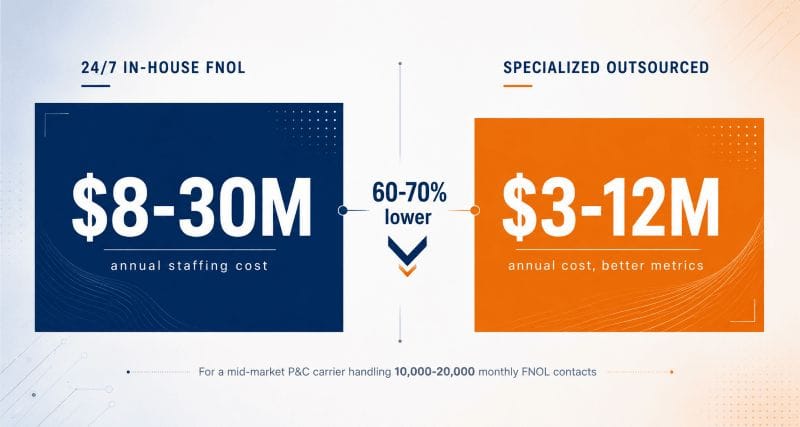
At $75K-$120K per rep loaded, that is $8M-$30M in annual staffing cost for the FNOL insurance function alone.
And that is before surge capacity for catastrophe events, which routinely produce 3-5x volume spikes.
Why does the math not work for in-house?
Because the shape of the demand curve is wrong for a fixed in-house team.
Business hours are efficient. Predictable volume, predictable staffing, predictable utilization.
Nights and weekends are not. Smaller volume, but not zero. Someone has to be sitting there, often taking one call an hour. Utilization collapses. Cost per contact goes through the roof.
Then a hurricane hits. Volume goes to 5x for a week. The in-house team cannot flex up in days. Response times balloon. Bad faith exposure rises under state Unfair Claims Settlement Practices rules. The NAIC framework starts working against the carrier instead of for it.
Talent scarcity compounds it. Trained claims intake reps in mid-market cities are hard to hire and harder to retain on off-shift rotations. Turnover on 24/7 in-house teams routinely runs above 40 percent annually.
The carrier ends up paying full-time cost for idle capacity most nights, and still cannot handle the moments that matter most.
What the customer expectation actually is
Slow FNOL is not just a customer experience problem. It is a claims severity problem.
Speed lowers claim cost. Auto claims reported within 24 hours settle 5-15 percent lower than claims reported after 72 hours. Faster damage assessment, quicker rental starts, less time for secondary damage, less room for claim inflation. Property claims see the same effect, particularly for water damage.
Speed drives retention. A policyholder whose midnight call gets answered promptly renews. A policyholder who gets routed to voicemail at 2am and calls back the next morning starts shopping. Retention differences of 10-20 percentage points between fast-responding and slow-responding carriers are common in claim-experience data.
Speed avoids regulatory exposure. Every state Department of Insurance enforces some version of the NAIC Unfair Claims Settlement Practices Model Act, which sets minimum response times and communication standards. Missed timelines create bad faith exposure that can dwarf the underlying claim value.
How mid-market carriers solve FNOL insurance staffing
The answer that mid-market P&C insurance has settled on is a split model.
Outsourced: FNOL insurance intake, triage, initial documentation, customer communication.
In-house: Licensed adjusters, coverage determinations, actual claim decisions.
The split works because most US states distinguish between claims intake (no adjuster license required) and claim adjustment (adjuster license typically required). The FNOL insurance intake work is exactly what a specialized 24/7 vendor can do at scale, with surge capacity for CAT events built in.
The third-party risk framework governing this arrangement is covered in our companion pieces on KYC and fraud monitoring for BFSI and efficient back-office outsourcing in BFSI. For FNOL insurance specifically, OCC Bulletin 2023-17-style governance principles apply, layered with NAIC-aligned controls and state DOI oversight.
The economics move meaningfully. A carrier spending $8M-$30M on 24/7 in-house intake often lands at $3M-$12M under a specialized outsourced FNOL insurance model. Better response times. Better surge coverage. Better retention.
The Bottom Line
FNOL insurance outsourcing is not a cost-cutting play. It is a math play.
The carrier that solves the 24/7 FNOL insurance problem well:
- Answers the Sunday evening call
- Staffs a hailstorm without emergency hiring
- Keeps response times inside NAIC guidelines
- Gets the severity and retention benefits of fast intake
The carrier that does not solve it pays full-time cost for idle overnight capacity, misses the moments that matter, and quietly loses policyholders during the wait.
The math is what forced the market. The carriers that have not moved yet are the ones still trying to hire their way out of a problem the market solved five years ago.
Venturesathi runs 24/7 FNOL insurance intake for mid-market P&C carriers who have decided to stop paying full-time cost for the moments they most need to cover. If that is a conversation you want to have, we can help.
About the Author
Rohit Gupta is a Chartered Accountant and the Founder of Venturesathi, on a mission to prove that world-class global operations aren’t defined by geography, but by discipline, systems, and intent.
In 2016, Rohit launched his first BPO in Rourkela, Odisha, mastering the complexities of global delivery from the ground up. Today, he leads Venturesathi, a team of 300+ professionals delivering high-tier CX, software development, and back-office operations that bridge the gap between tier-3 economics and tier-1 execution standards.
With over a decade of experience, Rohit specializes in building “audit-ready” scalable models. His background in finance (ISA) and deep technical expertise in data tools (Power Query, DAX, Automation) allow him to design operations that are as measurable as they are efficient. At Venturesathi, the philosophy is simple: don’t just provide a service, act as a Sathi (partner), helping global clients scale without the chaos.
Connect with Rohit on LinkedIn.
Related Reading on Venturesathi
- The Chargeback Bill Nobody Adds Up
- Why Your Chargeback Volume Is Growing 25% Every Year
- Can You Actually Outsource SAR Filing? What FFIEC and FinCEN Actually Say
- Why 60% of AML Alerts at Community Banks Never Get Investigated
- The Corporate Transparency Act Compliance Burden Nobody Prepared For
- KYC, Reconciliation & Fraud Monitoring: Why BFSI Needs Specialized Ops
- Banking & Financial Services (Service Page)
Frequently Asked Questions
What is FNOL in insurance?
FNOL stands for First Notice of Loss. It is the moment a policyholder first reports a claim to a carrier by phone, app, agent, or online form. FNOL kicks off the claims process and starts the regulatory clock on response timelines set by NAIC model rules and state Departments of Insurance.
Can FNOL insurance operations be outsourced?
Yes. Most US states allow claims intake to be handled by non-licensed staff, while claim adjustment stays with licensed adjusters. Carriers outsource FNOL insurance intake, triage, and documentation to a specialized vendor under OCC Bulletin 2023-17-style third-party risk management frameworks.
How much does 24/7 in-house FNOL insurance cost mid-market carriers?
A mid-market P&C carrier running 24/7 in-house FNOL insurance typically needs 110-250 fully-loaded intake reps. At $75K-$120K per rep loaded, that is $8M-$30M in annual staffing cost, before surge capacity for catastrophe events.
What is the impact of slow FNOL on claims severity?
Auto claims reported within 24 hours typically settle 5-15 percent lower than claims reported after 72 hours. Slow FNOL also increases bad faith exposure under state Unfair Claims Settlement Practices regulations.
How do NAIC regulations affect FNOL insurance outsourcing?
NAIC model laws set the framework, but each state Department of Insurance enforces the rules. Outsourced FNOL insurance vendors must meet state response-time standards, and the carrier retains full regulatory accountability under the Unfair Claims Settlement Practices Model Act.
Can FNOL insurance outsourcing handle catastrophe events?
Yes. Weather CAT events create 3-5x FNOL volume spikes that in-house teams cannot economically staff for. Specialized FNOL insurance vendors maintain surge capacity across multiple carrier accounts, scaling up rapidly during events without idle headcount in quiet periods.