Why 60% of AML Alerts at Community Banks Never Get Investigated
If you run BSA/AML compliance at a community bank or credit union, this pattern is probably familiar. Your transaction monitoring system generates hundreds of alerts every month. Your team of 2-4 analysts triages what they can. The rest go into a queue that never really clears. By quarter-end, the backlog has grown again, and everyone hopes the examiners do not look too closely.
Here is the uncomfortable reality: community banks investigate roughly 40-60 percent of the AML alerts their monitoring systems generate, and regulators are increasingly treating unreviewed alerts as equivalent to willful blindness. What used to be a “we will catch up next quarter” problem has become the single most common trigger for MRA findings and FinCEN enforcement actions against community banks.
This piece walks through why the backlog exists, what regulators actually look at during exams, why hiring alone rarely solves it, and what a sustainable operational fix looks like. It builds on our companion pieces on SAR filing outsourcing, CTA compliance burden, and rising chargeback volume solutions, and connects to our Banking and Financial Services practice.
TL;DR
Community banks investigate 40-60 percent of AML alerts. Regulators expect 100 percent alert review. That gap is where MRAs (Matters Requiring Attention), consent orders, and FinCEN civil money penalties originate.
Here is what community banks are actually dealing with in 2026:
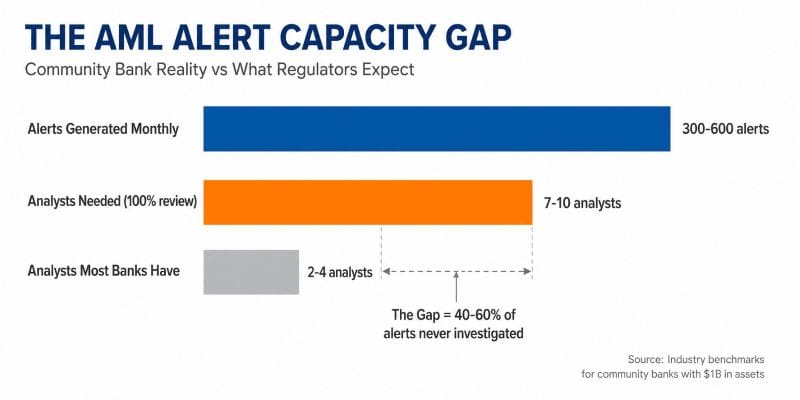
- Transaction monitoring systems generate 300-600 monthly alerts for a typical $1B bank. Most banks have 2-4 in-house BSA/AML analysts. Needed capacity: 7-10.
- False positive rates from platforms like NICE Actimize, Verafin, Featurespace, Norkom, and SAS AML run 90-95 percent. AI tuning can help, but it does not eliminate the need for human investigation.
- Regulators treat unreviewed alerts as willful blindness under BSA (Bank Secrecy Act) obligations. Alert backlogs are one of the top three MRA triggers in community bank exams.
- FinCEN enforcement actions against banks with systemic AML failures have ranged from $500K civil money penalties for small institutions to $100M+ for larger banks.
- Hiring alone rarely solves the problem. Analyst talent is scarce, ramp time is 6-9 months, and volume keeps growing.
Community banks investigate roughly 40-60 percent of the AML alerts their monitoring systems generate, and regulators are increasingly treating unreviewed alerts as equivalent to willful blindness. The banks that solve this stop trying to hire their way out and build operations that scale with alert volume growth.
The Mathematics of AML Alert Overwhelm
The alert-to-analyst math is what creates the backlog. It is not a productivity problem or a training problem. It is a capacity problem hiding in plain sight on every community bank’s compliance dashboard.
Here is the math for a typical $1B community bank:
- Alerts generated per month: 300-600 (varies by transaction monitoring platform tuning and customer base composition)
- Alerts requiring investigation: 100 percent must be reviewed. Not every review requires a full investigation, but every alert must be assessed.
- Alerts a trained BSA/AML analyst can process monthly: 100-150 with proper case management tools and clear procedures
- Analysts required for full review coverage: 3-6 analysts for 300-600 alerts
- Analysts most community banks actually have: 2-4
Result: 40-60 percent alert review rate. The remaining 40-60 percent sit in a queue. Some age past the 30-day SAR filing deadline. Some get closed without proper documentation. Some never get looked at until an examiner asks about them.
The math gets worse as alert volume grows. A community bank whose alert volume grew 15-20 percent annually over the past three years, while headcount stayed flat, is now sitting at 30-40 percent review rates. The backlog is now the operational baseline, not an anomaly.
What Do Regulators Actually Look At?
Examiners do not just count alerts. They test whether the entire alert workflow, from generation through disposition, meets FFIEC standards. Backlogs are one specific finding among several that regulators pursue.
Under the FFIEC BSA/AML Examination Manual, examiners test:
- Alert review completeness. Did the bank review every alert, or are there unreviewed alerts sitting in the queue?
- Alert disposition quality. For alerts that were reviewed, was the disposition properly documented and based on adequate investigation?
- SAR filing timeliness. Were SARs filed within 30 days (60 for no-subject cases) when investigation determined filing was warranted?
- Continuous activity monitoring. For accounts that generated multiple alerts, was continuous activity properly monitored per the 90-day SAR continuing activity reporting rule?
- Monitoring rule tuning. Are transaction monitoring rules periodically reviewed and tuned to reduce false positives without missing suspicious activity?
The backlog problem shows up in the first test, but it cascades into all the others. When alerts sit in a queue for months, disposition quality suffers because analysts race to catch up. SAR filing timeliness suffers because backlog alerts age past deadlines. Continuous activity monitoring breaks down because the underlying alerts were never worked in real-time. Rule tuning stalls because no one has bandwidth to analyze which rules are generating noise.
One backlog produces five categories of exam findings. That is why regulators treat it so seriously.
The MRA and Enforcement Action Pipeline
Unreviewed alerts move through a predictable regulatory escalation path: MRA finding, then MRIA, then formal enforcement. Each step increases the cost and duration of remediation.
Here is how the typical enforcement pipeline works for community banks:
Step 1: MRA (Matter Requiring Attention). The examiner identifies unreviewed alerts during the exam. The bank receives a formal MRA requiring remediation within 90-180 days. Documented remediation plan required. MRA remains in the supervisory record and gets tested in the next exam.
Step 2: MRIA (Matter Requiring Immediate Attention). If the MRA is not resolved by the next exam, or if the deficiency is more serious, the finding escalates to an MRIA. Timeframes tighten. Board involvement typically required. Documented root cause analysis expected.
Step 3: Formal Enforcement Action. If MRIAs are not resolved, or if the underlying pattern is systemic, regulators can pursue formal enforcement. This includes consent orders (imposing specific operational requirements), civil money penalties (financial fines), or in severe cases, restrictions on business activities or removal of individuals from banking.
The cost accumulates at every step. An initial MRA remediation typically costs a community bank $150K-$400K in consulting fees, additional staff time, and process rebuild. An escalation to MRIA doubles that. A formal enforcement action can cost $500K-$5M for community banks and much more for larger institutions.
You can browse recent enforcement actions on the FinCEN Enforcement Actions page and the OCC Enforcement Actions Search. Most recent AML-related actions against community banks trace back to systemic BSA/AML program deficiencies, and alert backlogs appear in the majority of them.
Why Hiring Alone Does Not Solve the Backlog
Community banks trying to hire their way out of AML alert backlogs typically fail. The math does not work, and the timeline is wrong.
Here is why hiring alone rarely solves the problem:
The talent shortage is real. ACAMS-certified BSA/AML analysts are in genuine short supply, particularly outside major US metros. Community banks in secondary markets often struggle to fill even one BSA analyst opening within six months. Fully-loaded cost per analyst runs $120K-$180K, and turnover in the role runs 25-35 percent annually at understaffed banks.
The ramp time is too slow. Even when hiring succeeds, new BSA/AML analysts take 6-9 months to reach full productivity. During ramp, they can handle 30-50 percent of what an experienced analyst handles. A bank hiring two new analysts in Q1 will not see full capacity impact until Q3 or Q4.
Volume keeps growing. While the bank is hiring, alert volume keeps climbing at 15-20 percent annually. By the time new hires are productive, the backlog has grown further. The bank is running to stand still.
Hiring does not fix the underlying process. Adding analysts to a broken workflow just spreads the same problems across more people. Banks that add headcount without fixing case management, disposition procedures, and quality assurance often see their exam findings get worse, not better.
The community banks that actually solve alert backlogs treat it as an operational capacity problem, not a hiring problem. That reframing opens up the three approaches that actually work.
What Are the 3 Ways Community Banks Catch Up?
Community banks facing AML alert backlogs typically use one of three approaches. Each has different economics, timelines, and sustainability characteristics.
Approach 1: Fully In-House Hiring
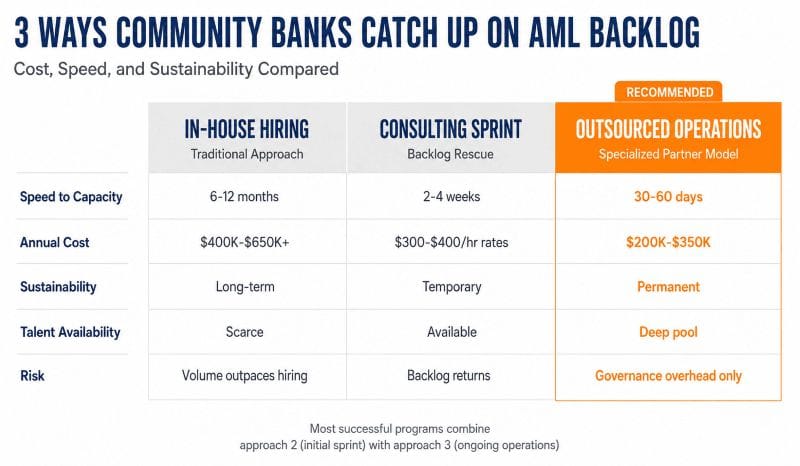
Hire additional BSA/AML analysts to close the capacity gap. Slow (6-12 month ramp), expensive ($120K-$180K per analyst loaded), and difficult given the talent shortage. Works only for larger community banks with mature compliance depth and predictable long-term volume.
Approach 2: Specialized Consulting for Backlog Sprint
Engage a specialized BSA/AML consulting firm for a 60-90 day backlog remediation sprint. Fast (weeks to ramp), but expensive ($200-$400 per hour analyst rates) and inherently temporary. The consulting firm clears the backlog, delivers documentation, and leaves. Six months later, the backlog returns because the underlying capacity gap was never solved.
Approach 3: Specialized Outsourced Operations Partner
Engage a specialized BSA/AML operations vendor to handle ongoing alert investigation, SAR narrative preparation, and case documentation under proper third-party risk management framework per OCC Bulletin 2023-17. The bank retains BSA officer signing authority, quality oversight, and full regulatory accountability. The vendor provides ongoing capacity that scales with alert volume. Our companion piece on cybersecurity audits as the backbone of successful outsourcing covers the security framework required.
How the economics compare. A community bank spending $400K annually on 2-4 in-house BSA/AML analysts (with a persistent backlog) can shift to a specialized outsourced model where 6-8 vendor-supplied analysts cost $200K-$350K annually. Alert review rates move from 40-60 percent to 98-100 percent. MRA risk drops. And the model scales up or down as alert volume shifts.
The most successful backlog remediation programs combine approaches: an initial consulting sprint to clear the historical backlog, followed by a permanent outsourced or hybrid operational model to prevent the backlog from returning.
Where Does Outsourcing Become Necessary?
Outsourced BSA/AML operations become necessary when the alert volume growth curve permanently exceeds in-house hiring capacity. For most community banks, that threshold arrived several years ago.
At Venturesathi, we run BSA/AML alert investigation and SAR narrative preparation for community bank and credit union clients handling anywhere from 200 to 3,000 monthly alerts. Our Bhubaneswar teams work under ACAMS-informed process design, SOC 2 Type II controls, and OCC Bulletin 2023-17 governance frameworks. Clients typically see alert review rates move from 40-60 percent to 98-100 percent within 60-90 days, SAR filing timeliness move from 75-85 percent to 95-98 percent, and total BSA/AML operations cost drop by 40-60 percent versus in-house equivalents. Our guide to what makes a good BPO contract covers the contract structure that makes this compliant.
The bank keeps BSA officer authority, signs every SAR, controls final case disposition, and maintains full regulatory accountability. The vendor provides the analyst capacity, case documentation discipline, and process depth that most community banks cannot economically build in-house. This is the operational model that solves the backlog permanently, not just for one quarter.
Frequently Asked Questions
Why do community banks have AML alert backlogs?
Community banks have AML alert backlogs because transaction monitoring systems generate far more alerts than in-house BSA/AML analyst teams can investigate. A typical $1B community bank generates 300-600 monthly alerts but has only 2-4 analysts to review them. Combined with false positive rates of 90-95 percent from most transaction monitoring platforms, this creates a structural gap where 40-60 percent of alerts routinely go uninvestigated. Regulators treat unreviewed alerts as equivalent to willful blindness under BSA requirements.
What percentage of AML alerts should be investigated?
100 percent of AML alerts generated by transaction monitoring systems should be reviewed under FFIEC BSA/AML Examination Manual expectations. Not every alert needs a full investigation, but every alert must be assessed to determine whether investigation is required. Well-run BSA/AML programs achieve 98-100 percent alert review rates. Community banks operating at 40-60 percent review rates are at significant regulatory risk during examinations.
What is an MRA from the OCC?
An MRA (Matter Requiring Attention) is a formal exam finding issued by the OCC (Office of the Comptroller of the Currency) when a bank has deficiencies serious enough to require corrective action but not severe enough for formal enforcement. MRAs must be remediated within specific timeframes, become part of the bank’s supervisory record, and follow the bank into future examinations. Unresolved MRAs can escalate to MRIAs, consent orders, or civil money penalties. AML alert backlogs are one of the most common MRA triggers for community banks.
How many analysts per 1000 AML alerts do banks need?
As a working benchmark, a fully-trained BSA/AML analyst can investigate 100-150 alerts per month when investigations are properly resourced with case management tools and clear procedures. This means 1,000 monthly alerts requires approximately 7-10 analysts to maintain a full review rate. Community banks generating 500-600 monthly alerts with only 2-4 analysts are operating at roughly one-third of the required capacity, which is where investigation backlogs and MRA findings originate.
What triggers a FinCEN enforcement action?
FinCEN enforcement actions against banks typically involve systemic BSA/AML program failures rather than isolated errors. Common triggers include failure to file SARs when required, willfully inadequate transaction monitoring, systematic unreviewed alert backlogs, inadequate CDD program, and failure to remediate prior exam findings. Recent FinCEN enforcement actions have resulted in civil money penalties ranging from $500,000 for small community banks to over $100 million for larger institutions with more severe violations.
Can AI reduce AML alert volume?
AI and machine learning can meaningfully reduce false positive alert volume, typically by 20-40 percent when properly tuned. However, AI does not eliminate the need for human investigation. AI reduces the volume of alerts requiring review but cannot make the regulatory decision on whether suspicious activity has occurred. The most effective approach combines AI-tuned monitoring (to reduce false positives) with sufficient analyst capacity (to investigate the remaining alerts). Banks that invest only in AI without scaling analyst capacity typically see backlogs return within 12-18 months as alert volume grows.
How do banks catch up on AML alert backlog?
Banks catching up on AML alert backlogs typically use one of three approaches: hiring additional in-house analysts (slowest, most expensive, difficult given the talent shortage), engaging specialized short-term consulting resources (expensive, temporary), or partnering with a specialized outsourced BSA/AML operations vendor (fastest scaling, most cost-effective for sustained volume growth). The most successful backlog remediation programs combine an initial burst of contract capacity to clear the backlog with a longer-term outsourced or hybrid operational model to prevent the backlog from returning.
The Bottom Line
The AML alert backlog at community banks is not a temporary problem that will resolve itself. Alert volumes are growing 15-20 percent annually. Analyst hiring is slow and difficult. Regulators are treating unreviewed alerts as willful blindness, and enforcement pipeline math favors the government at every step. Banks that do not fundamentally rethink how they staff BSA/AML operations will keep receiving MRAs, keep spending money on remediation, and keep operating with a compliance risk they cannot fully quantify.
The community banks that solved this share one common decision. They stopped trying to hire their way out of the problem and built operations that scale with alert volume growth. Some did it with technology investment. Some did it with hybrid outsourcing. All of them treated the backlog as an operational capacity problem, not a compliance program problem.
At Venturesathi, this is exactly the operational model we run for our community bank and credit union clients. Our Bhubaneswar-based BSA/AML operations teams give community banks the analyst capacity they cannot economically build in-house. Clients typically see alert review rates move from 40-60 percent to 98-100 percent within 60-90 days, SAR filing timeliness improve to 95-98 percent, and total BSA/AML operations cost drop 40-60 percent versus in-house equivalents. Our teams work under ACAMS-informed process design, SOC 2 Type II controls, and OCC Bulletin 2023-17 governance. The BSA officer keeps signing authority and regulatory accountability. We handle the operational load.
If your community bank is quietly running with an AML alert backlog you cannot fully see, or if you have received an MRA related to alert investigation or SAR filing timeliness, our Banking and Financial Services team can walk you through the numbers for your specific situation. Most engagements start with a 5-10 analyst pilot within 30-60 days.
About the Author
Rohit Gupta is a Chartered Accountant and the Founder of Venturesathi, on a mission to prove that world-class global operations aren’t defined by geography, but by discipline, systems, and intent.
In 2016, Rohit launched his first BPO in Rourkela, Odisha, mastering the complexities of global delivery from the ground up. Today, he leads Venturesathi, a team of 300+ professionals delivering high-tier CX, software development, and back-office operations that bridge the gap between tier-3 economics and tier-1 execution standards.
With over a decade of experience, Rohit specializes in building “audit-ready” scalable models. His background in finance (ISA) and deep technical expertise in data tools (Power Query, DAX, Automation) allow him to design operations that are as measurable as they are efficient. At Venturesathi, the philosophy is simple: don’t just provide a service, act as a Sathi (partner), helping global clients scale without the chaos.
Connect with Rohit on LinkedIn.
Related Reading on Venturesathi
- Can You Actually Outsource SAR Filing? What FFIEC and FinCEN Actually Say
- The Corporate Transparency Act Compliance Burden Nobody Prepared For
- Why Your Chargeback Volume Is Growing 25% Every Year
- KYC, Reconciliation & Fraud Monitoring: Why BFSI Needs Specialized Ops
- Why Fintech Outsourcing Fails Without PCI DSS / GDPR Compliance
- Cybersecurity Audits: The Backbone of Successful Outsourcing
- What Makes a Good BPO Contract? 7 Clauses Every Founder Must Negotiate