Why Your Chargeback Volume Is Growing 25% Every Year
(And What Actually Fixes It)
If you run card operations, a card program at a community bank or credit union, or a dispute team at a fintech, chargeback volume has probably climbed 20-25 percent every year for the past several years. Meanwhile, your dispute team is likely the same size it was three years ago.
Here is the uncomfortable truth about why: it is not because fraud is exploding. It is because customer expectations for instant dispute resolution have outpaced bank operational capacity. First-party fraud has become normalized behavior. Regulation E (Reg E) deadlines are unforgiving. And traditional fraud prevention tools do not catch any of this because the customer’s own legitimate card was used.
This piece walks through what is actually driving the growth, why traditional fraud tools do not fix it, and what actually reduces chargeback numbers. It builds on our companion pieces on SAR filing outsourcing and the CTA compliance burden, and connects to our Banking and Financial Services practice.
TL;DR
Chargebacks are growing 20-25 percent annually at most US card issuers because of structural changes, not fraud. Digital commerce expansion, normalized first-party fraud (60-70 percent of all disputes in 2026, up from 40 percent in 2019), and customer expectations for instant refunds are the real drivers. Traditional fraud prevention tools do not catch first-party fraud. Regulation E deadlines are getting harder to meet. Fully-loaded cost per chargeback for issuers runs $40-$120, and total dispute operations cost typically exceeds visible spend by 2-3x when hidden costs (CFPB risk, weak representment, customer damage) are counted.
The card issuers that solved this stopped treating chargebacks as a fraud problem and started treating them as a dispute operations problem. They built operations that scale with volume growth, either through hiring, technology, or specialized outsourcing.
Chargebacks in 60 Seconds: What They Are and Why They Matter
A chargeback is a transaction reversal initiated by a cardholder through their card issuer. When a customer disputes a transaction (claiming it was unauthorized, merchandise never arrived, or the item was not as described), the issuer investigates. If valid, the issuer reverses the charge and takes the money back from the merchant.
The process is governed by Regulation E (for debit disputes, under the Electronic Fund Transfer Act) and Regulation Z (for credit disputes, under the Truth in Lending Act). Both are enforced by the Consumer Financial Protection Bureau (CFPB). Card networks (Visa, Mastercard, Discover, American Express) add their own rules on top.
For scale: a community bank with 50,000 active cards typically processes 300-800 chargeback cases monthly. A mid-sized regional card program handles 5,000-15,000. A digital fintech with 500,000 cardholders can see 20,000-40,000 cases per month. Every case has a Reg E clock running. Every missed deadline is a potential CFPB finding.
What Are the Three Drivers of Chargeback Growth?
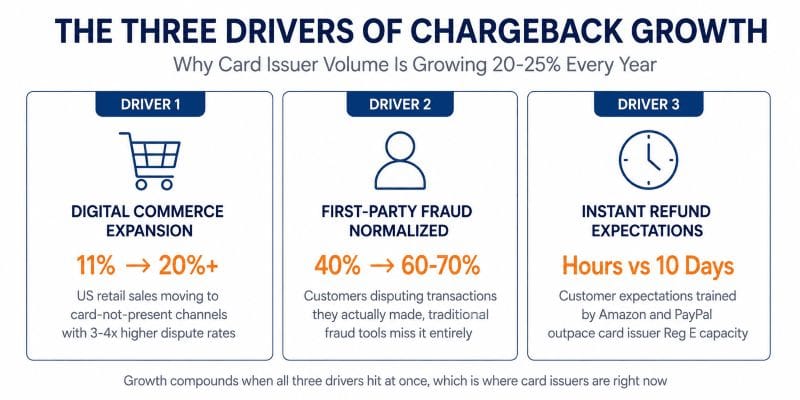
Chargeback growth is being driven by three structural changes in how consumers use commerce, not by more fraud.
Driver 1: Digital commerce has expanded the dispute surface area. E-commerce grew from 11 percent of US retail sales in 2019 to over 20 percent in 2026. Card-not-present transactions have chargeback rates 3-4 times higher than card-present transactions. When more transactions move to higher-dispute-rate channels, volume climbs even if consumer behavior stays constant.
Driver 2: First-party fraud has become normalized behavior. First-party fraud is when a customer disputes a transaction they actually made. Industry data suggests 60-70 percent of all chargebacks in 2026 fall into this category, up from about 40 percent in 2019. Social media has spread “how to get a refund” playbooks. Customers learn quickly that disputing works, so they do it more.
Driver 3: Instant refund expectations outpace operational capacity. Amazon and PayPal have trained consumers to expect refunds within hours. Card issuers cannot match that pace under Reg E without dramatically more headcount. So customers who cannot get fast service call the dispute line instead, because the 10-day provisional credit rule guarantees quick money back. The slower a card issuer’s refund process, the more disputes it generates.
The three drivers compound. More e-commerce means more disputable transactions. Normalized first-party fraud means more disputes on the same volume. Slow service converts customer complaints into disputes. Add them together and 20-25 percent annual growth is nearly inevitable for card issuers that do not fundamentally rethink dispute operations.
Why Traditional Fraud Prevention Is Not Enough
Card issuers keep buying more fraud tools even though the tools do not address what is actually growing.
Fraud prevention platforms from Kount, Sift, Riskified, Featurespace, and NICE Actimize excel at detecting stolen cards, account takeovers, and known fraud typologies. When criminals use stolen cards, these tools catch it.
But first-party fraud is not what these tools detect. The customer’s own card is being used from the customer’s own device, at usual merchants, in normal geography. Nothing looks fraudulent because technically it is not. The customer authorized it. They plan to dispute it later.
Every dollar spent on more sophisticated fraud detection to solve a rising chargeback problem is a dollar that will not solve the actual problem. The growth is coming from customer behavior and operational capacity, not stolen cards. The fix comes from dispute operations: better customer communication, faster proactive resolution, sharper first-party fraud identification, and disciplined representment.
The Reg E Timeline Problem
Regulation E gives card issuers 10 business days to investigate a debit card dispute or provide provisional credit. This is where most chargeback pain concentrates at card issuers.
Under Regulation E (codified at 12 CFR Part 1005):
- 10 business days to complete the investigation or provide provisional credit
- 45 days to complete full investigation (90 days for point-of-sale or foreign transactions)
- Immediate notification to the customer if provisional credit is given
- Full documentation of the investigation and resolution
Regulation Z governs credit card disputes with parallel timelines. Both are enforced by the CFPB, and both have been the subject of recent enforcement actions.
Here is where the crunch hits. A team of 5 analysts handling 400 monthly cases needs to complete each case in about 4 hours to meet deadlines. When volume jumps to 500 cases at the same headcount, per-case time drops to 3 hours. At 600 cases, 2.5 hours. Analysts start cutting corners: shorter investigations, weaker documentation, faster provisional credits without proper vetting. Every corner cut becomes a future exam finding.
Card issuers with clean Reg E compliance built dispute operations that scale with volume. Card issuers with fixed teams that get squeezed as volume grows have the deadline problem, plus weaker representment win rates, plus more exam findings.
What Does a Chargeback Actually Cost Card Issuers?
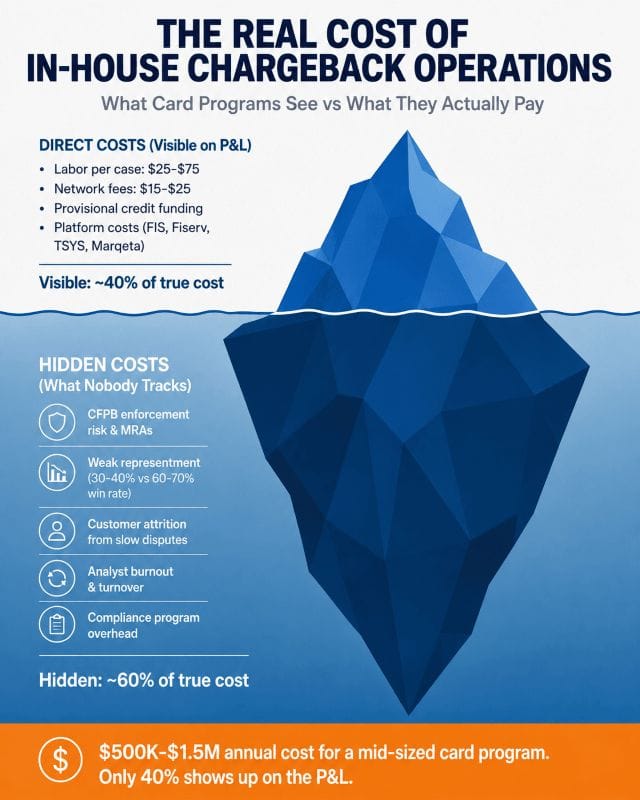
Fully-loaded cost per chargeback runs $40-$120 per case, and total dispute operations cost typically exceeds visible spend by 2-3x when hidden costs are counted.
Direct costs per case include labor for investigation ($25-$75), network fees ($15-$25), provisional credit funding cost, representment costs if challenged ($10-$30), and allocated technology and compliance overhead. Chargeback fees collected from merchants ($15-$100 per case) offset some direct cost, but rarely cover it fully when platform costs from FIS, Fiserv, TSYS, or Marqeta are included.
The hidden costs are bigger:
- CFPB enforcement risk. Consent orders and civil money penalties from Reg E and Reg Z violations can reach tens of millions of dollars. Even without formal enforcement, MRAs (Matters Requiring Attention) from banking regulators create months of remediation work.
- Weak representment. Community banks winning 25-40 percent of representment cases (versus 60-70 percent for best-in-class operations) leave real revenue uncollected. Moving from 30 percent to 60 percent representment win rate on 500 monthly cases at $150 average recovers about $270K annually.
- Customer relationship damage. Slow disputes damage customer relationships. Attrition tied to dispute experience is invisible on the P&L but adds up.
Add it all together and a mid-sized card program running 500 monthly chargebacks quietly costs $500K-$1.5M per year in fully-loaded dispute operations, of which only 40 percent typically shows up as an explicit budget line.
Where Does Outsourcing Fit in Chargeback Operations?
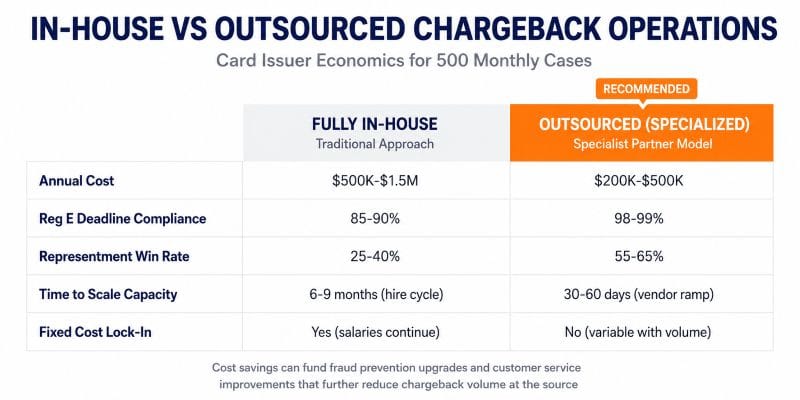
Outsourced dispute processing costs 40-60 percent less than in-house equivalents, delivers better Reg E deadline compliance, and improves representment win rates. It is the fastest way to close the capacity gap without a 6-12 month hiring cycle.
Card issuers have three options when volume outpaces capacity:
Hire more analysts. Slow (3-6 months per hire, 6-9 months to productivity), expensive ($80K-$130K fully-loaded per analyst), and difficult in most US metros where dispute talent is scarce.
Buy more technology. Helps at the margins but does not solve the fundamental capacity problem. Cases still need analyst judgment, especially for first-party fraud.
Outsource to a specialized dispute operations partner. Modern outsourced operations run under OCC Bulletin 2023-17 governance deliver capacity that flexes with volume, deep Reg E and Reg Z expertise, and representment win rates in-house teams struggle to match.
How the economics compare. A card program running 500 monthly chargebacks might spend $500K-$1.5M annually on fully-loaded in-house operations. The same volume handled through a specialized outsourced team from Bhubaneswar typically runs $200K-$500K, with better representment win rates. That $300K-$1M annual difference can fund the fraud prevention upgrades and customer service improvements that further reduce volume at the source.
At Venturesathi, we run dispute operations for community bank and fintech card programs handling 100 to 5,000 monthly cases. Our Bhubaneswar teams work under Reg E and Reg Z trained process design, ACAMS-informed compliance framework, and SOC 2 Type II controls. Clients typically see Reg E deadline compliance move from 85-90 percent to 98-99 percent, representment win rates move from 30-40 percent to 55-65 percent, and total dispute operations cost drop 40-60 percent versus in-house equivalents.
Our guides on what makes a good BPO contract and why fintech outsourcing fails without PCI DSS and GDPR compliance cover the contract and security essentials.
Frequently Asked Questions
Why are chargebacks growing so fast?
Chargebacks are growing 20-25 percent annually at most US card issuers because of three structural drivers, not because fraud is exploding. First, digital commerce has expanded the surface area where disputes can occur. Second, first-party fraud has become normalized behavior. Third, customer expectations for instant refunds have outpaced operational capacity.
What is first-party fraud vs friendly fraud?
Both terms describe the same behavior: a customer disputes a transaction they actually made. Friendly fraud often implies the customer forgot or misunderstood. First-party fraud is used when the customer knowingly disputes to avoid paying. Industry data suggests 60-70 percent of all chargebacks in 2026 fall into this category, up from 40 percent in 2019.
How much does each chargeback cost card issuers?
For card issuers, fully-loaded cost per chargeback runs $40-$120 per case, including labor ($25-$75), network fees ($15-$25), provisional credit funding, representment costs ($10-$30), and technology overhead. Chargeback fees from merchants ($15-$100 per case) offset some direct cost, but total operational cost typically exceeds fee revenue by 2-3x.
What is the Reg E timeline for chargebacks?
Under Regulation E, card issuers have 10 business days to investigate a debit card dispute or provide provisional credit. Full investigation must complete within 45 days (90 days for point-of-sale or foreign transactions). Missing deadlines can trigger CFPB enforcement, MRAs (Matters Requiring Attention), and consumer class action risk.
Can chargeback processing be outsourced?
Yes. Card issuers can outsource dispute investigation, representment preparation, documentation, and customer communication under OCC Bulletin 2023-17 third-party risk management rules. The issuer retains final decision-making and regulatory accountability. Outsourced dispute processing typically costs 40-60 percent less than in-house and delivers better Reg E deadline compliance.
What is representment in chargeback processing?
Representment is when a merchant challenges a chargeback with evidence the transaction was legitimate. Community banks typically win 25-40 percent of representment cases. Well-resourced operations achieve 60-70 percent. The gap comes down to documentation quality, investigation depth, and analyst training.
How do BNPL platforms handle disputes?
Buy Now Pay Later platforms like Affirm, Klarna, and Afterpay handle disputes under Regulation Z and state lending laws rather than Regulation E because BNPL transactions are typically installment loans. BNPL dispute volumes are growing 30-40 percent annually, faster than card disputes, driven by payment schedule confusion and return policy complexity.
The Bottom Line
Chargeback volume is going to keep growing 20-25 percent every year for the foreseeable future. Digital commerce is not reversing. First-party fraud is not going to un-normalize. Customer expectations for instant refunds will only sharpen. The question is not whether volume will keep growing, but whether your dispute operations will grow with it.
The card issuers that solved this stopped treating chargebacks as a fraud problem and started treating them as a dispute operations problem. They built operations that scale with volume through some combination of hiring, technology, and specialized outsourcing.
At Venturesathi, this is exactly the operational model we run for our card issuer, community bank, and fintech clients. Our Bhubaneswar teams handle 100 to 5,000 monthly chargeback cases with 40-60 percent lower total cost than in-house equivalents, better Reg E deadline compliance, and higher representment win rates. If your card program is falling behind on chargeback processing, our Banking and Financial Services team can walk you through the numbers for your specific situation. Most engagements start with a 5-15 analyst pilot within 30-60 days.
About the Author
Rohit Gupta is a Chartered Accountant and the Founder of Venturesathi, on a mission to prove that world-class global operations aren’t defined by geography, but by discipline, systems, and intent.
In 2016, Rohit launched his first BPO in Rourkela, Odisha, mastering the complexities of global delivery from the ground up. Today, he leads Venturesathi, a team of 300+ professionals delivering high-tier CX, software development, and back-office operations that bridge the gap between tier-3 economics and tier-1 execution standards.
With over a decade of experience, Rohit specializes in building “audit-ready” scalable models. His background in finance (ISA) and deep technical expertise in data tools (Power Query, DAX, Automation) allow him to design operations that are as measurable as they are efficient. At Venturesathi, the philosophy is simple: don’t just provide a service, act as a Sathi (partner), helping global clients scale without the chaos.
Connect with Rohit on LinkedIn.
Related Reading on Venturesathi
- Can You Actually Outsource SAR Filing? What FFIEC and FinCEN Actually Say
- The Corporate Transparency Act Compliance Burden Nobody Prepared For
- KYC, Reconciliation & Fraud Monitoring: Why BFSI Needs Specialized Ops
- Why Fintech Outsourcing Fails Without PCI DSS / GDPR Compliance
- What Makes a Good BPO Contract? 7 Clauses Every Founder Must Negotiate
- Banking & Financial Services (Service Page)