The Hidden Financial Risk in Your BPO Contract (It’s Not the Price)
You can negotiate a great hourly rate and still lose. The most expensive part of a BPO contract usually isn’t what you’re paying for the work — it’s what the contract lets the vendor get away with when something goes wrong.
Between 40% and 70% of outsourcing relationships fail. They don’t fail at the rate card. They fail at the auto-renewal clause, the data-ownership ambiguity, the SLA written in vague language, and the exit terms nobody read until month 18 when service quality collapsed.
This is a guide to the 22 red flags that quietly turn good-on-paper contracts into expensive operational traps — and what to demand in writing before you sign.

TL;DR
The biggest financial risk in a BPO contract isn’t the hourly rate. It’s the absence of written guarantees on SLAs, exit terms, data ownership, and compliance. Vague language costs more than expensive language.
Roughly half of outsourcing engagements fail to deliver expected value. Most of those failures trace back to contract gaps the buyer didn’t catch at signing — auto-renewals, minimum commitments, weak data clauses, undefined attrition policies, and termination fees that lock you in even when the vendor underperforms.
The discipline: every promise in the sales process must appear in writing in the contract. If a BPO won’t put a commitment in writing, assume it doesn’t exist.
Why This Matters Now
A BPO contract is a financial instrument, not a service agreement. Treat it like one.
Most buyers approach BPO contracts the way they approach a SaaS subscription — read the price, skim the terms, click sign. That worked when outsourcing was a 12-month commitment for one function at one rate. It doesn’t work in 2026.
A few data points that frame the stakes:
- Around 57% of companies outsource primarily to cut costs (Deloitte) — meaning pricing transparency is non-negotiable
- The global BPO market reached $435 billion in 2026, with thousands of providers competing on opaque commercial terms
- 40–70% of outsourcing relationships fail to deliver expected value, and most failures originate in contract gaps rather than operational ones
- Courts have consistently held that vague service standards like “timely service” or “reasonable efforts” are unenforceable, leaving clients without recourse
The point: the contract is where the money actually lives. Below are the 22 red flags grouped into six categories, plus what “good” looks like in each.

Pricing and Billing Red Flags
1. Hidden fees buried in the appendix
If your quote doesn’t itemize training, onboarding, QA, reporting, night shifts, software licenses, and attrition replacement, those costs are coming — they just aren’t priced yet.
The pattern: vendors quote an attractive hourly rate, then layer 15–25% in fees once the contract is signed. Setup runs $1K–$25K. QA programs add 5–10% of contract value. Multilingual support adds 20–40% per language. 24/7 coverage adds 15–30%. CRM integrations run $1K–$15K.
What to demand: A fully itemized cost breakdown listing every potential fee category before signing. The single most powerful question in any vendor call: “What is NOT included in this quote?”
2. Unclear pricing model
Per-hour, per-agent, per-ticket, and outcome-based pricing mixed together without clarity is a setup for monthly invoice disputes.
Each model has trade-offs. Per-hour exposes you to agent idle time. Per-ticket explodes on complex calls. Per-resolution requires baseline measurement neither party usually has. Mixed models without clear thresholds become billing arguments.
What to demand: One primary pricing model with documented overage rules. Define what counts as a “call,” a “ticket,” a “resolution” — vague definitions become future disputes.
3. Long lock-in periods
Three-year contracts with heavy exit penalties trap you with poor service. Two-year initial terms with renewal options serve you better than three-year mandatory terms.
Enterprise BPOs (Tech Mahindra, TCS, Concentrix) often default to 3-year MSAs. Mid-market BPOs (HGS, Sutherland, Movate) typically run 2 years. Startup-tier BPOs (Venturesathi, Helpware, SupportNinja) often start at 12–24 months.
What to demand: Initial term of 12–24 months with mutual renewal options. Annual performance reviews tied to renewal eligibility.
4. Automatic renewal clauses
If the contract renews automatically unless you cancel within a 30-day notice window, the vendor controls your exit timing — not you.
The trap: a 12-month contract with a clause that auto-renews for another 12 months unless cancelled in days 30–60 of month 11. Miss the window and you’re locked in for another year regardless of performance.
What to demand: Opt-in renewal, not opt-out. If auto-renewal stays, push the notice window to 90 days minimum and require written confirmation from the vendor.
5. Minimum seat commitments
Paying for 50 agents when you only use 20 during slow months is a structural overpayment — and it’s in the contract on purpose.
The vendor wins either way. You pay for capacity you don’t use. They book guaranteed revenue. This is especially punishing for D2C brands with seasonal volume swings.
What to demand: Flex clauses allowing 20–30% scale-down rights without penalty. Tiered minimums that adjust with volume bands. Right to convert unused capacity to credits for peak periods.

Operational Red Flags
6. No SLA guarantees
If response times, CSAT, uptime, QA scores, and resolution targets aren’t documented with specific numbers and consequences, expect disputes within 6 months.
An effective SLA quantifies performance in terms the vendor cannot dispute: uptime percentages, response times in minutes, defect rates, transaction volumes. Vague language like “best efforts” or “industry-standard quality” is functionally meaningless.
What to demand: SLAs with specific numbers (e.g., “First response under 5 minutes for 95% of inbound chats”) tied to service credits or penalties. Tiered remedies: minor breaches trigger credits, repeated failures trigger enhanced oversight, material breaches permit termination without penalty.
7. Vague staffing promises
“Dedicated team” without naming agent count, backup plans, supervisor ratios, or training depth is sales fluff, not an operational commitment.
A real staffing clause specifies: number of FTEs, supervisor-to-agent ratio (typically 1:10 to 1:15), backup agent pool size, escalation paths, and the conditions under which staffing flexes up or down.
What to demand: Named role allocations, named backup capacity, documented training duration before agents go live on your account, and a defined replacement timeline when agents leave.
8. No attrition policy
BPO attrition runs 30–45% annually globally. If the contract doesn’t address replacement timelines, training continuity, and knowledge retention, service quality collapses every time an agent quits.
India BPO attrition has improved to 30–35% in 2025–2026 from a historical 50%, but it’s still high enough that an unaddressed attrition policy is a structural risk. Tier-2 cities run lower at 15–22%. The Caribbean nearshore market runs under 15%.
What to demand: Maximum replacement timeline (typically 14–21 days). Mandatory knowledge transfer documentation. Vendor responsibility for productivity loss during ramp-up of replacement agents.
9. No escalation matrix
You should know exactly who handles emergencies, outages, performance failures, and disputes — by name and phone number — before signing.
The dysfunction: an outage happens at 2am, your account manager is sleeping, the on-call number rings to a generic helpdesk, and you spend three hours getting to anyone who can act. By then your customers have already churned.
What to demand: A documented escalation matrix with named contacts at three levels — account team, delivery director, executive sponsor. Response time commitments at each level. 24/7 emergency contact protocols.
10. No reporting transparency
Weak dashboards, no live access, or manually edited reports are three of the biggest warning signs in any vendor evaluation.
If the vendor controls the data, they control the narrative. Manually compiled monthly reports can be massaged to hide problems. By the time you notice declining CSAT or rising AHT in a quarterly review, the damage is months old.
What to demand: Real-time dashboard access with raw data export rights. Audit trails on all performance metrics. Live API access to your call logs, tickets, and recordings. Anything less means the vendor is curating your view of their performance.

Security and Compliance Red Flags
11. Weak data protection clauses
If your engagement touches customer data, payment information, or healthcare data, the data protection clauses are more important than the pricing clauses.
The standard data protection framework should cover: data residency, encryption at rest and in transit, access controls, audit logging, breach notification timelines, and data deletion certificates upon contract termination.
What to demand: Named data controllers and processors. Specific data residency commitments (India, US, EU). 24-hour breach notification windows. Right to audit data handling practices annually.
12. No compliance certifications
The baseline certifications every serious BPO should hold are ISO 27001, ISO 9001, and SOC 2 Type II. Industry-specific certifications layer on top.
For regulated verticals, the stack expands:
| Industry | Required Certifications |
| Healthcare | HIPAA + HITRUST + BAA framework |
| Fintech / BFSI | PCI DSS + GLBA |
| EU customer data | GDPR + Data Processing Agreement |
| India delivery for US clients | India DPDP Act 2023 |
| US federal contracts | FedRAMP + ITAR (where applicable) |
What to demand: Current audit reports — audit-dated within the last 12 months — from independent auditors. Marketing PDFs with certification logos don’t count. Verify the auditor’s identity.
13. Broad access permissions
BPO agents should not have unrestricted access to your internal systems. Role-based access control isn’t optional — it’s table stakes.
A common failure pattern: agents are granted Salesforce admin permissions for “operational efficiency,” then a departing agent walks out with a customer list, or a compromised agent account exposes the full CRM.
What to demand: Role-based access tied to job function. Time-bound access for temporary assignments. Quarterly access audits. Automatic deprovisioning within 24 hours of agent separation. Multi-factor authentication on all admin accounts.
14. No breach liability terms
If the vendor avoids responsibility for data leaks, regulatory fines, or breaches caused by their personnel or systems, you’re carrying their risk.
Without a liability clause, a breach in the vendor’s environment can leave you absorbing regulatory penalties (GDPR fines run up to 4% of global revenue), notification costs, and class-action exposure while the vendor walks away.
What to demand: Clear liability allocation for breaches originating in vendor systems or personnel actions. Mandatory cyber insurance coverage with minimums tied to engagement scale. Indemnification for regulatory fines triggered by vendor failures.

Performance and Quality Red Flags
15. No pilot phase
Any serious BPO will accept a 60–90 day pilot at 5–15 FTEs with clear go/no-go criteria. Providers that demand full ramp commitment up front are optimizing for revenue, not your outcome.
The pilot is your only structured opportunity to validate the vendor’s capability against your specific workload before full commitment. Vendors that refuse pilots are either too small to absorb the discovery cost or too confident that you’ll discover problems too late to walk away.
What to demand: 60–90 day pilot at full pricing with documented success criteria. Right to terminate without penalty if pilot metrics aren’t met. Pilot agents become part of the full ramp team (so knowledge transfers).
16. No QA framework
Industry standard is 5–10 audits per agent per month, scored on a documented rubric, with coaching follow-up tracked in a dedicated tool. If the BPO can’t explain their quality scoring methodology in detail, they don’t have one — they have marketing.
QA failures are invisible until they’re not. By the time CSAT scores drop, you’ve lost customers. By the time NPS shifts, the damage is structural.
What to demand: Documented QA rubric with scoring criteria. Audit frequency commitments. Calibration sessions with your team. Right to spot-audit any agent’s call recordings.
17. Overpromising metrics
“90% CSAT in 30 days” or “instant scalability” without baseline data and methodology is sales fluff.
Real performance commitments include: baseline metrics from the BPO’s existing book of business, your specific industry segment, comparable client engagements, and realistic ramp curves (typically 60–90 days to steady-state).
What to demand: Tiered SLA commitments aligned to ramp phases. Performance bands (months 1–3 baseline, months 4–6 ramp, months 7+ steady-state). Service credits if commitments aren’t met by phase.
18. No reference clients
A BPO claiming enterprise experience but unable to produce three current clients running comparable engagements should be treated as unproven.
The distinction matters: BPO-supplied references are marketing. Real validation comes from references you find independently through LinkedIn, industry communities, or your own network. A vendor confident in their delivery will encourage this.
What to demand: Three current client references running comparable engagements (same support type, similar volume, your tech stack). Right to conduct reference calls without vendor presence.

Legal and Ownership Red Flags
19. Vendor owns your processes, scripts, or recordings
Your SOPs, scripts, workflows, training materials, and call recordings should remain your intellectual property. If the contract is silent or gives the vendor ownership, you’re funding their next pitch deck.
The pattern: the BPO documents your workflows as part of “shared improvement.” When you exit, those documents are claimed as vendor IP and you can’t take them. Your replacement vendor has to rebuild from scratch.
What to demand: Explicit IP ownership clauses. Client owns all process documentation, scripts, training materials, customer data, recordings, and reports — regardless of who created them during the engagement.
20. Difficult termination clauses
Watch for 90–180 day notice periods, expensive early termination fees, mandatory renewal cycles, and “cooperation upon termination” language that lacks teeth.
What to demand: 90-day notice maximum. No early termination fees after the initial term. Transition support of 30–60 days included at no cost. Penalty clauses on the vendor if they delay data delivery or withhold passwords.
21. Non-compete restrictions
Some vendors restrict you from working with their competitors or hiring back agents who served your account. These clauses primarily benefit the vendor.
The legitimate version: a 6–12 month non-solicitation clause preventing direct poaching of named agents. The illegitimate version: a multi-year non-compete preventing you from engaging any BPO in their portfolio.
What to demand: Non-solicitation limited to 6–12 months and named individuals only. No non-compete on industry, geography, or competitor providers.
22. No transition support
If you exit, the vendor should help migrate operations smoothly — not because they’re generous, but because it’s in the contract.
Many terminations fail because the departing vendor delays data delivery, withholds passwords, or refuses to assist the replacement vendor. Without contractual obligations, you have no recourse.
What to demand: 30–60 day transition support included at no cost. Defined deliverables (data migration, knowledge transfer, parallel processing if needed). Penalty clauses if the vendor fails to cooperate. Right to recover transition costs from the vendor if they obstruct the exit.

Side-by-Side: What “Good” Looks Like vs What to Reject
| Contract Element | Reject This | Demand This |
| Pricing model | Mixed, undefined | Single primary model, documented overages |
| Initial term | 3 years mandatory | 12–24 months with renewal options |
| Renewal | Auto-renew with 30-day notice | Opt-in renewal, 90-day notice |
| SLAs | “Best efforts,” “timely service” | Specific numbers tied to service credits |
| Attrition policy | Not addressed | Replacement within 14–21 days |
| Data ownership | Vendor or silent | Client owns all data, recordings, scripts |
| Exit clauses | 6-month notice + penalty | 90-day notice, no penalty after initial term |
| Transition support | Not included | 30–60 days at no cost |
| Compliance audits | Marketing PDFs | Current audit reports under 12 months old |
| Pilot phase | Not offered | 60–90 day pilot with go/no-go criteria |

What This Looks Like in Practice: Two Real Patterns
Pattern 1: The Auto-Renewal Trap
A Series B SaaS company signed a 12-month BPO contract with a 30-day cancellation window starting day 335. They were busy. They missed the window by 9 days. The contract auto-renewed for another 12 months. CSAT had been declining for months, but they couldn’t exit without paying $180,000 in early termination fees.
The fix: 90-day cancellation windows, opt-in renewal, and a calendar reminder set for month 8 — not month 11.
Pattern 2: The Data Hostage
A mid-market healthcare brand exited a BPO after 18 months of declining performance. The vendor refused to release call recordings, training materials, or process documentation, citing “vendor IP.” The brand spent $90,000 rebuilding from scratch with their new partner, plus 4 months of CSAT pain during the rebuild.
The fix: Explicit IP ownership clauses signed up front, plus a contractual obligation for the vendor to provide all materials within 30 days of termination — with penalty clauses if they don’t.

How to Stress-Test a BPO Contract Before Signing
A structured 7-step audit before signing any BPO contract:
- Read the entire contract twice. Including the appendices. Especially the appendices.
- List every commitment from the sales process. Verify each one appears in writing. If it doesn’t, the commitment doesn’t exist.
- Run the auto-renewal math. When does the notice window open? When does it close? Set calendar reminders before you sign.
- Audit the data ownership clauses. Walk through what happens to recordings, scripts, training materials, and customer data on exit.
- Verify compliance evidence. Demand current audit reports for every certification claimed. Verify auditor identity.
- Stress-test exit clauses. Walk through a worst-case exit scenario: vendor underperforms at month 14, you want out. What does the contract allow?
- Get legal review. For any engagement over $250K annual, the $5K–$15K in legal fees is the best money you’ll spend.
Frequently Asked Questions
How much does it cost to outsource a call center in 2026?
Roughly $6–$45 per agent hour depending on geography. Offshore (India, Philippines) is cheapest at $6–$16. Nearshore (LatAm) sits at $10–$22. Onshore (US) runs $25–$45. AI voice agents cost about $0.40 per call. A 25-agent team typically runs $1M–$8M over 3 years depending on where they sit.
What’s the cheapest country for call center outsourcing?
India and the Philippines. India Tier-2 cities run $6–$10/hour with lower attrition than the metros. Philippines runs $8–$14/hour with stronger US-accent voice quality.
What hidden costs should I expect?
Setup fees, 24/7 premium (15–30%), multilingual surcharge (20–40%), technology integration, QA programs, annual escalations, minimum commitments, non-talk time billing, compliance overhead, and early termination penalties. Budget 20–25% on top of any quoted rate.
How much does AI deflection actually save?
A lot. Human calls cost $7–$12 each; AI handles the same call for around $0.40. Gartner projects $80 billion in global savings in 2026 alone. Forrester found 331–391% 3-year ROI for typical deployments. The catch: deflection rates vary from 25% (basic) to 60%+ (best-in-class), so model conservatively.
Should the BPO own my toll-free number or should I?
You should own it. If the BPO owns it and you exit the contract, your customers can’t reach you anymore. Negotiate ownership of all customer-facing telephony before signing.
How much does 24/7 coverage add to the cost?
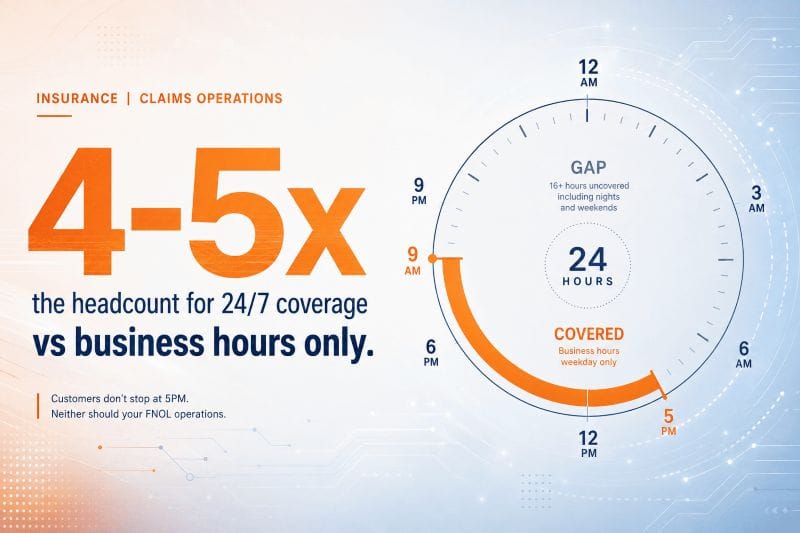
About 15–30% above standard business-hours rates. Evening, overnight, weekend, and holiday staffing all carry differential pay. Many companies use AI for overnight tier-1 coverage to cut this premium.
The Bottom Line
The hourly rate is the easiest number to compare and the least useful.
A $6/hour offshore agent isn’t cheap if hidden costs add 30% and the engagement breaks at month 9. A $45/hour onshore agent isn’t expensive if compliance violations would cost you more than the labor premium.
The real questions aren’t about the rate. They’re:
- What’s the total 3-year cost, hidden fees included?
- What’s the right tier of provider for my engagement size?
- How much of my volume should AI deflect?
- What does my hybrid stack actually need to look like?
Answer those before you compare quotes. The vendors will reward the discipline.