In-House vs Outsourced Inbound Call Center: The Honest Comparison
The “in-house vs outsourced” call center decision gets framed as a cost question in almost every leadership conversation. It isn’t. It’s a decision about control, growth trajectory, risk tolerance, and the specific business you’re actually running — and framing it as cost-only is how teams end up with the wrong model for their situation.
The honest truth: outsourcing wins on cost, speed, and elasticity. In-house wins on control, brand voice ceiling, and organizational learning. Hybrid wins for most companies at most stages. But which specifically fits your business depends on six factors that no vendor pitch will walk through honestly.
This piece is that walkthrough — with the real numbers, the honest trade-offs, and the decision framework that separates the businesses that pick right from the ones that spend two years unwinding the wrong choice.
TL;DR
Outsourcing wins on cost (40-70% savings), speed (30-60 day scaling), elasticity (peak season capacity), and 24/7 coverage economics. In-house wins on control (100% brand voice fidelity vs 85-92% outsourced), organizational learning, and preserving direct customer relationships. Hybrid models — combining in-house core with outsourced volume — are increasingly the right answer for most businesses at $1M-$10M ARR.
The decision framework isn’t binary. Six specific factors determine which model fits: engagement size, growth trajectory, brand voice sensitivity, peak-season concentration, geographic coverage needs, and internal management capability. This piece walks through each factor with the honest math and the honest trade-offs.
What’s the Real Cost Difference Between In-House and Outsourced Call Centers?
In-house call centers cost 40-70% more per agent per year than outsourced offshore delivery when calculated on a fully loaded basis. But the sticker-price comparison hides the more important cost — flexibility.
Here’s the honest fully-loaded cost breakdown for 2026:
| Delivery Model | Cost Per Agent Per Year (USD) | 15-Agent Team Annual Cost |
|---|---|---|
| US in-house | $85,000 – $140,000 | $1.4M – $2.2M |
| UK in-house | $70,000 – $110,000 | $1.1M – $1.7M |
| Australia in-house | $80,000 – $125,000 | $1.2M – $1.9M |
| US outsourced | $60,000 – $110,000 | $960K – $1.7M |
| LATAM outsourced | $45,000 – $72,000 | $720K – $1.15M |
| Philippines outsourced | $30,000 – $48,000 | $480K – $770K |
| India Tier-1 outsourced | $25,000 – $40,000 | $400K – $640K |
| India Tier-2 outsourced | $18,000 – $32,000 | $270K – $480K |
What’s included in “fully loaded” cost:
- Base salary
- Benefits and payroll taxes (~30%)
- Real estate and utilities (~10%)
- Technology and platform costs (~5%)
- Supervision and management overhead (~10%)
- Training and quality assurance (~5%)
- Attrition replacement (varies significantly)
The takeaway: Outsourcing to India Tier-2 delivers approximately 75-80% cost savings vs US in-house for equivalent quality dedicated agents. But the raw cost isn’t the whole story — the more important cost is what happens when your volume changes, which we’ll cover in the elasticity section.
What Are the Pros and Cons of In-House Call Center Support?
In-house wins on control, direct oversight, and organizational learning. It loses on cost, scaling speed, and coverage economics.
The Pros of In-House
- Complete brand voice control. Agents live inside your culture, absorb your product philosophy organically, and represent your voice at 100% fidelity rather than the 85-92% ceiling of outsourced teams
- Direct oversight of every interaction. Team leads can walk the floor, listen to live calls, and coach in real time
- Faster feedback loops between support and product. In-house agents share observations with product managers, engineering, and marketing informally
- Higher-tenured agents. In-house teams often retain agents for 3-5+ years, accumulating deep product knowledge that shows up in resolution quality
- No vendor management overhead. No SLA negotiations, no vendor QA calibrations, no procurement cycles
The Cons of In-House
- 40-70% higher fully-loaded cost per agent than offshore alternatives
- Slower to scale. Adding 15 agents typically takes 90-120 days minimum in the US
- Structurally difficult to provide 24/7 coverage — night-shift premiums add 40-60% to labor cost
- Peak-season capacity requires permanent overhead. Staffing for BFCM peak means carrying that headcount all 52 weeks
- Larger real estate footprint and technology infrastructure
- Higher management overhead per agent — WFM, QA, training, and HR functions all scale with team size
What Are the Pros and Cons of Outsourcing a Call Center?
Outsourcing wins on cost, speed, elasticity, and coverage. It loses on absolute brand voice fidelity, direct oversight, and organizational learning.
The Pros of Outsourcing
- 40-70% cost savings on fully-loaded per-agent basis (India Tier-2 vs US in-house)
- 30-60 day scaling for well-managed engagements — 3x faster than in-house hiring cycles
- 24/7 coverage economics — offshore night-shift is offshore business-hours, no premium pay required
- Peak-season elasticity — 100-200% capacity spikes for 6-10 week windows without permanent headcount
- Certification portfolio access — SOC 2 Type II, ISO 27001, HIPAA, PCI DSS infrastructure without in-house buildout
- Multi-channel delivery consolidation — mature vendors deliver voice, chat, email, and social under one relationship
- Geographic redundancy — multi-site delivery provides BCP resilience most in-house teams can’t match
The Cons of Outsourcing
- CSAT typically drops 3-5 points during 60-90 day transition as the outsourced team ramps
- Brand voice fidelity plateaus at 85-92%, not 100%
- Requires operational scaffolding to preserve quality — CSAT rubrics, weekly QA, escalation paths, agent context tools
- Reduces direct oversight of individual customer interactions
- Vendor management overhead — quarterly business reviews, SLA monitoring, calibration sessions
- Slower feedback loops between support insights and product decisions — vendor teams don’t have hallway conversations with your engineering team
- Reliance on vendor’s business continuity — their operational disruptions become yours
What Are the 6 Decision Factors That Determine Which Model Fits Your Business?
Six specific factors determine whether in-house, outsourced, or hybrid is right for your business. Weigh them honestly.
Factor 1: Engagement Size (Number of Agents Required)
- 1-3 agents: In-house wins. Below the minimum engagement threshold most outsourcing providers require, and founder-led support builds direct relationships that matter at this scale
- 3-5 agents: In-house or specialist outsourcing that supports small starts (Venturesathi, SupportNinja, Boldr). Enterprise BPOs won’t touch this
- 5-25 agents: Outsourcing typically wins on economics. Sweet spot for mid-market BPO relationships
- 25-100 agents: Outsourcing or hybrid. Hybrid gains attractiveness at this scale — dedicated in-house team for escalations + outsourced for volume
- 100+ agents: Hybrid almost always wins. Pure in-house is prohibitively expensive; pure outsourced concentrates too much risk in vendor relationships
Factor 2: Growth Trajectory
- Flat or slow growth: In-house works well. Predictable staffing, deep tenure
- Rapid growth (2-3x agent count per year): Outsourcing wins. In-house hiring can’t keep pace
- Cyclical growth (D2C peak season, tax firms, enrollment cycles): Hybrid wins. In-house handles baseline; outsourced flexes for peaks
- Uncertain growth (Series A-B startups): Outsourcing preserves optionality. Easier to scale down than layoffs
Factor 3: Brand Voice Sensitivity
- Voice IS the product (opinion-led brands, luxury retail, premium services): In-house wins. Outsourcing dilutes the differentiation
- Voice is professionally important (mid-market D2C, SaaS, healthcare admin): Outsourced dedicated teams reach 85-92% fidelity — enough for most
- Voice is procedural (utility billing support, standardized SB banking, insurance FNOL): Outsourcing wins on all dimensions
Factor 4: Peak-Season Concentration
- Flat volume year-round: In-house or steady-state outsourcing works well
- Modest seasonality (20-40% peak vs baseline): Outsourcing with elastic capacity
- Heavy seasonality (>40% of annual volume in a 6-10 week window): Outsourcing wins decisively. In-house peak staffing is uneconomic
Factor 5: Geographic Coverage Requirements
- Domestic business hours only: In-house economical
- Extended hours (evenings + weekends): Outsourcing wins on cost
- 24/7 coverage required: Outsourcing wins decisively — offshore night-shift is offshore day-shift
- Multi-language coverage: Depends on languages — Indian delivery covers English + Hindi + regional; Philippines covers English + Spanish; LATAM covers Spanish + Portuguese; European multilingual usually requires nearshore
Factor 6: Internal Management Capability
- Strong CX leadership + WFM + QA + Training: Either model works. In-house preserves organizational learning
- Growing but incomplete team: Outsourcing lets you defer building these functions internally
- No dedicated CX operations leadership: Outsourcing wins — vendors provide the operational infrastructure you’d otherwise need to hire
When Should You Choose the In-House Call Center Model?
Three scenarios where in-house is worth the higher cost.
Scenario 1: You Have Fewer Than 500 Total Customers
At this scale, founder-led or CX-lead-led voice support builds durable relationships that show up in retention, referrals, and product feedback. The per-call cost is meaningfully higher, but the strategic value is higher too. Outsource only after you cross the point where hand-crafted voice support isn’t structurally possible.
Scenario 2: Voice Interaction IS Your Product
Premium brands where the voice experience is the differentiator — luxury retail, private banking, concierge B2B services, high-end healthcare. If customers chose you specifically because “when I call, I speak to someone who knows me,” outsourcing dilutes exactly what you sold them.
Scenario 3: You Deliver Regulated Advice With Personal Legal Accountability
Medical diagnosis, financial planning, legal counsel — voice interactions that carry professional liability. In these domains, “voice quality” and “professional accountability” are inseparable. Keep the advice-adjacent tier in-house; outsource only the routine layer (appointment scheduling, general policy questions, order status).
When Should You Choose the Outsourced Call Center Model?
Four scenarios where outsourcing structurally wins.
Scenario 1: You Need 5+ Agents and Growing
Below 5 agents, outsourcing minimum engagements often make it uneconomic. At 5+ agents with growth trajectory, outsourced dedicated teams deliver equivalent quality at 40-70% cost savings, freeing capital for product, marketing, or engineering hires.
Scenario 2: You Need 24/7 or Extended-Hours Coverage
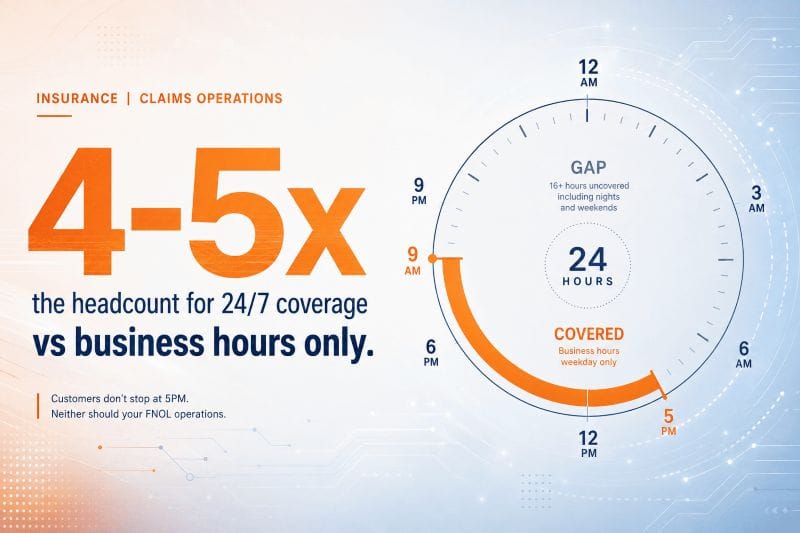
Round-the-clock coverage using in-house teams requires 4-4.5x baseline headcount (shift differentials, weekends, holidays). Offshore delivery in Bhubaneswar, Manila, or Bangalore covers US business hours as a natural night-shift overlap, delivering 24/7 capability at meaningfully lower blended cost.
Scenario 3: You Have Heavy Peak-Season Concentration
If 40%+ of your annual revenue lands in a 6-10 week window (D2C during BFCM, tax firms during Q1, education companies during enrollment, healthcare during Medicare AEP), permanent in-house hires are structurally uneconomic. Outsourced elastic capacity solves this cleaner than any internal model.
Scenario 4: You Lack Internal CX Operations Infrastructure
Building in-house WFM, QA, training, and management infrastructure typically costs $300K-$800K in first-year setup plus $200K-$500K annually. Outsourcing gives you access to that infrastructure without the buildout, letting you defer or avoid the investment entirely.
When Should You Choose the Hybrid Call Center Model?
Hybrid is the right answer for most businesses at $1M-$10M ARR. Three structural patterns work best.
Pattern 1: In-House Escalations + Outsourced Volume
- Small in-house team (2-5 senior agents) handles tier-2/3 escalations and complex accounts
- Larger outsourced team (10-40 agents) handles tier-1 volume — 60-80% of call flow
- Preserves direct control for the sensitive interactions while capturing outsourcing economics for the routine ones
Pattern 2: In-House Business Hours + Outsourced Extended Coverage
- In-house team covers domestic business hours (9am-5pm local)
- Outsourced team covers evenings, weekends, and holidays (2pm-11pm and overnight)
- Common in healthcare, financial services, and premium D2C where “US-based agents” matters during business hours but coverage matters overall
Pattern 3: In-House Enterprise + Outsourced SMB and Consumer
- In-house team dedicated to enterprise and high-value account support
- Outsourced team handles SMB and consumer segment volume
- Aligns cost structure with account value
How Long Does It Take to Transition From In-House to Outsourced?
Realistic transition timeline: 6 months from decision to fully stabilized outsourced operations.
Weeks 1-4: Vendor Selection and Contract Negotiation
- RFP process, vendor pilots, contract signature
- Legal review of DPA, MSA, SLA agreements
- Compliance certifications validated
Weeks 5-12: Onboarding and Ramp
- Knowledge transfer sessions
- Agent hiring and training by vendor
- Platform integration (CRM, telephony, WFM)
- Pilot production runs with limited volume
- CSAT typically drops 5-10 points during this window
Weeks 13-24: Stabilization
- Full production volume shifts to outsourced team
- Weekly QA calibration sessions
- CSAT progressively recovers toward baseline
- By week 20-24, well-managed engagements are within 2 points of pre-transition CSAT
Ongoing: Continuous Improvement
- Monthly business reviews
- Quarterly strategic reviews
- Annual contract adjustments
Faster transitions (under 60 days) almost always skip calibration steps. The savings appear real in month 1 but cost more in month 4-6 when CSAT damage becomes structural.
The Honest Comparison Table
| Factor | In-House | Outsourced | Hybrid | Winner | Why |
|---|---|---|---|---|---|
| Cost per agent per year | $85K-$140K (US) | $18K-$32K (India Tier-2) | $30K-$70K blended | Outsourced | 40-70% cost savings on equivalent quality |
| Scaling speed | 90-120 days | 30-60 days | Depends on split | Outsourced | 3x faster capacity additions |
| Brand voice fidelity | 100% | 85-92% | 90-95% | In-house | Direct oversight preserves the top tier |
| 24/7 coverage economics | High cost | Structural fit | Best of both | Outsourced | Offshore night = offshore day |
| Peak-season elasticity | Requires permanent headcount | 100-200% flex capacity | Best of both | Outsourced | Contractual scaling without severance |
| Organizational learning | Strong | Weak (vendor team) | Moderate | In-house | Direct hallway-conversation loops |
| Management overhead | High (WFM+QA+HR internal) | Low (vendor provides) | Moderate | Outsourced | Access without buildout |
| Direct oversight | Complete | Reduced | Partial | In-house | Real-time coaching, floor presence |
| BCP/geographic redundancy | Single-site risk | Multi-site delivery | Distributed | Outsourced | Geographic distribution built-in |
| Certification portfolio | Requires in-house buildout | Vendor-provided | Depends | Outsourced | SOC 2/ISO 27001/HIPAA without capital investment |
The takeaway: Outsourced wins on 7 of 10 factors. In-house wins on 3 (brand voice fidelity, organizational learning, direct oversight). Which 3-vs-7 count matters depends entirely on your business — this is why the decision isn’t binary.
The Decision Framework Applied
Combining the 6 decision factors and the honest comparison, here’s the practical decision framework:
- If you’re at 1-3 agents: In-house
- If you’re at 3-25 agents with steady growth: Outsourced dedicated
- If you’re at 25-100 agents: Hybrid — in-house escalations + outsourced volume
- If you’re at 100+ agents: Hybrid mandatory — geographic and cost diversification requires it
- If your voice IS your product: In-house core, outsourced only for routine tier
- If you have heavy peak seasonality: Hybrid or pure outsourced with elastic contracts
- If you need 24/7 coverage: Outsourced or hybrid — pure in-house is uneconomic
For a deeper look at what outsourcing preservation actually requires operationally, see how to outsource inbound voice without killing CSAT — the framework side of the same decision.
Frequently Asked Questions
Is it cheaper to have an in-house or outsourced call center?
Outsourced is meaningfully cheaper at nearly every scale — typically 40-70% lower total cost of ownership for offshore delivery. A 15-agent US in-house team runs $1.4M-$2.2M annually fully loaded, versus $250K-$500K for the same team outsourced to India Tier-2 cities. The exception is teams under 3 agents, where in-house founder-led support is often more economical than the minimum engagement thresholds outsourcing providers require.
When should I outsource my call center vs keep it in-house?
Outsource when you need 5+ agents, require 24/7 or extended-hours coverage, have predictable peak volume that makes permanent hires uneconomic, or lack the internal expertise to manage a call center at scale. Keep in-house when your customer base is under 500 total accounts, when voice interaction IS your product, or when you deliver regulated advice with personal legal accountability.
What are the pros and cons of outsourcing a call center?
Pros: 40-70% cost savings, 24/7 coverage, elastic capacity for peaks, faster scaling (30-60 days vs 90-120 days), access to certification portfolio, geographic redundancy. Cons: CSAT typically drops 3-5 points during 60-90 day transition, brand voice fidelity plateaus at 85-92% rather than 100%, requires operational scaffolding to preserve quality, and reduces direct oversight of customer interactions.
What are the pros and cons of in-house call center support?
Pros: Complete brand voice control, direct team oversight, faster feedback loops between support and product, and higher-tenured agents accumulating institutional knowledge. Cons: 40-70% higher cost, slower to scale, structurally difficult to provide 24/7 or peak-season coverage economically, higher management overhead, and larger real estate and technology footprint.
How much does it cost to run an in-house call center in 2026?
Fully loaded in-house call center cost in 2026 runs $85K-$140K per agent per year in the US, accounting for salary, benefits, real estate, technology, supervision, training, and attrition replacement. For a 15-agent US team: $1.4M-$2.2M annually. In the UK: $70K-$110K per agent. In Australia: $80K-$125K per agent. These numbers rise 4-6% annually with wage inflation.
How much does outsourced call center support cost in 2026?
Fully loaded outsourced call center cost in 2026: $18K-$32K per agent per year for India Tier-2 delivery (Bhubaneswar), $25K-$40K for India Tier-1 (Bangalore), $30K-$48K for Philippines, $45K-$72K for LATAM, and $60K-$110K for US-based providers. For a 15-agent team outsourced to India Tier-2: $270K-$480K annually — roughly 65-75% below in-house US cost.
Can I combine in-house and outsourced call center operations?
Yes — hybrid models are increasingly common and often the optimal choice. Typical hybrid structures: in-house team for tier-2/3 complex escalations, outsourced team for tier-1 volume (60-80% of calls); in-house team for US business hours, outsourced team for extended and 24/7 coverage; or in-house team for enterprise accounts, outsourced team for SMB and consumer volume. Hybrid models capture cost savings while preserving direct control for the most sensitive interactions.
The Bottom Line
The in-house vs outsourced call center decision is not a cost question — it’s a strategic question about what you want to control, what you’re willing to trade for cost savings, and what your business actually needs to succeed. Cost matters, but so does scaling speed, coverage economics, brand voice fidelity, and organizational learning.
For most businesses at $1M-$10M ARR, the honest answer is hybrid: keep a small in-house core for escalations and brand-voice-critical interactions, and outsource the tier-1 volume that fills 60-80% of your queue. This structure captures the cost savings while preserving the strategic control that pure outsourcing gives up.
Whichever model you pick, do the math honestly. Model the full 3-year TCO in our BPO ROI calculator, account for the transition costs and CSAT dip in year one, and pressure-test your peak-season assumptions. The businesses that pick right are the ones that model honestly. The businesses that spend two years unwinding the wrong choice are the ones that decided on cost alone.
If your evaluation lands on some form of outsourcing, the next question is which vendors can actually deliver against your standards — and that shortlist is meaningfully shorter than most buyers expect.