Why Cashless Approvals Still Take Hours: Inside the Pre-Authorization Bottleneck
IRDAI says cashless approval should take 60 minutes. Most take 3 hours. Here is why, and the five steps that actually fix it.
by Rohit Gupta | 13th October 2026 | 10 mins read

We build and run pre-authorization desks for Indian health insurers. In every engagement, cashless pre-authorization is the first place we look.
The reason is simple. A patient needs to be admitted. The hospital sends a cashless request to the insurance company. The insurance company has to decide, in writing, whether the admission is covered. The patient, the family, and the hospital staff are all waiting. IRDAI says this decision must happen in 60 minutes. In practice, we find most insurers take 2 to 4 hours when we run the audit.
This piece walks through what we find, how we fix it, and the exact math behind what changes when we are in the room.
What IRDAI Actually Requires
The IRDAI Master Circular on Health Insurance Products, issued in May 2024, is clear:
- Cashless pre-authorization: 60 minutes from receipt of a complete request
- Cashless discharge: 3 hours from receipt of the final bill
- Written reasons for every denial: mandatory
- 100% cashless at network hospitals: the goal
The regulator moved. Operations have not caught up. That is almost always the first finding when we audit a new client.
One technical point we see insurers lean on too much: the 60-minute clock starts only when the request is “complete.” That gives insurers room to pause the clock while asking for missing documents. But when a patient waits 4 hours and the insurer says the clock was paused for 3 of them, that is not a defence to the regulator. The patient still waited 4 hours. We tell every client the same thing. Build the operation for what the patient experiences, not for what the TAT report shows.
Where The Time Actually Goes
A cashless request goes through five stages inside the insurance company:
Stage 1: Document check. Someone looks at what the hospital sent and checks if everything needed is there. Time: 10-30 minutes.
Stage 2: Doctor’s review. A medical reviewer at the insurance company checks whether the admission is medically needed. Time: 15-25 minutes.
Stage 3: Policy check. A benefits team confirms the policy covers the treatment, checks room category limits, co-pay rules, and exclusions. Time: 10-20 minutes.
Stage 4: Questions back to the hospital. If anything is missing or unclear, a query goes back to the hospital. The hospital replies. If something else comes up, another query goes back. Time: 45-75 minutes per round trip.
Stage 5: Final approval letter. Approval or denial is written up, hospital is told, patient is told. Time: 5-15 minutes.
Add these up for a normal case with one round of questions and you get about 2 hours 45 minutes. Add a second round and you cross 4 hours. The IRDAI 60-minute rule only works when there are zero rounds of questions, which almost never happens on day one of an engagement.
When we audit a client’s cashless desk, this is where the finding always lands. The bottleneck is not the doctor. It is the questions.
A Worked Example: A Leading Insurance Company
A mid-sized Indian health insurer. 2 million people covered. 1,200 cashless requests per day. Pre-authorization desk running 24 hours a day across two sites. This is what we usually see when we walk in:
- Median approval time: 2 hours 45 minutes (165 minutes)
- Slowest 10% of cases: 4 hours 30 minutes (270 minutes)
- Share of cases decided within IRDAI 60 minutes: 18%
- Share of complaints caused by slow cashless: 42%
Breaking down the 165-minute median:
- Document check at intake: 25 minutes
- Doctor’s first review: 20 minutes
- Question 1 to hospital (missing lab reports): 60 minutes
- Doctor’s second review: 15 minutes
- Policy check: 10 minutes
- Question 2 to hospital (room category clarification): 25 minutes
- Final approval letter: 10 minutes
- Total: 165 minutes
Two rounds of questions eat 85 minutes. That is 51% of the total approval time.
When we remove one round of questions by catching missing documents earlier, approval time drops to 105 minutes. When we remove both rounds and run the policy check in parallel with the doctor’s review, approval time drops to 55 minutes. Inside the IRDAI 60-minute rule. Without hiring a single new doctor.
That is the whole engagement. The entire fix sits before the doctor ever sees the case, which is why the economics work.
The Five Steps That Fix Cashless Pre-Authorization
These are not theoretical. They are the five things we install, in order, in every cashless pre-authorization engagement we take on.
Step 1: Check documents at the front door
In most desks we audit, incomplete requests go straight to the doctor, who then has to raise questions. This is where most of the delay starts.
What we install: a trained intake team that checks every incoming request within 10 minutes of arrival. The team is not medical staff. They are trained to spot missing items:
- Patient details and policy number
- Treatment plan and diagnosis
- Lab reports and investigation summary
- Hospital bill estimate
- Treating doctor’s notes
If anything is missing, they send one message back to the hospital listing everything missing, not one item at a time.
This alone cuts 60 minutes from the typical case.
Step 2: Train hospitals on what to send
Many hospitals send incomplete requests because they do not know exactly what each insurer needs. We fix this before the insurer loses credibility with them.
What we install: a one-page checklist for every network hospital, sorted by common admission types:
- Diabetes admissions: list of required documents
- Cardiac admissions: a different list
- Maternity admissions: a different list again
Hospitals that follow the checklist get fast approvals. Hospitals that do not get queries. They learn quickly, and the insurer gets the credit for the faster experience.
Step 3: Ask all questions in one message
In most desks we take over, questions go to the hospital one at a time. Doctor asks for a lab report. Hospital sends it. Doctor spots a room category issue. Hospital clarifies. Each round trip is 45 to 75 minutes.
What we install: a short huddle before any query goes out. The doctor and the policy team review the case together and list every possible question in one message to the hospital.
Result: one round of questions instead of two. 45 to 75 minutes saved per case, every case.
Step 4: Run doctor’s review and policy check at the same time
In the desks we audit, the policy check happens after the doctor approves. That adds 10 to 15 minutes at the tail of every case.
What we install: the policy check kicks off the moment the case arrives, in parallel with the doctor’s review. By the time the doctor finishes, the policy mapping is done. The approval letter goes out immediately.
Step 5: Send automatic status updates to everyone
In most engagements we start, the hospital hears nothing until the final letter. The patient and family hear nothing at all. People get anxious. They call customer service. They raise complaints that trace back to silence, not to the approval decision itself.
What we install: automated status messages.
- “Request received” (immediately)
- “Under doctor review” (within 15 minutes)
- “Query raised” (if applicable)
- “Approved” or “Denied with reason” (final)
Sent by SMS to the hospital, patient, and treating doctor.
Even when the actual time is 60 minutes, the perceived wait is halved when people get updates. This is where grievance volume drops first.
What The Math Looks Like After The Fix
This is what the engagement delivers at Northern Shield once the five steps are in place.
- Front-door document check: saves 60 minutes (removes query 1)
- Query batching: saves 25 minutes (removes query 2)
- Parallel policy check: saves 10 minutes
- Peak-hour staffing adjustment: saves 15 minutes
165 minutes – 110 minutes saved = 55 minutes.
Inside the IRDAI 60-minute rule. On the median case. No new technology. No new doctors.
Share of cases decided within 60 minutes moves from 18% to around 85%. Complaints about slow cashless drop sharply. The insurer’s TAT report starts matching what hospitals actually experience, which is the point.
What This Analysis Does Not Cover
We are honest with clients about what the five steps do not solve.
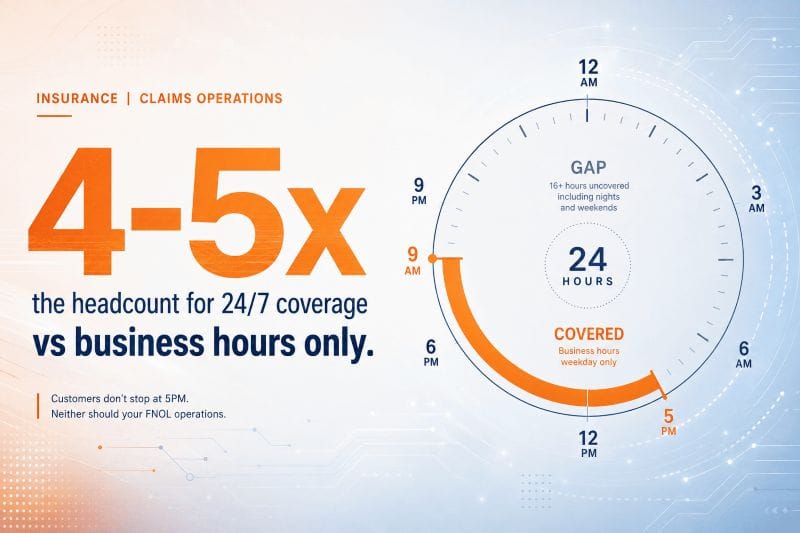
- Weekend and night-shift gaps. The 165-minute median assumes business-hours staffing. Desks with thin night coverage see times double after midnight. The fix for this is a shift design project, not the five steps.
- Catastrophe events. A dengue outbreak or an air pollution spike can push cashless volume to 2-3 times normal in 48 hours. We handle this with surge pods pulled from our other engagements, but it needs to be contracted in the SLA before it happens.
- Complex specialist cases. Oncology, high-value cardiac, and transplant cases need specialist consultation that cannot be rushed below 60 to 90 minutes. We route these through a separate adjudication path. The five steps cover the common case, not the complex case.
For 90% of cashless requests, the five steps are enough. For the complex 10%, we design additional capacity into the engagement.
A 15-point Checklist You Can Run Yourself
This is the scorecard we use when we audit a new client’s cashless desk. We are giving it away because the audit itself is not where our value lives. The redesign is.
Score your own desk. Each item is worth 1 point. 12 or higher means you probably meet the IRDAI 60-minute rule most of the time. Below 8 means you are structurally outside it, and the five steps are built for your situation.
Front-door document check
- Document completeness check runs within 10 minutes of request arrival
- Rejection messages are specific, listing exactly what is missing
- Repeat failures from the same hospital are tracked and escalated
- First-pass completeness rate is measured monthly
Doctor’s review speed 5. Doctor’s median review time is tracked by diagnosis type 6. Doctor utilization is matched to peak-hour volume 7. Simple cases follow a short protocol, not full review
Policy check accuracy 8. Policy database is updated monthly, not quarterly 9. Policy check runs in parallel with doctor’s review, not after 10. Letter correction rate is tracked and reviewed
Question handling 11. All questions for one case go out in one message, not one by one 12. Hospital response time is tracked per hospital 13. Repeat-question rate is under 10%
Communication 14. Hospital gets at least 3 status updates per case 15. Patient gets a status update at approval or denial, with reasons if denied
Take this to your head of claims. If the score surprises you, it is probably correct. If the score matches what you expected and you are still outside 60 minutes on the median, the problem is deeper than the checklist can show, and we should talk.
The Bottom Line
Cashless pre-authorization in India is a problem the regulator has already solved. IRDAI said 60 minutes. Most insurers have not caught up operationally.
The reason is not slow doctors or missing software. It is a broken process at the front door. Incomplete requests reach the doctor. The doctor sends questions. Questions go one at a time. Policy check waits until after the doctor is done. Nobody gets updates. We see this at nearly every insurer we audit, which is why we built the five-step install for exactly this gap.
When we deploy the five steps, median approval time drops from 165 minutes to 55 minutes. Inside the IRDAI rule. No new technology. No new medical hires.
Insurers who partner with us on this see complaints drop, hospital relationships improve, and ombudsman reviews fall. Insurers that keep trying to fix it internally keep paying the cost of 2-4 hour approvals in frustrated patients, repeated complaints, and regulatory risk.
The rule assumes this is possible. We make it so.
Frequently Asked Questions
How long should cashless pre-authorisation actually take?
Under the IRDAI Master Circular on Health Insurance Products (2024), cashless pre-authorization must be decided within 60 minutes of receiving a complete request. Most Indian health insurers take 2 to 4 hours today. The delay almost always comes from back-and-forth questions with the hospital, not from the doctor’s review.
What is the IRDAI rule for cashless pre-authorization?
IRDAI requires a cashless pre-authorization decision within 60 minutes and a cashless discharge within 3 hours. Both rules were set in the IRDAI Master Circular on Health Insurance Products issued in May 2024.
Why do cashless approvals take so long?
Cashless approvals take long because insurance companies send one question at a time back to the hospital. Each round trip takes 45 to 75 minutes. Two round trips add up to 2 hours. The doctor’s actual review takes only 20 minutes.
Can an insurance company outsource cashless pre-authorization?
Yes. The paperwork, document checks, hospital follow-ups, and communication can be outsourced to a specialized BPO. The final medical decision and the approval letter must stay with the insurance company’s own doctors to meet IRDAI governance rules.
What are the five steps that fix cashless TAT?
The five steps are: check documents at the front door, train hospitals on what to send, ask all questions in one message, run policy check and doctor review at the same time, and send automatic status updates. Together these can bring cashless approval under 60 minutes.
Do insurance companies need new technology to fix this?
No. Most cashless delays are caused by process, not technology. Trained intake staff, batched queries, and smart shift planning can bring median approval time under 60 minutes without new software or AI.
If this reads like a diagnosis of your own operation, that is because we have audited enough cashless desks to recognise the pattern on sight. Venturesathi runs cashless pre-authorization desks for Indian health insurers who are done trying to hire their way to the IRDAI 60-minute rule. If you want us in the room, we can help.
About the Author
Rohit Gupta is a Chartered Accountant and the Founder of Venturesathi, on a mission to prove that world-class global operations aren’t defined by geography, but by discipline, systems, and intent.
In 2016, Rohit launched his first BPO in Rourkela, Odisha, mastering the complexities of global delivery from the ground up. Today, he leads Venturesathi, a team of 300+ professionals delivering high-tier CX, software development, and back-office operations that bridge the gap between tier-3 economics and tier-1 execution standards.
With over a decade of experience, Rohit specializes in building “audit-ready” scalable models. His background in finance (ISA) and deep technical expertise in data tools (Power Query, DAX, Automation) allow him to design operations that are as measurable as they are efficient. At Venturesathi, the philosophy is simple: don’t just provide a service, act as a Sathi (partner), helping global clients scale without the chaos.
Connect with Rohit on LinkedIn.