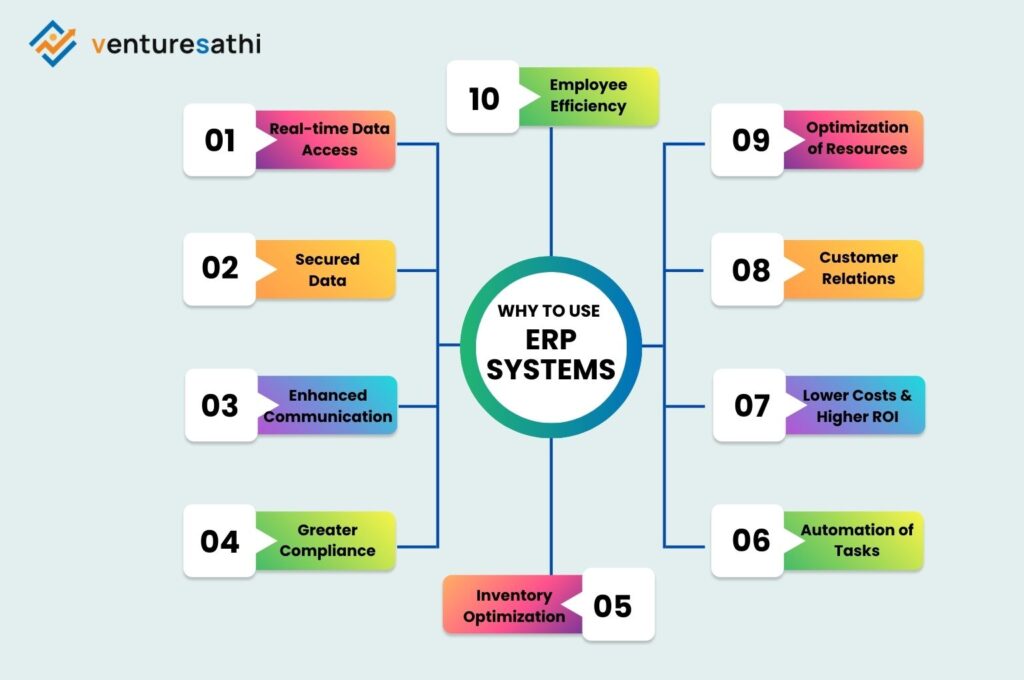
Top ERP Features for Businesses: What Growing Companies Need in 2026
Growth is both an opportunity and a structural challenge. As organizations scale, operations become multidimensional which includes multiple teams, dispersed data, rising transaction volumes, more customers, and increasingly complex workflows. What once worked for a lean team begins to strain under expansion. This fragmentation is exactly why ERP features for businesses matter more than ever.
ERPs consolidate fragmented operations into a unified, intelligent platform, integrating finance, HR, supply chain, CRM, reporting, and workforce systems. For a growing business, choosing the right ERP is no longer optional, it is a strategic investment that unlocks efficiency, agility, and long-term scalability.
Approximately 70% of large enterprises in the USA use ERP software to manage operations. For small and medium-sized enterprises with revenues under $50 million, over 80% rely on ERP systems. Therefore, today’s high-growth organizations from manufacturing to retail to services are increasingly evaluating ERP not just as software but as a foundation for operational excellence.
With this shift, understanding the core ERP features for businesses, advanced capabilities, and ERP scalability becomes mission-critical for leaders driving transformation.
Top 5 Core ERP Features For Businesses
A growing business can’t afford guesswork. As operations expand, small inefficiencies begin to compound, communication gaps widen, and managers lose visibility into what’s really happening across teams. This is where the core ERP features for businesses play a transformative role. A strong ERP system becomes the central nervous system of the organization, streamlining processes, improving accuracy, and enabling teams to collaborate with ease.
These foundational capabilities set the stage for ERP scalability, allowing the business to grow without breaking its operational backbone.
1. Real-Time Reporting Dashboards
In today’s digital-first landscape, data is no longer a byproduct, it’s the operating system of every modern business. Real-time dashboards have evolved into one of the most indispensable ERP reporting features, empowering decision-makers with accurate, live information across every operational layer.
KPI Tracking
Leaders shouldn’t have to wait for weekly reports or end-of-month reconciliations to know how their business is performing. With integrated KPI tracking, an ERP system delivers instant insights into:
- Sales and revenue trends
- Cash flow health
- Inventory turnover cycles
- Employee productivity metrics
- Procurement and vendor performance
This visibility eliminates blind spots and empowers leaders to act before problems escalate.
Operational Visibility
When stakeholders can monitor operations with precision, decision-making becomes proactive rather than reactive. Real-time dashboards provide clarity on daily order flows, stock movement, project progress, and customer updates.
Unlike static spreadsheets, dynamic dashboards adapt instantly to new data. This level of operational awareness reduces risk, improves forecasting accuracy, and strengthens business agility.
2. Inventory and Supply Chain Tools
A growing business thrives on the rhythm of its supply chain. When inventory is mismanaged, the entire operation suffers. Strong ERP features solve this by turning supply chain chaos into a predictable, optimized system.
Stock Automation
Inventory management is no longer about manual stock checks or reactive reordering. With ERP-driven stock automation, businesses gain automatic updates of inventory levels, smart reorder alerts, real-time stock movement tracking, and visibility across warehouses. This eliminates costly errors and ensures product availability without tying up capital in excess inventory.
Order Tracking
End-to-end order tracking is vital for industries like retail, manufacturing, distribution, and e-commerce. A robust ERP system enables businesses to track every order from procurement to delivery, helping teams anticipate delays, manage vendors better, and provide accurate customer updates. This consistency directly supports ERP scalability, as businesses can handle higher order volumes without operational strain.
3. Financial Management
Finance is the language of business and it must be accurate, compliant, and timely for leaders to make sound decisions. ERP financial modules centralize all financial activity, ensuring transparency and control.
Billing & Invoicing
A good ERP automates billing cycles, manages invoicing templates, tracks payments, and reduces human errors. Faster, cleaner billing strengthens cash-flow and accelerates collections.
Expense Controls
Expense tracking becomes effortless with granular categorization, automated approvals, and real-time cost visibility. Leaders can instantly detect cost leaks, monitor department spending, and maintain profitability with confidence.
Financial automation also ensures compliance with tax and regulatory norms, reduces repetitive admin work, and enables more accurate forecasting, an integral part of strategic ERP reporting features.
CRM and Customer Lifecycle Management
Customer expectations have evolved. They expect timely communication, personalized experiences, and smooth engagement at every touchpoint. A CRM embedded inside a modern ERP connects the dots across marketing, sales, finance, and operations, creating a 360° customer view.
Lead Management
From the moment an inquiry comes in, an ERP-integrated CRM tracks the journey—source of lead, interactions, follow-ups, and pipeline movement. This improves conversion rates and ensures no lead slips through the cracks.
Sales Pipeline Visibility
Sales teams get real-time visibility into deal stages, forecasted revenue, conversion probabilities, and team performance. When CRM and ERP share the same database, finance and operations teams also gain instant context, making customer fulfillment and invoicing much smoother.
5. HR and Workforce Tools
As teams grow, HR processes become harder to manage manually. A strong ERP includes HR tools that simplify workforce administration and support organizational growth.
Attendance & Payroll
Automated attendance logs, biometric integrations, and payroll calculations ensure accuracy and compliance. Payroll cycles run faster with fewer errors, and employees enjoy transparent visibility into their compensation.
Employee Records
A centralized employee database stores performance reports, training history, leave balance, skill records, and contractual documents. This makes HR management smoother and more scalable. With these HR capabilities, businesses can confidently expand their workforce without increasing administrative strain, which is another pillar of long-term ERP scalability.
Advanced ERP Features for Businesses Ready to Scale
As businesses grow, the operational demands evolve from basic process management to intelligent automation, predictive insights, and enterprise-grade control. This is where advanced ERP features for businesses step in, transforming a traditional system into a strategic growth engine. For companies preparing for their next stage of expansion, these capabilities define the true meaning of ERP scalability.
1. AI Insights & Forecasting
Over 83% of ERP projects now include AI, with 64% of businesses reporting improved productivity. We’re no longer in an era where ERPs simply store data. By 2026, modern ERP systems function as decision engines powered by AI and machine learning. These predictive layers elevate traditional ERP reporting features into forward-looking intelligence. AI-enabled ERPs help growing businesses by:
- Predicting demand long before bottlenecks appear
- Identifying inventory risks that threaten fulfillment
- Automating procurement suggestions to maintain optimal stock
Forecasting revenue, margins, and cash flow with remarkable accuracy
This shift is transformative. Instead of reacting to reports, leaders can anticipate trends and make proactive decisions. AI-driven forecasting becomes the foundation for ERP scalability, giving businesses the insight they need to expand confidently and sustainably.
2. Workflow Automation
If growth exposes anything, it’s the inefficiency of manual processes. The more humans handle repetitive tasks, the more errors creep in slowing decisions, fracturing workflows, and holding teams back.This is why workflow automation has become one of the most essential ERP scalability features. A future-ready ERP should support:
- Trigger-based actions: Automatic emails, alerts, stock-level notifications, quote approvals so that no human intervention is required.
- Automated approval workflows: Seamless routing of purchase orders, budgets, leaves, and vendor requests.
- Smart task routing & reminders: Ensuring work never stalls because someone missed an update.
Automation doesn’t just boost productivity, it frees teams from low-value tasks so they can focus on growth. It also reduces the operational friction that often prevents scaling businesses from reaching the next level.
3. Role-Based Access & Segmented Visibility
As businesses expand across teams, locations, and functions, security and precision of access become non-negotiable. This is where role-based access emerges as a core pillar of intelligent ERP design. A scalable ERP must ensure:
- Data access is limited to the right people: No more unnecessary exposure of financials, customer lists, or HR data.
- Teams view exactly what they need and nothing more: This means sales sees pipelines, finance sees budgets, HR sees employee records.
- Audit trails remain clean and compliant: Every action is logged, timestamped, and traceable.
This level of segmentation ensures operational integrity as the business becomes more complex. Strong access governance is not optional, it’s foundational to long-term ERP scalability.
Security & Compliance – A Core Requirement for Growing Businesses
As companies scale, security risks grow with more users, more data, more potential vulnerabilities. A modern ERP must support compliance frameworks such as ISO 27001, SOC 2, GDPR, and industry-specific norms like PCI DSS. These safeguards ensure secure data handling, controlled access, encrypted workflows, and fully traceable activity logs. For growing companies, security isn’t optional, it’s a structural requirement that protects both operational integrity and customer trust.
Read more: Driving Exceptional Shopping Experiences Through Smarter Insights
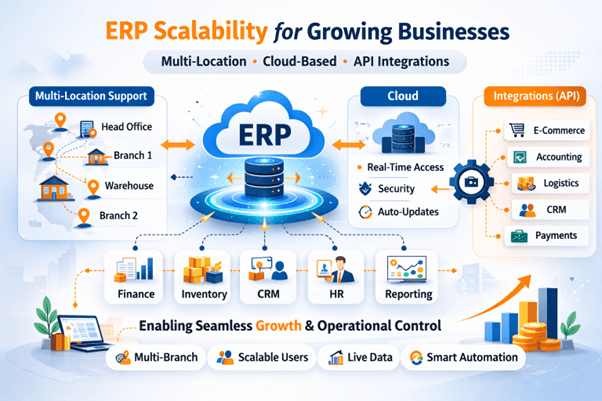
ERP Scalability Essentials – What Growing Companies Must Demand
Every growing business eventually outgrows its tools unless the ERP system is intentionally built for expansion. True ERP scalability is what determines whether your platform will support your next leap or become an expensive bottleneck. Here’s what a future-ready ERP must include:
Multi-Location & Multi-Branch Support
Expansion isn’t just about revenue, it’s about geographical footprint. Your ERP must be capable of supporting multiple cities, warehouses, departments, business units, branches. This ensures consistency across locations and gives leadership unified visibility without forcing teams into fragmented workflows.
Cloud-Native Architecture
A cloud-native ERP is no longer a luxury, it’s the backbone of digital scale. A cloud-first architecture guarantees anywhere, anytime access for distributed teams, zero-hassle updates that keep the system modern, enhanced security with encrypted environments and lower IT infrastructure costs. For businesses adopting hybrid work, multiple warehouses, or remote branches, cloud ERP is the only sustainable choice.
Modular Architecture – Scale Only When You’re Ready
One of the biggest advantages of cloud-native ERPs is modular scalability. Growing companies can begin with essential modules such as finance, CRM, inventory, or HR, and add advanced capabilities only when needed.
This approach ensures no unnecessary features or costs upfront, faster adoption for teams, smooth expansion as operations become more complex, and long-term ERP scalability without system rebuilds. Modular ERPs like Venturesathi allow businesses to scale at their own pace, activating new modules effortlessly as they grow.
API Integration Readiness
In real scaling environments, integrations are survival and not convenience.A modern ERP must integrate with ecommerce platforms, accounting tools, logistics systems, CRM platforms, internal apps, and marketing stacks.This interoperability ensures the ERP becomes the central operating hub rather than another isolated system. API readiness is the hallmark of true ERP scalability, without it, growth becomes slow, manual, and dangerously inefficient.
Modern businesses need ERP features that grow with them, not slow them down. At Venturesathi, we built our ERP solution to give leaders real-time clarity, remove operational silos, and support scalable, sustainable growth.
Top 3 Key ERP Reporting Features to Look For
The real ROI of ERP begins with its reporting capabilities. Strong ERP reporting features turn raw data into strategic clarity. Here’s how:
Custom Reports
No two businesses track performance the same way. Your ERP should allow custom KPIs, tailored dashboards, department-specific insights, configurable data views. This gives teams the freedom to measure what truly matters.
Trend Analysis
Trend analysis transforms your ERP from a record-keeper into a strategic advisor. Look for capabilities that highlight historical performance patterns, seasonal fluctuations, profitability shifts, and emerging risks. Trend-driven insights help leadership anticipate change instead of reacting to it.
Predictive Dashboards
Predictive dashboards blend AI and analytics to provide revenue forecasting, iInventory risk prediction, cost optimization insights, and customer behavior modeling. This is the next frontier of ERP reporting features, turning tomorrow’s challenges into today’s action plan.
Read more: Driving Operational Excellence through Custom ERP for a Mining & Trading Firm in India
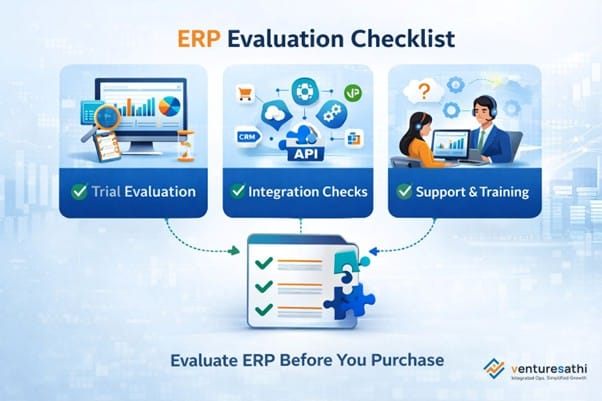
3 Ways to Evaluate ERP Before You Purchase
Choosing an ERP is not just a software decision, it’s an operational blueprint for the next decade. Every growing business should evaluate carefully.
1. Trial Evaluation
Trials reveal what sales demos don’t. Use the trial to assess user interface and ease of navigation, speed of generating reports, workflow intuitiveness, mobile usability, and team adoption readiness. If your team cannot adapt to the ERP quickly, scalability becomes impossible.
2. Integration Checks
Your ERP must fit naturally into your existing tech ecosystem. Verify integrations with your CRM, ecommerce platform, logistics tools, and finance systems.Integration readiness is one of the most critical, yet overlooked, drivers of ERP scalability.
3. Support, Training & Ecosystem
A powerful ERP is only as good as the support behind it. Evaluate onboarding and migration assistance, depth of training resources, customer service responsiveness, frequency of feature updates and product roadmap stability before a purchase decision.
This is where Venturesathi ERP solution excels, offering implementation support, customizable modules, and a constantly expanding integration ecosystem tailored for SMBs and mid-market businesses.
Frequently Asked Questions (FAQs)
1. What are the most important ERP features for businesses that are growing?
The most essential ERP features for businesses include real-time reporting dashboards, inventory and supply chain management, financial automation, CRM integration, and HR tools. These core modules help streamline operations, reduce manual effort, and create a single source of truth for the entire organization.
2. Which ERP reporting features should companies prioritize?
Growing companies should look for ERP reporting features such as customizable dashboards, KPI-driven insights, AI-enabled forecasting, trend analysis, and predictive analytics. These features allow leaders to make faster, data-backed decisions and stay ahead of operational risks.
3. How does ERP scalability impact long-term business growth?
ERP scalability determines how well your system can handle increased data, users, transactions, and multi-location operations. A scalable ERP supports cloud architecture, API integrations, modular expansion, and multi-branch management, allowing the business to grow without system limitations or operational bottlenecks.
4. How do I know if an ERP solution is right for my business?
You should evaluate your ERP by testing the user experience, checking integration readiness, reviewing reporting capabilities, assessing scalability needs, and examining the support ecosystem.
5. Why should small or mid-sized companies invest in ERP instead of manual tools?
Manual tools create silos, increase errors, and limit real-time visibility. An ERP unifies data across departments, automates workflows, enhances reporting accuracy, and improves decision-making. For small and mid-sized companies, ERP features for businesses help build a scalable foundation for sustainable growth.