Travel Back Office Outsourcing: How It Improves Customer Satisfaction in 2026
Customer expectations in travel have never been higher and they’re not forgiving either. In fact, 82% of travelers expect a response within 15 minutes from customer service, making speed and efficiency non-negotiable in today’s experience-driven economy.
This is where many travel brands struggle. Customer experience doesn’t begin and end with a support interaction, it spans booking confirmations, itinerary changes, refunds, and post-trip engagement. Yet, most companies still operate customer support and backend operations in silos. That disconnect creates delays, errors, and frustrated customers.
In this blog you’ll discover how leading brands are solving this in 2026 with integrated operations travel models, where CX back office support works as a single, unified system and how this shift is also driving the rise of travel back office outsourcing not just as a cost-saving tactic, but as a strategic move to improve customer satisfaction.
Why Customer Experience in Travel Is So Complex
Travel is inherently multi-layered, involving several interconnected processes that must work flawlessly together. A single customer journey often includes flight bookings, hotel confirmations, payment processing, and real-time itinerary changes.
Each of these steps depends on both customer-facing teams and backend operations functioning in sync.
When these functions operate in isolation, customers experience friction. Delays in backend processing can slow down responses, inaccurate data can lead to incorrect bookings, and poor coordination forces customers to repeat their issues multiple times. This lack of alignment directly impacts satisfaction and trust.
What Is Travel Back Office Outsourcing and How Does It Work?
Breaking Down the Model
Integrated operations travel refers to a model where customer support and backend operations are aligned into a single workflow. Instead of operating separately, both functions collaborate in real time to deliver faster and more accurate outcomes.
This includes backend processes such as booking management, ticketing, refunds, data verification, and vendor coordination being tightly connected to CX teams.
Why It Matters More in Travel
Travel is highly time-sensitive, and even small delays can significantly impact the customer experience. A refund request is only resolved once backend processing is complete, and a booking update is only confirmed when systems are accurately updated.
This is why CX back office support must function as one unit. When integration is missing, customers feel the lag. When integration is strong, experiences feel seamless and effortless.
Read more: How Travel Companies Can Scale Customer Support Without Hiring During Peak Seasons
How Travel Back Office Outsourcing Improves Customer Experience
Outsourcing both CX and backend operations under a unified model allows travel companies to streamline processes and improve outcomes at scale.
1. Faster Resolution Times
When customer support and backend teams operate in sync, issues are resolved much faster. Agents no longer need to wait for internal updates or escalate requests repeatedly, as they have access to real-time backend information.
This directly reduces wait times and improves responsiveness. In fact, companies leveraging integrated models often see significantly faster turnaround times due to reduced handoffs and improved coordination.
2. Improved Accuracy Across Touchpoints
Accuracy is critical in travel, where even a small mistake can disrupt an entire journey. Integrated workflows ensure that backend processes are standardized, monitored, and quality-checked.
This leads to fewer booking errors, more consistent communication, and improved reliability across all customer touchpoints. As a result, customers experience fewer disruptions and greater confidence in the brand.
3. Seamless Omnichannel Experience
Modern travelers interact across multiple channels, including chat, email, phone, and mobile apps. Integrated CX back office support ensures that customer data is unified and accessible across all these channels.
This means customers do not have to repeat information, and agents can provide context-aware support instantly. According to industry data, 70% of support interactions resolved on the first contact achieve up to 90% customer satisfaction, highlighting the importance of seamless, connected systems.
4. Better Handling of Peak Travel Demand
Travel demand fluctuates significantly during holidays, peak seasons, and major events. Without integration, backend bottlenecks can slow down customer support during these critical periods.
With integrated operations travel models, businesses can scale both CX and backend functions together. This ensures that service quality remains consistent even during high-demand periods, preventing delays and customer dissatisfaction.
5. Enhanced Customer Satisfaction (CSAT)
Ultimately, integration leads to better customer outcomes. When issues are resolved faster, communication is consistent, and processes are accurate, customers are more likely to trust and return to a brand.
Research shows that 82% of travelers are more likely to become brand advocates after a positive experience, while 65% are willing to pay more for better CX.
This clearly highlights how operational efficiency directly impacts revenue and loyalty.
Key Components of a Successful Travel Support Operations Model
For travel back office outsourcing to deliver real value, businesses need to build the right operational foundation that supports both efficiency and seamless collaboration.
1. Unified Technology Stack
A shared technology ecosystem ensures that both CX and backend teams have access to the same real-time data, enabling faster decision-making and smoother collaboration. It also eliminates data silos, reduces duplication of work, and ensures that every customer interaction is backed by accurate, up-to-date information.
2. Cross-Functional Training
Teams that understand both customer interaction workflows and backend processes are more efficient and less dependent on constant escalations. This cross-functional knowledge enables agents to resolve issues more independently, improving response times and delivering a more consistent customer experience.
3. Clear SLAs and KPIs
Defining clear metrics such as response time, resolution time, and accuracy ensures accountability and continuous performance improvement. These benchmarks also help align CX and backend teams toward shared goals, ensuring both functions work together to deliver better outcomes.
4. AI + Automation Integration
Automation helps handle repetitive backend tasks such as data entry and ticket routing, allowing human agents to focus on complex, high-value interactions. When implemented effectively, it also improves speed, reduces human error, and enhances the overall efficiency of integrated operations.
Read more: Travel CX in 2026: How AI + Human Support Is Redefining Customer Experience
Why Travel Companies Are Adopting Integrated Support Operations
The shift toward integrated operations travel is being driven by rising customer expectations and increasing operational complexity.
Today’s travelers expect instant responses, personalized experiences, and seamless journeys across channels. At the same time, travel ecosystems are becoming more fragmented, involving multiple vendors, platforms, and systems.
Companies that fail to integrate CX and backend operations struggle to keep up.
On the other hand, businesses that adopt CX back office support models benefit from faster resolutions, better accuracy, and improved customer satisfaction, giving them a clear competitive advantage.
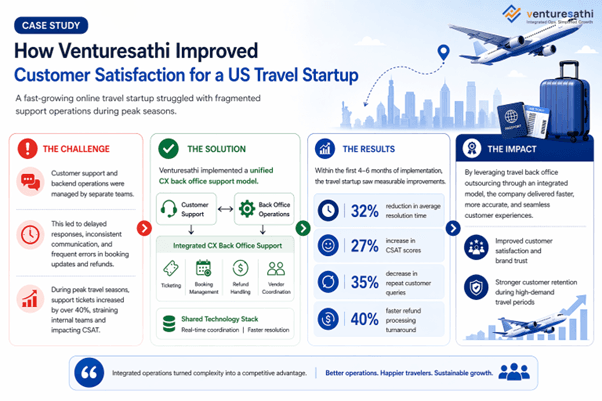
Case Study: How Venturesathi Improved Customer Satisfaction for a US Travel Startup
To understand the real impact of integrated operations travel models, consider the example of a fast-growing US-based online travel startup struggling with fragmented support operations.
The Challenge
The company was managing customer support and backend operations through separate teams, which led to delayed responses, inconsistent communication, and frequent errors in booking updates and refunds. During peak travel seasons, support tickets increased by over 40%, further straining their internal teams and impacting customer satisfaction.
The Solution
Venturesathi implemented a unified CX back office support model by integrating customer support with backend processes such as ticketing, booking management, and refund handling. Dedicated teams were deployed with a shared technology stack, enabling real-time coordination and faster issue resolution.
The Results
Within the first 4-6 months of implementation, the travel startup saw measurable improvements:
- 32% reduction in average resolution time
- 27% increase in CSAT scores
- 35% decrease in repeat customer queries
- 40% faster refund processing turnaround
The Impact
By leveraging travel back office outsourcing through an integrated model, the company was able to deliver faster, more accurate, and seamless customer experiences. This not only improved customer satisfaction but also strengthened brand trust and retention during high-demand travel periods.
Read more: From 20 Seats to 200+: How a Large Travel Tech Company Transformed Its Customer Support Operation
Final Thoughts
Customer experience in travel is no longer just about frontline interactions, it’s about what happens behind the scenes. By aligning customer support with backend operations, travel companies can eliminate delays, reduce errors, and deliver truly seamless experiences.
This is why travel back office outsourcing is evolving into a strategic growth lever. It enables brands to scale efficiently while meeting the rising expectations of modern travelers. In a competitive, experience-driven industry, integration isn’t optional anymore, it’s essential.
FAQs
1. What are the benefits of travel back office outsourcing for customer experience?
Travel back office outsourcing improves customer experience by reducing delays, increasing accuracy in bookings and refunds, and enabling faster resolution times through better coordination with CX teams. It also helps travel companies maintain consistency across touchpoints, ensuring a smoother and more reliable customer journey.
2. How does integrated operations travel reduce customer complaints?
Integrated operations travel minimizes errors and miscommunication by aligning backend processes with customer support, leading to fewer delays, fewer repeat queries, and smoother issue resolution. This alignment ensures customers receive timely updates and accurate information, significantly reducing frustration and complaints.
3. Can small travel startups benefit from CX back office support?
Yes, CX back office support is especially valuable for startups as it helps them scale operations efficiently, manage high ticket volumes, and deliver consistent customer experiences without large in-house teams. It also allows them to focus on growth and core business functions while maintaining high service quality.
4. What processes are included in travel back office outsourcing?
Travel back office outsourcing typically includes booking management, ticketing, refund processing, data entry, itinerary updates, and vendor coordination to support seamless customer interactions. These processes ensure that backend operations run smoothly, directly impacting the speed and quality of customer support.
5. How does AI improve integrated CX and back-office operations in travel?
AI enhances integrated operations travel by automating repetitive tasks, enabling real-time updates, improving ticket routing, and providing insights that help teams deliver faster and more accurate support. It also reduces manual errors and allows support teams to focus on complex, high-value customer interactions.
6. What KPIs should travel companies track for CX back office support?
Key metrics include First Response Time (FRT), Average Resolution Time (ART), First Contact Resolution (FCR), CSAT scores, and backend accuracy rates to measure the effectiveness of CX back office support. Tracking these KPIs helps businesses continuously optimize performance and improve overall customer satisfaction.