AI Contact Center
The Complete 2025 Guide to Automation & Intelligence
Introduction
The contact center industry is experiencing its most significant transformation in decades. What was once a cost center staffed primarily by human agents is rapidly evolving into an intelligent, data-driven powerhouse that shapes customer relationships and drives business growth.
The numbers tell a compelling story. The global AI contact center market reached $2.1 billion in 2024 and is projected to explode to over $100 billion by 2034, growing at nearly 20% annually. More striking still, conversational AI is expected to reduce contact center labor costs by $80 billion by 2026.
But this isn’t just about cost savings. Today’s customers demand instant, personalized support across every channel. They expect businesses to remember their preferences, anticipate their needs, and resolve issues without repeating information. Meanwhile, 61% of contact centers report increasingly emotionally charged customer interactions, making the right mix of humans and AI more critical than ever.
In this comprehensive guide, you’ll discover:
- What AI contact centers are and why they matter more in 2025 than ever before
- The core AI technologies revolutionizing customer service operations
- Real-world use cases showing AI in action across industries
- Practical insights for implementing AI in your contact center strategy
Key Takeaways
Before diving deep, here are the essential insights from this guide:
- Market Momentum: The AI contact center market is experiencing explosive growth, expanding from $2.1 billion in 2024 to a projected $100+ billion by 2034, driven by rising customer expectations and the need for operational efficiency.
- Intelligence Layer: AI serves as the intelligence layer that powers modern customer service through natural language processing, machine learning, predictive analytics, and generative AI capabilities.
- Augmentation Over Replacement: The most successful implementations position AI as an agent’s best tool rather than a replacement, automating repetitive tasks while empowering human agents to handle complex, emotionally charged interactions.
- 24/7 Omnichannel Support: AI enables seamless customer experiences across phone, chat, email, and messaging platforms with consistent quality and instant responses around the clock.
- Cost and Performance Balance: Organizations implementing AI report significant cost reductions while simultaneously improving key metrics like first-call resolution, customer satisfaction scores, and average handle time.
- Technology Stack Evolution: Core AI technologies including NLP, machine learning, speech recognition, and sentiment analysis work together to understand context, predict intent, and deliver personalized experiences at scale.
Outsource Smarter With Venturesathi AI-Driven CX
• Data-Driven Recommendations for CX Teams
• Scalable Support Across Every Channel
Understanding AI Contact Centers
A contact center is the operational hub where organizations manage all customer interactions across multiple communication channels. Unlike traditional call centers that focused exclusively on voice calls, modern contact centers integrate phone, email, chat, social media, messaging apps, and video platforms into a unified customer experience ecosystem.
Contact centers serve as the front line of customer service, handling everything from simple product inquiries and technical support requests to complex problem resolution and sales opportunities. They collect invaluable data about customer needs, preferences, and pain points, making them strategic assets rather than mere support functions. Understanding the role of AI in modern call center solutions is essential for any organization looking to stay competitive.
Why AI Matters in Today’s Contact Centers
The evolution of contact centers mirrors changing customer behavior and technological advancement. What began as phone-only operations measured by basic metrics like call volume has transformed into dynamic environments where digital channels have grown by 6% annually since 2010. Cloud-based infrastructure has replaced on-premise systems, enabling remote work, greater agility, and lower operational costs.
Today’s contact centers face mounting pressure on multiple fronts. Customer expectations have reached unprecedented heights, with 80% of American customers citing speed, convenience, knowledgeable assistance, and friendly service as essential elements of great experiences. At the same time, contact centers grapple with high agent attrition, rising labor costs, and the challenge of delivering consistent quality across an expanding array of channels.
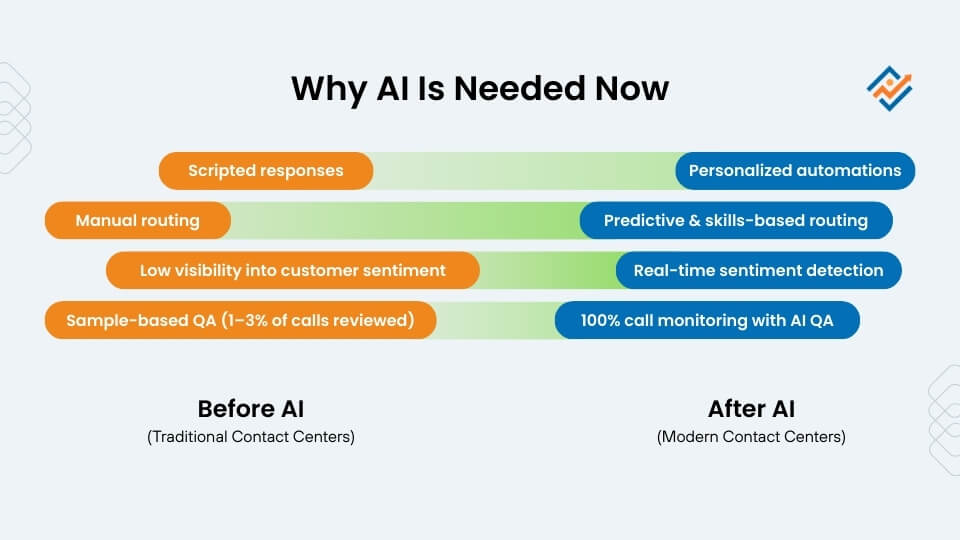
These pressures have created the perfect conditions for AI adoption. Traditional manual workflows and legacy systems simply cannot keep pace with the volume, velocity, and complexity of modern customer interactions. Organizations need technology that can process vast amounts of data in real time, recognize patterns, predict outcomes, and deliver personalized responses instantly—capabilities that artificial intelligence provides.
The contact center’s role has fundamentally shifted. No longer just a reactive support function handling incoming complaints, modern contact centers equipped with AI proactively engage customers, prevent issues before they escalate, identify upsell opportunities, and generate insights that inform product development and business strategy. This transformation from cost center to strategic asset represents one of the most significant shifts in how organizations think about customer service.
Why AI Contact Centers Matter Now More Than Ever
The convergence of technological capability, market forces, and customer behavior has created an inflection point for AI adoption in contact centers. Several powerful trends explain why this transformation is accelerating in 2025 and why organizations can no longer afford to delay AI implementation.
Rising Customer Expectations
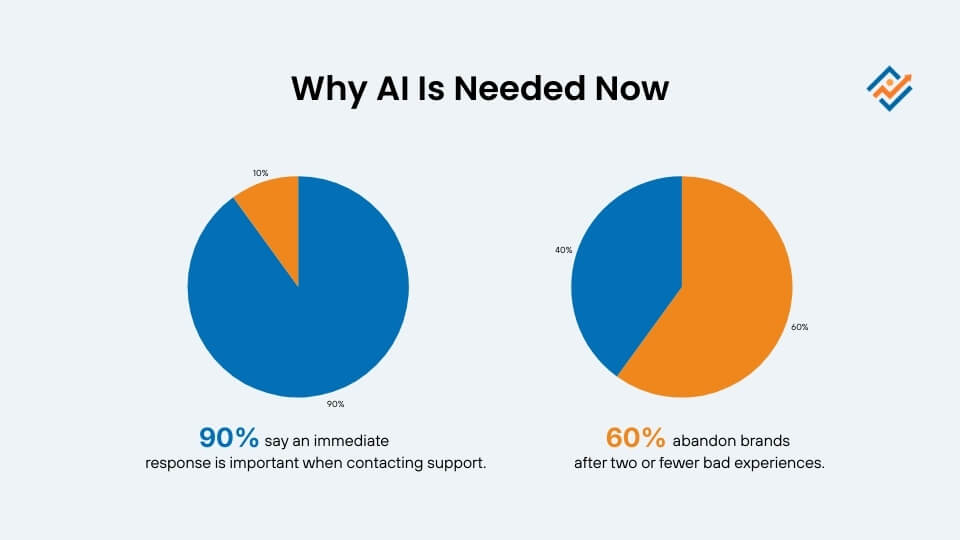
Customers have been trained by consumer technology giants to expect instant, personalized service. When Amazon delivers packages in hours and Netflix recommends content with uncanny accuracy, customers naturally expect similar experiences from every business they interact with. A staggering 73% of customers prefer solving issues independently through self-service options, yet they also expect seamless escalation to human agents when needed. This paradox wanting both independence and immediate human support—can only be resolved through intelligent automation that knows when to assist and when to transfer. Organizations are increasingly leveraging AI for hyper-personalization to transform customer experiences.
Economic Pressure and Labor Challenges
Contact centers face persistent labor shortages and rising wage costs. Only 48.3% of agents report they have no plans to leave their jobs within a year, with the rest either actively considering departure or uncertain about staying. Attrition remains a widespread problem, with only 23.4% of contact centers reporting it’s not an issue. Traditional approaches to staffing simply cannot keep pace with demand. AI provides a solution by automating routine inquiries, reducing the workload on human agents, and allowing organizations to do more with fewer resources while improving agent satisfaction by eliminating repetitive tasks. Understanding how to adapt to AI in contact centers is crucial for modern workforce management.
Omnichannel Complexity
Customers no longer confine themselves to a single communication channel. They start conversations on social media, continue them via email, and expect seamless transitions to phone support—all without repeating information. Yet 56% of customers still report being asked to repeat themselves during support interactions, highlighting a critical gap. Managing this omnichannel complexity requires systems that can track context across platforms, maintain conversation history, and provide agents with complete customer views. AI powers these capabilities through intelligent routing, unified customer profiles, and contextual awareness.
Data Explosion and Insight Generation
Contact centers generate massive volumes of interaction data daily. Without AI, this data remains underutilized, representing missed opportunities for improvement. Modern AI systems analyze every conversation, identify emerging trends, detect customer sentiment, predict churn risk, and surface coaching opportunities automatically. Organizations leveraging AI for analytics gain competitive advantages through faster problem identification, more targeted agent training, and data-driven decision-making about products, policies, and processes.
Competitive Differentiation
In markets where products and pricing have reached parity, customer experience becomes the primary differentiator. Companies that deliver superior support experiences build loyalty, reduce churn, and command premium pricing. Early AI adopters report significantly better outcomes across customer satisfaction, operational efficiency, and business growth metrics. The debate around AI vs. human agents in customer service shows that the right balance drives superior results. Learn more about the key AI contact center technologies and trends shaping 2025.
Technological Maturity
AI technology has reached a level of sophistication and accessibility that makes implementation practical for organizations of all sizes. Natural language processing now understands context and nuance, not just keywords. Machine learning models train on real interaction data to continuously improve. Cloud platforms eliminate the need for massive infrastructure investments. The barrier to entry has dropped dramatically, making 2025 the ideal time for organizations to embrace AI-powered contact center capabilities.
Regulatory and Security Requirements
Industries handling sensitive customer data face increasingly strict compliance requirements. AI systems help contact centers meet these standards by automatically redacting sensitive information, monitoring for compliance violations, ensuring consistent policy application, and generating audit trails. As regulations tighten globally, AI becomes essential for maintaining compliance at scale.
The question is no longer whether to adopt AI in contact centers, but how quickly and strategically organizations can implement it. Those who move decisively will reap first-mover advantages in customer satisfaction, operational efficiency, and competitive positioning.
Core AI Technologies Powering Modern Contact Centers
AI-powered contact centers rely on a sophisticated stack of interconnected technologies, each serving specific functions while working together to create seamless, intelligent customer experiences. Understanding these core technologies helps organizations make informed decisions about implementation and optimization.
Natural Language Processing (NLP)
Natural Language Processing enables machines to understand, interpret, and generate human language in ways that feel natural and contextually appropriate. Rather than relying on rigid scripts or keyword matching, NLP systems comprehend intent, recognize entities, extract meaning from conversational context, and even detect subtle nuances like sarcasm or urgency.
Where NLP is deployed:
Chatbots and virtual assistants use NLP to interpret customer questions in any form and match them to the correct intent for fast, accurate responses. Discover how AI chatbots are transforming customer service in 2025.
Email and chat routing relies on NLP to read incoming messages, understand their topic and urgency, and automatically direct them to the right teams. Organizations are also implementing voice-based GenAI in customer service for enhanced interaction quality.
Voice-based systems apply NLP to convert speech into text, understand natural conversation, and enable IVRs where customers can simply speak instead of navigating menus.
Knowledge bases leverage NLP to understand the intent behind a query and deliver the most relevant articles even when the keywords don’t fully match.
Machine Learning (ML)
Machine Learning algorithms enable systems to learn from data, identify patterns, and improve performance over time without explicit programming for every scenario. Unlike rule-based systems that require manual updates, ML models train on historical interaction data and continuously refine their accuracy and effectiveness.
Where NLP is deployed:
Predictive routing uses ML to match customers with the best agents by analyzing history, issue type, skills, and workload, improving resolution rates and balancing teams.
ML-powered quality assurance evaluates every interaction—not just small samples—to spot coaching needs, compliance risks, and performance patterns automatically.
Workforce management relies on ML forecasting to predict contact volumes using historical trends, seasonality, and external events, enabling accurate staffing and lower labor costs. Learn how to leverage predictive analytics and AI to forecast customer needs.
Churn prediction models flag customers likely to leave based on behavior and sentiment, allowing proactive retention outreach.
Recommendation engines use ML to suggest relevant products or solutions based on customer profiles and interaction history, driving personalized upsell and cross-sell opportunities.
Speech Recognition and Analytics
Speech recognition technology converts spoken language into text with high accuracy, while speech analytics extracts meaningful insights from voice interactions. These capabilities are essential for contact centers where voice remains a primary channel despite digital growth.
Where speech recognition is deployed:
Real-time transcription converts live calls into text, enabling instant agent assist, compliance checks, and quick reference during long conversations. Explore how real-time agent assist empowers your team.
Post-call analytics reviews recorded calls to surface key topics, customer feedback, competitive mentions, and process issues that would be impossible to manually analyze at scale.
Voice biometrics authenticate customers using their unique voice characteristics, reducing verification time and improving fraud prevention.
Accent and dialect recognition helps systems understand diverse speech patterns, improving accuracy and accessibility for all customers.
Agent coaching tools analyze tone, pace, silence, and overtalk to deliver objective feedback that improves communication skills.
Sentiment Analysis
Sentiment analysis uses AI to identify and interpret emotions, attitudes, and satisfaction levels expressed in customer communications. By understanding not just what customers say but how they feel, organizations can respond more appropriately and identify problems before they escalate. For a deeper dive, read our complete guide to AI sentiment analysis for contact centers.
Where sentiment analysis is deployed:
Real-time agent assist uses sentiment signals to detect rising frustration or improving mood, helping agents adjust conversations or escalate when needed.
Quality monitoring adds sentiment scores to evaluations, highlighting effective recovery moments and challenging interactions.
Survey analysis processes open-ended feedback at scale, grouping comments by sentiment and uncovering key themes.
Social media monitoring tracks brand sentiment across platforms to flag risks, emerging issues, and engagement opportunities.
Customer journey mapping combines sentiment across touchpoints to pinpoint experience breakdowns and moments that drive strong emotional impact.
Getting Started: How to Implement AI in Your Contact Center
Organizations looking to implement AI should start with a strategic approach. First, identify specific pain points—whether it’s high call volumes, low first-call resolution, or agent burnout. Then learn how to automate your contact center with AI and RPA to address these challenges systematically.
When evaluating solutions, consider reviewing AI-powered contact center software platforms to find the right fit for your organization’s size, budget, and technical requirements. Many organizations are also exploring whether AI will replace BPOs or create a human-AI hybrid future for customer experience.
Remember, successful AI implementation isn’t just about technology—it’s about preparing your team for change, providing comprehensive training, and creating a culture where AI and humans work together effectively. Questions like why companies outsource their contact centers in 2025 often lead to discovering AI-powered solutions. Stay updated on the most important AI technology trends for contact centers to ensure your strategy remains competitive.
Conclusion
AI is reshaping contact centers beyond traditional automation, helping organizations deliver faster, more personalized, and more efficient customer experiences. With AI now a core part of modern CX infrastructure, early adopters are seeing clear gains in operational performance, data-driven decision-making, and customer satisfaction.
The strongest results come from combining AI with human strengths. While AI handles repetitive tasks, analysis, and real-time support, human agents bring empathy, judgment, and emotional understanding that technology cannot replicate. This partnership creates a balanced model where both technology and people contribute to better outcomes.
For organizations starting this journey, the best approach is to focus on targeted, high-impact use cases and support them with clear communication, training, and change management. By building early wins and preparing teams for collaboration with AI, businesses set the foundation for long-term success as capabilities continue to evolve and customer expectations rise.
Frequently Asked Questions
An AI contact center uses automation, NLP, and ML to streamline customer service tasks. It improves personalization, speeds up responses, and supports 24/7 omnichannel interactions. Agents get real-time assistance and automated QA for better performance.
No. AI augments rather than replaces agents. AI handles repetitive tasks while humans provide empathy and creative problem-solving. With 61% of contact centers reporting more emotionally charged interactions, human agents remain essential for complex situations.
Pricing ranges from a few thousand dollars monthly for mid-market platforms to enterprise solutions starting higher. ROI comes from reduced workload, lower costs, and better retention. Many organizations see 3–8x returns.
Smaller deployments like chatbots or QA take 3–6 months. Full-scale AI transformations usually take 9–18 months. Continuous tuning improves performance over time.
Begin with a clear use case like virtual agents or automated QA. Assess data readiness and evaluate vendors with proven expertise. Start with a pilot, measure results, and scale gradually.