
Motor Claims and the Surveyor Gap: How Documentation Decides Your TAT
IRDAI has put a clock on every stage of a motor claim. In my experience, whether insurers beat that clock is decided long before the surveyor arrives.
by Rohit Gupta | 24th November 2026 | 13 mins read
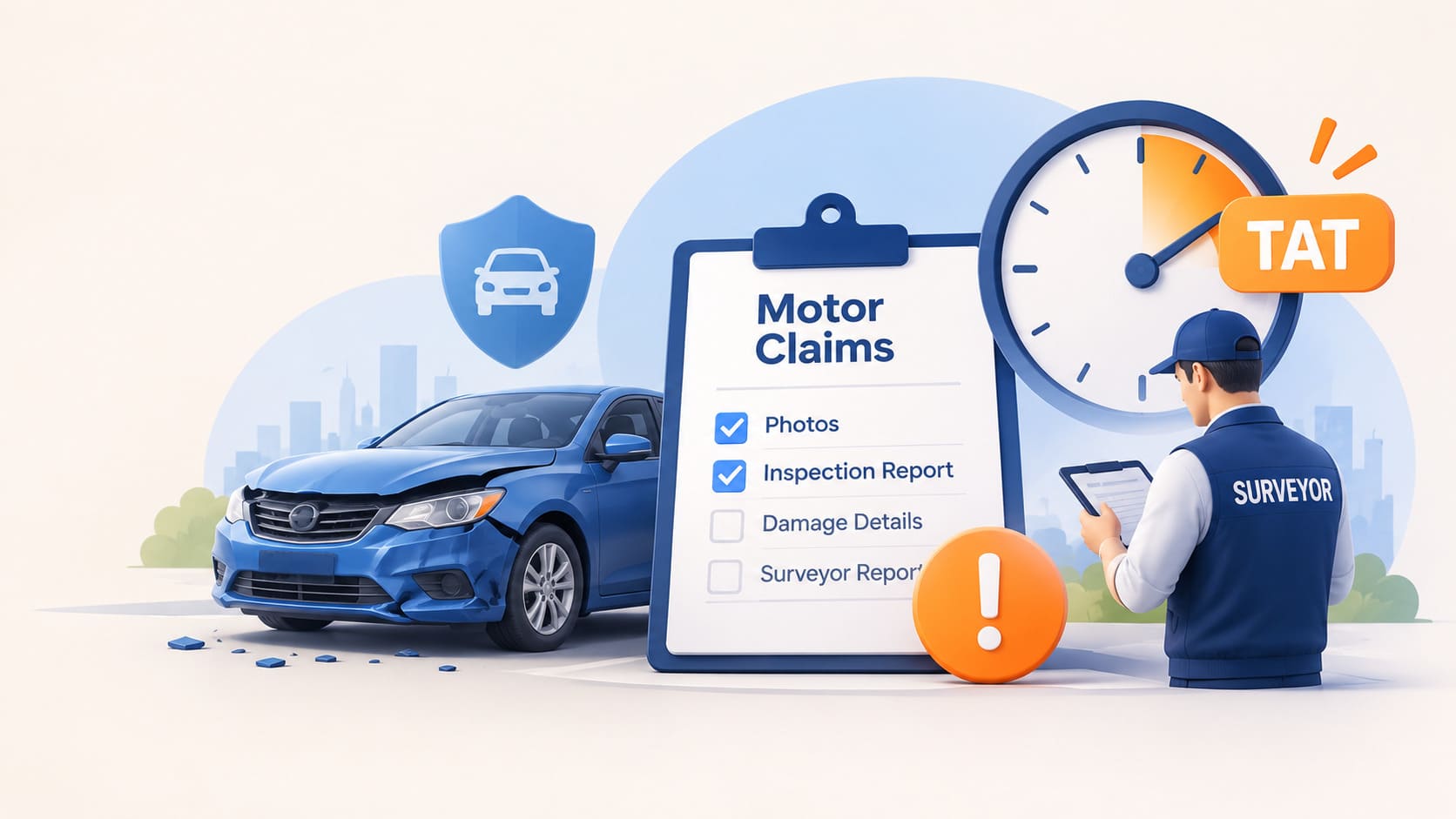
Motor insurance generates more complaints than almost any other line. Motor accounted for 26.18% of all complaints received by IRDAI in FY24, and 24.8% in FY25. Behind most of those complaints is one simple frustration: the customer’s car is sitting in a garage, and nobody can say when the claim will be settled.
The clock IRDAI has set
IRDAI’s 2024 master circulars tightened the motor claims process considerably. A surveyor must now be allotted within 24 hours of a claim being reported, through the General Insurance Council’s technology platform. The surveyor must submit the report within 15 days of allotment, and if it is late, a penalty of Rs 500 per day is payable to the claimant. The insurer must then decide the claim within 7 days of receiving the report.
The old rules gave insurers far more room: 72 hours to appoint a surveyor, 30 days for the final report and 30 days to settle. The new clock is much shorter, and the penalty is paid to the customer, which makes every delay visible.
IRDAI also said customers can only be asked for documents directly related to the claim, and that claims should not be rejected for lack of documents. That puts the burden on insurers to get documentation right, not on customers to keep sending more.
Where the time actually goes
When we look inside motor claims operations, the surveyor is rarely the real bottleneck. The gap is almost always documentation.
A typical delayed claim looks like this. The customer reports the accident. A surveyor is allotted on time. The surveyor visits the garage, but the repair estimate isn’t ready. A week later the estimate arrives, but the driving licence copy is unclear and the registration certificate is missing. The garage opens the car further and finds more damage, so a supplementary estimate is needed and the surveyor has to inspect again. By the time everything is in place, the 15 days are gone, and the 7-day decision window starts from a report that should have been ready a week earlier.
Each step looks small. Together they turn a two-week claim into a six-week one.
The documents that decide your TAT
In most motor own-damage claims, turnaround depends on a handful of items being right the first time:
- Claim intimation details: date, time, place and a clear description of how the accident happened
- Photos of the damage: taken at the spot or on arrival at the garage, before any dismantling
- Registration certificate and driving licence: clear, valid copies that match the policy and the driver
- Repair estimate from the garage: itemised, with parts and labour separated
- FIR or police report: where required, such as theft, third-party injury or major accidents
- Final repair invoice and payment details: for settlement, along with bank account details for reimbursement claims
None of these is complicated. The problem is that they arrive from three different places, the customer, the garage and sometimes the police, at three different times. And nobody is responsible for pulling them together before the surveyor needs them.
Fix the start of the claim, not the end
The insurers that consistently meet IRDAI’s timelines do one thing differently: they treat the first 24 hours of a claim as the most important.
Collect documents at intimation. The moment a claim is reported, the customer should get a clear, simple list of what is needed for their type of claim, with a way to upload it immediately. Our piece on FNOL in insurance explains why those first minutes shape the rest of the claim.
Check for completeness before the surveyor goes. A document desk should confirm that the RC, licence, photos and estimate are present and readable before the survey is scheduled. A surveyor who visits an incomplete file is a surveyor who will visit again.
Work the garage, not just the customer. In cashless claims, the garage controls the estimate and the repair timeline. Network garages need clear standards for estimates, photos and supplementary claims, and someone tracking them daily.
Use digital survey where the rules allow it. For motor losses below Rs 50,000, IRDAI does not require a survey by a registered surveyor. That makes app-based self-inspection and video survey practical for small claims, freeing surveyors for the complex ones.
Track the claim against the clock, stage by stage. Every claim should show how much of its 15-day survey window and 7-day decision window has been used, with alerts before deadlines are missed, not after.
Speed without opening the door to fraud
Faster claims must not mean looser claims. Motor is also one of the most fraud-prone lines, from inflated estimates to staged accidents and surveyor-garage collusion. Good documentation helps here too: time-stamped photos, location data and consistent records make fraud harder to hide. Our piece on insurance fraud in India covers the patterns worth watching.
The question for leaders
The question I would put to any motor claims head is simple: how many of your surveys happen on a complete file?
If the answer is “we don’t know”, that is where your turnaround time is being lost.
At Venturesathi, we run claims support operations that collect, check and chase documentation from the first hour of a claim, so surveyors and claims teams can work within IRDAI’s timelines. If that’s what you need, we can help.
Frequently Asked Questions
What are IRDAI’s timelines for motor insurance claims?
Under IRDAI’s 2024 master circulars, a surveyor must be allotted within 24 hours of a claim being reported, through the General Insurance Council’s technology platform. The surveyor must submit the report within 15 days of allotment, and the insurer must decide the claim within 7 days of receiving the report. If the survey report is delayed, a penalty of Rs 500 per day is payable to the claimant.
Is a surveyor required for every motor insurance claim?
No. Under IRDAI’s Master Circular on Protection of Policyholders’ Interests 2024, motor losses below Rs 50,000 do not need to be surveyed by a registered surveyor. Insurers can use other methods, such as app-based or video inspection, for these claims.
What documents are needed for a motor insurance claim?
A typical motor own-damage claim needs claim intimation details, photos of the damage, the registration certificate, the driving licence, an itemised repair estimate, an FIR where required, the final repair invoice and payment details. IRDAI says customers should only be asked for documents directly related to the claim.
Why do motor insurance claims get delayed?
Most delays come from documentation rather than the surveyor. Missing or unclear documents, late repair estimates, supplementary estimates after further damage is found and repeat inspections all push the survey report past its deadline. Collecting and checking documents at the start of the claim is the most effective way to reduce turnaround time
About the Author
Rohit Gupta is a Chartered Accountant and the Founder of Venturesathi, on a mission to prove that world-class global operations aren’t defined by geography, but by discipline, systems, and intent.
In 2016, Rohit launched his first BPO in Rourkela, Odisha, mastering the complexities of global delivery from the ground up. Today, he leads Venturesathi, a team of 300+ professionals delivering high-tier CX, software development, and back-office operations that bridge the gap between tier-3 economics and tier-1 execution standards.
With over a decade of experience, Rohit specializes in building “audit-ready” scalable models. His background in finance (ISA) and deep technical expertise in data tools (Power Query, DAX, Automation) allow him to design operations that are as measurable as they are efficient. At Venturesathi, the philosophy is simple: don’t just provide a service, act as a Sathi (partner), helping global clients scale without the chaos.
Connect with Rohit on LinkedIn.
Related Reading on Venturesathi
- FNOL Insurance 2026: Why Mid-Market Can’t Afford 24/7
- Insurance Fraud in India: Six Patterns and the Controls That Catch Them
- Why Cashless Approvals Still Take Hours: Inside the Pre-Authorization Bottleneck
- Closed, Not Resolved: Why Template Responses Generate Repeat Complaints
- Banking & Financial Services (Service Page)