
Using Customer Data Platforms (CDPs) to Improve CX
Customer experience today is only as strong as the data behind it. According to a survey, inconsistent customer experience (CX) frustrates 65% of consumers, often driving them to competitors. Yet most organizations still operate with fragmented customer data spread across multiple systems such as CRM, marketing tools, support platforms, and analytics dashboards.
Thus, traditional systems were not designed for customer data integration at scale. As a result, businesses struggle to unify data in real time and act on it effectively. In this blog, you’ll discover why a customer data platform (CDP) is imperative for enabling true customer data unification and powering seamless, data-driven CX and how businesses can kickstart this journey to gain a competitive advantage.
What Is a Customer Data Platform and Why It Matters
A customer data platform is a centralized system that collects, unifies, and activates customer data from multiple sources to create a single, persistent customer profile.
Understanding Customer Data Platform Architecture
A robust customer data platform architecture is built on three core layers, which includes:
- Data Ingestion Layer: This layer collects data from multiple sources such as websites, apps, CRM systems, and third-party tools.
- Identity Resolution Layer: This is the next layer that matches and merges data points to create a unified customer profile across channels.
- Activation Layer: This final layer enables businesses to use unified data for marketing, personalization, and customer engagement.
This architecture allows organizations to achieve true customer data unification, ensuring consistency across all touchpoints.
Customer Data Platform (CDP) vs CRM: Key Differences
Understanding CDP vs CRM is critical for CX leaders looking to build a truly data-driven customer experience strategy.
| Aspect | CRM (Customer Relationship Management) | CDP (Customer Data Platform) |
|---|---|---|
| Core Purpose | Operational tool for managing customer interactions | Analytical and activation platform for customer data |
| Primary Function | Manages sales pipelines, relationships, and communication | Unifies customer data and enables data-driven activation |
| Data Usage | Focused on structured, interaction-based data | Combines data from multiple sources for a single customer view |
| Key Benefit | Improves sales and customer relationship management | Enables personalization and advanced customer insights |
| Role in Business | Execution (sales workflows, customer interactions) | Intelligence (data unification, insights, personalization) |
| How They Work Together | Executes engagement strategies | Powers those strategies with unified data and insights |
Common Customer Experience Challenges For Businesses
The top 3 CX challenges include:
1. Disconnected Customer Journeys Across Channels
Without unified data, customers experience inconsistent messaging across channels, leading to confusion and reduced engagement. For example, a customer may receive irrelevant promotions despite recent interactions, breaking the continuity of the experience and weakening brand trust.
2. Limited Personalization Due to Data Silos
When data is siloed, businesses cannot deliver personalized experiences in real time, impacting conversion and retention. This often results in generic communication that fails to resonate with customer needs, ultimately reducing engagement and lifetime value.
3. Inefficient Customer Data Integration Across Systems
Manual data integration processes slow down decision-making and create delays in customer engagement. These inefficiencies not only increase operational overhead but also prevent teams from acting on insights quickly, limiting the ability to deliver timely and relevant experiences.
Customer experience is no longer driven by intuition, it is driven by data. Businesses that unify and activate their data effectively will lead the next era of CX
How Customer Data Platforms Improve Customer Experience
With 73% of consumers stating customer experiences influence their purchasing decisions, it is evident that designing a unified CX for consumers is the need of the hour for businesses. A well-implemented customer data platform transforms CX from reactive to proactive by enabling real-time insights and action. Here’s how:
Enabling Real-Time Customer Data Unification
CDPs create a single customer view by combining behavioral, transactional, and demographic data across multiple touchpoints. This ensures consistency and accuracy in every interaction, regardless of channel or device. As a result, businesses can eliminate data discrepancies and respond to customer actions in real time, creating a seamless and connected experience.
Driving Personalization at Scale
With unified data, businesses can segment audiences dynamically and deliver highly targeted campaigns that align with individual preferences and behaviors. This level of personalization goes beyond basic segmentation, enabling real-time recommendations, contextual messaging, and journey-based engagement. As a result, organizations see improved engagement, higher conversion rates, and stronger customer loyalty.
Improving Decision-Making with Unified Data
Leadership teams gain access to real-time, unified insights that provide a complete view of customer behavior and performance across channels. This enables faster and more informed decision-making, reducing reliance on fragmented reports or delayed data. Ultimately, it strengthens the overall data-driven CX strategy by aligning business decisions with accurate, actionable insights.
Read more: How a Customer Experience Strategy Impacts Revenue, Customer Retention, and Brand Loyalty
Step-by-Step Approach to Implementing a Customer Data Platform
Here’s a detailed step-by-step approach to help CX leaders seamlessly implement a customer data platform into their workflow:
1. Assessing Existing Customer Data Sources
Identify all data sources across marketing, sales, and support systems, including websites, mobile apps, CRM platforms, and third-party tools. Evaluate data quality, identify duplication or inconsistencies, and map out gaps in data collection. This step helps establish a clear foundation for effective customer data unification and ensures that critical insights are not lost during integration.
2. Designing Scalable Customer Data Platform Architecture
Define how data will flow across systems, from ingestion to activation. Ensure the architecture supports scalability, real-time processing, and compliance requirements such as data privacy regulations. A well-designed architecture should also account for future growth, allowing businesses to add new data sources and channels without disrupting existing workflows.
3. Integrating Systems for Seamless Data Flow
Connect the CDP with CRM systems, marketing automation platforms, analytics tools, and customer support systems to enable seamless customer data integration. Focus on creating real-time or near real-time data pipelines to eliminate delays. Proper integration ensures that all teams have access to consistent, up-to-date customer information across functions.
4. Activating Data Across Marketing, Sales, and Support
Use unified data to power personalized campaigns, improve sales interactions, and enhance support experiences. This includes enabling real-time segmentation, triggering automated workflows, and delivering context-aware communication across channels. Effective data activation ensures that insights are translated into meaningful customer interactions that drive engagement and business outcomes.
Top 3 Benefits of Customer Data Platforms for Businesses
The key benefits of implementing customer data platforms for organizations include:
1. Improved Customer Retention and Loyalty
Studies show that quick resolution to problems makes customers 2.4 times more likely to stick with a brand. Thus, unified data enables consistent and personalized experiences across every touchpoint, which is critical for building trust and long-term relationships. When customers receive relevant communication and seamless interactions, they are more likely to stay engaged and loyal. Over time, this leads to higher lifetime value and reduced churn, making retention a predictable growth lever.
2. Enhanced Marketing ROI through Better Targeting
Accurate segmentation powered by unified data allows businesses to target the right audience with the right message at the right time. This significantly improves campaign performance by increasing conversion rates and engagement. At the same time, it reduces wasted spend on irrelevant audiences, ensuring that marketing budgets are utilized more efficiently and deliver measurable returns.
3. Operational Efficiency via Customer Data Integration
Centralized data and automation eliminate the need for manual data handling and reconciliation across systems. This reduces errors, speeds up workflows, and allows teams to focus on higher-value activities. Improved cross-functional collaboration ensures that marketing, sales, and support teams operate with the same data, leading to faster execution and more aligned decision-making.
Top Tools and Technologies for Customer Data Platforms
Selecting the right customer data platform (CDP) is critical to successfully executing a data-driven CX strategy. The effectiveness of your CDP depends not only on its core capabilities but also on how well it integrates with your existing ecosystem.
Popular Customer Data Platform Solutions
Leading CDP tools are designed to enable customer data unification, real-time activation, and scalable personalization. Below is a comparison of widely used platforms:
| Tool | Best For | Key Capabilities | Ideal Use Case |
|---|---|---|---|
| Segment | Data collection & integration | Real-time data ingestion, strong API ecosystem, easy integrations | Mid-sized businesses looking for quick CDP deployment |
| Tealium | Enterprise data orchestration | Tag management, real-time data streaming, audience segmentation | Enterprises with complex data environments |
| Adobe Real-Time CDP | Advanced personalization | AI-driven insights, real-time segmentation, deep Adobe ecosystem integration | Large enterprises focused on omnichannel CX |
These platforms provide a strong foundation for building a scalable customer data platform architecture, enabling organizations to unify and activate data across channels effectively.
Integration with CRM and Marketing Automation Tools
A CDP does not operate in isolation. Its true value is realized when it integrates seamlessly with CRM systems, marketing automation platforms, analytics tools, and customer support systems.
By connecting these systems, businesses can:
- Ensure consistent and real-time customer data integration across departments
- Enable marketing, sales, and support teams to work with a unified customer view
- Automate workflows such as campaign triggers, lead scoring, and customer engagement
This integrated ecosystem allows organizations to move from siloed operations to a fully connected, data-driven CX execution model, where every interaction is informed by accurate and up-to-date customer insights.
Read more: Omnichannel CX Strategy: An Imperative for Global Brands
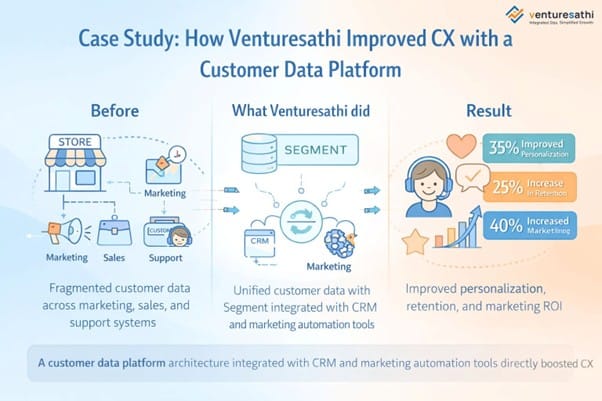
Case Study: How Venturesathi Improved CX with a Customer Data Platform
Before:
A US-based mid-sized e-commerce company struggled with fragmented customer data across marketing, sales, and support systems, leading to inconsistent messaging and poor personalization.
What Venturesathi did:
Venturesathi implemented Segment as the customer data platform, enabling real-time customer data unification. The CDP was integrated with the client’s CRM and marketing automation tools to create a single customer view and enable real-time campaign activation.
Result:
- 35% improvement in personalization effectiveness
- 25% increase in customer retention
- 40% higher marketing ROI
This demonstrates how a well-integrated customer data platform architecture can directly enhance CX and business performance.
Conclusion: Building a Data-Driven CX Strategy with CDPs
A customer data platform is no longer just a technology investment, it is a strategic capability. Businesses that prioritize customer data unification and customer data integration can deliver consistent, personalized, and high-impact customer experiences.
As customer expectations continue to evolve, organizations must move beyond fragmented systems and adopt a unified data approach. CDPs will play a central role in shaping the future of CX by enabling real-time insights, personalization at scale, and smarter decision-making.
To accelerate this transformation, many organizations are choosing experienced partners like Venturesathi as their vendor of choice to design, implement, and optimize CDP-driven CX strategies, ensuring faster execution, seamless integration, and measurable business outcomes.
Frequently Asked Questions(FAQs)
The timeline for implementing a customer data platform typically ranges from 3 to 6 months, depending on the complexity of existing systems and data sources. A well-defined customer data integration strategy can significantly accelerate deployment and improve outcomes.
A strong customer data platform architecture includes data ingestion, identity resolution, and activation layers. These components work together to enable seamless customer data unification, real-time insights, and cross-channel personalization at scale.
Yes, a customer data platform is highly scalable and can deliver significant value to mid-sized businesses. By improving customer data integration and enabling targeted engagement, CDPs help growing companies compete with larger enterprises more effectively.
A customer data platform improves marketing performance by enabling precise segmentation, real-time targeting, and personalized campaigns. This leads to higher engagement, better conversion rates, and improved ROI through more efficient use of marketing budgets.
Before implementing a customer data platform, businesses should assess their data sources, define clear CX objectives, and evaluate integration requirements. Planning for scalability, compliance, and ongoing optimization is essential to maximize the long-term value of customer data unification.