How a Customer Experience Strategy Impacts Revenue, Customer Retention, and Brand Loyalty
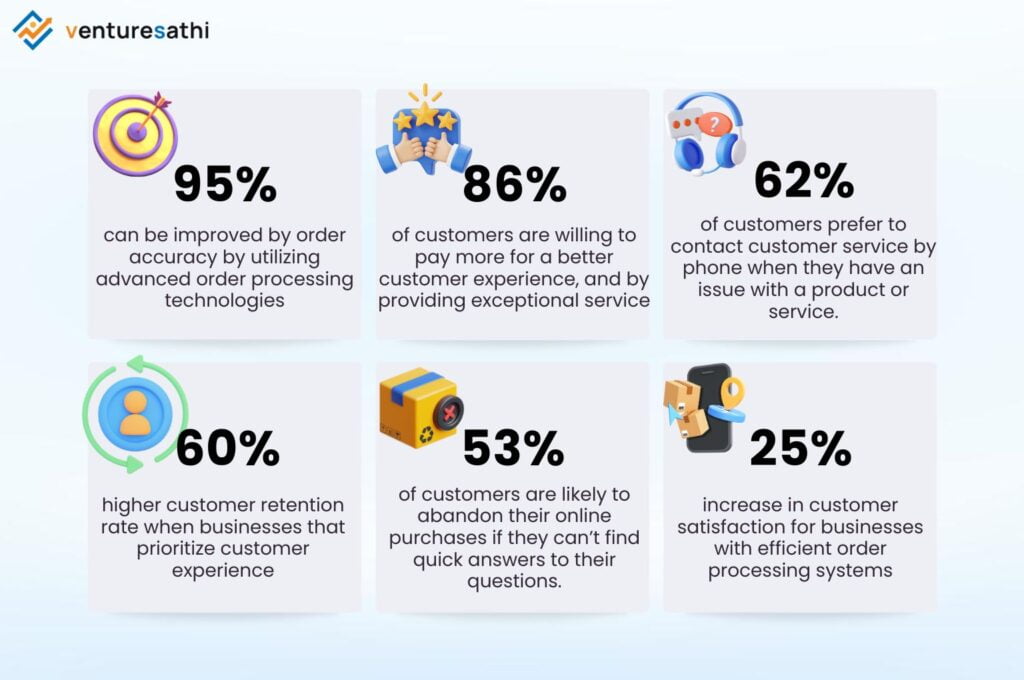
Customer expectations have fundamentally changed. According to a survey, poor CX causes 49% of customers to abandon loyal brands within 12 months. Today, customers evaluate businesses not only on the quality of their products but on the overall customer experience they receive throughout their journey. Therefore, for CXOs and business leaders, customer experience strategy is no longer a marketing initiative. It is a revenue strategy.
A well-structured customer experience strategy influences how customers perceive your brand, how long they stay with your business, and how frequently they return to purchase again. Companies that consistently invest in improving customer experience often see measurable outcomes such as higher customer lifetime value, increased customer retention rates, stronger customer loyalty strategy outcomes, and reduced customer acquisition costs.
In this blog, we explore how customer experience strategy impacts revenue, customer retention, and brand loyalty, and we provide a practical framework for building an effective customer retention strategy through better customer experience.
What a Modern Customer Experience Strategy Looks Like
A customer experience strategy defines how a company delivers consistent, positive interactions across every stage of the customer journey.
Customer experience today is not limited to customer service. It spans the entire lifecycle including product discovery and onboarding, purchase and payment experience, customer support interactions and post-purchase engagement and retention.
Organizations that succeed in improving customer experience treat CX as a cross-functional responsibility involving marketing, operations, product teams, and support teams.
Core Elements of a Strong Customer Experience Strategy
An effective customer experience strategy typically includes:
- Customer journey mapping to understand every touchpoint
- Data-driven insights that track customer behavior and satisfaction
- Operational alignment between departments responsible for customer interactions
- Technology and automation to ensure consistent service delivery
When these elements work together, businesses can design experiences that naturally support customer retention strategy and long-term brand loyalty.
Key Operational Metrics
To make analytics meaningful, companies track specific performance metrics within their operations. Some common back-office metrics include ticket resolution time, process cycle time, error rates in operational tasks, team productivity levels, customer satisfaction scores (CSAT), and operational cost per transaction.
Tracking these metrics through operational analytics enables teams to identify performance trends and optimize processes.
Customer experience is no longer just a service function. It is an operational discipline that directly influences retention, revenue, and brand trust.
How Customer Experience Strategy Impacts Revenue, Customer Retention, and Brand Loyalty
Many organizations treat revenue growth, customer retention, and brand loyalty as separate initiatives. In reality, they are deeply connected through customer experience. According to a 2026 PwC survey, 65% of U.S. customers find a positive experience with a brand to be more influential than great advertising. Therefore, a strong customer experience strategy creates a compounding business effect that influences multiple performance indicators simultaneously.
1. Customer Experience Drives Revenue Growth
Customers who receive consistent and positive experiences are significantly more likely to return for repeat purchases. When businesses focus on improving customer experience, they often see higher average order values, increased cross-selling opportunities, and greater customer lifetime value. Satisfied customers trust the brand more, which reduces purchase hesitation and increases long-term revenue potential.
2. Customer Experience Improves Customer Retention
Acquiring a new customer is significantly more expensive than retaining an existing one. This is why customer retention strategy is closely tied to customer experience management.
A seamless experience across onboarding, product usage, and customer support increases the likelihood that customers will remain with the company over time. Businesses that invest in customer experience strategy can reduce churn by identifying friction points early and resolving issues before customers decide to leave.
3. Customer Experience Builds Long-Term Customer Loyalty
Brand loyalty is not built through marketing campaigns alone. It is built through consistent and reliable experiences. A well-designed customer loyalty strategy depends on delivering fast and helpful customer support, personalized communication, and frictionless service interactions. When customers repeatedly receive high-quality experiences, they become advocates for the brand. This leads to referrals, organic growth, and stronger brand reputation.
Read more: Omnichannel CX Strategy: An Imperative for Global Brands
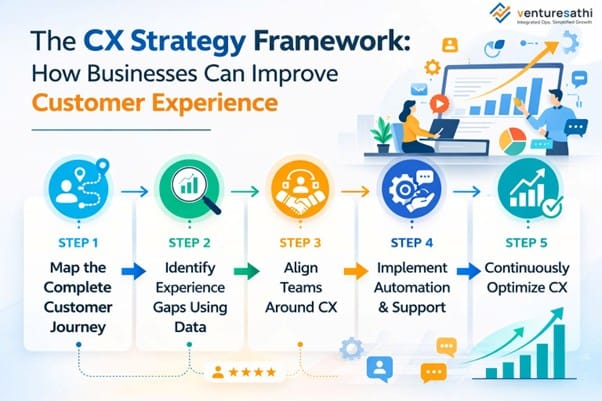
The CX Strategy Framework: How Businesses Can Improve Customer Experience
While 80% of companies recognize that customer experience (CX) is as important as their products or services, many struggle to bridge the gap between acknowledging its value and operationalizing it. Therefore, for many organizations, the challenge is not understanding the importance of CX but knowing how to operationalize it effectively.
Below is a practical framework businesses can use to build a scalable customer experience strategy.
Step 1: Map the Complete Customer Journey
The first step in improving customer experience is understanding the full customer journey. This involves identifying every interaction customers have with the brand, including website visits and product discovery, purchase and checkout processes, customer support requests, and post-purchase engagement. Journey mapping helps businesses identify friction points that negatively impact customer retention.
Step 2: Identify Experience Gaps Using Customer Data
Once the customer journey is mapped, companies must analyze customer feedback and behavioral data. Important signals include customer satisfaction scores (CSAT), Net Promoter Score (NPS), support ticket trends, and customer churn patterns. These insights help organizations prioritize improvements within their customer retention strategy.
Step 3: Align Internal Teams Around Customer Experience
Customer experience does not belong to a single department. A successful customer experience strategy requires collaboration across product teams, marketing teams, customer support teams, and operations teams. When these departments work together, businesses can create a consistent experience across all customer touchpoints.
Step 4: Implement Automation and Operational Support
Automation plays a key role in improving customer experience at scale. Examples include automated customer onboarding workflows, AI-powered customer support systems, and CRM-driven personalization. Many organizations also rely on outsourced CX support teams to manage customer interactions efficiently while maintaining service quality.
Step 5: Continuously Optimize the Customer Experience
Customer expectations evolve constantly. This means customer experience strategy must also evolve. Companies should continuously evaluate their customer retention strategy by monitoring performance metrics and adjusting processes based on real-time insights.
How CX Leaders Use Technology to Improve Customer Experience
High-performing CX teams use data platforms to uncover patterns across the customer journey and act on those insights. Here’s how:
Customer Relationship Management (CRM) platforms
CX leaders use CRM data to identify relationship gaps such as missed follow-ups, repeated complaints, or stalled onboarding journeys. These signals allow organizations to proactively intervene before dissatisfaction turns into churn, strengthening their customer retention strategy.
Customer support and ticket management systems
Helpdesk platforms provide a real-time view of customer issues and resolution performance. Rather than treating support requests as isolated incidents, CX teams analyze ticket trends to identify systemic problems.
Data analytics dashboards
Analytics platforms allow CX leaders to monitor operational health across service channels. By aggregating metrics such as response times, escalation rates, and customer satisfaction trends, businesses can quickly detect service breakdowns and allocate resources where they are most needed.
Customer feedback and experience management tools
Feedback platforms provide direct insight into customer sentiment. When analyzed alongside behavioral data, these insights reveal not only what customers experience but also the underlying drivers of satisfaction or dissatisfaction.
Read more: How AI is Transforming Customer Experience Through Hyper-Personalization
Measuring the Success of a Customer Experience Strategy
A successful customer experience strategy must be measured through outcomes that reflect both customer satisfaction and long-term relationship strength.
However, many organizations focus on tracking metrics rather than extracting insights from them. High-performing CX teams use performance indicators to diagnose operational issues, identify emerging customer needs, and guide strategic improvements.
Using Customer Experience Metrics to Identify Operational Gaps
CX metrics act as diagnostic signals that reveal where customer journeys are succeeding or failing via:
Customer Satisfaction Score (CSAT)
Rather than treating CSAT as a standalone indicator, CX leaders analyze it alongside support interaction data. A decline in CSAT following specific service interactions often reveals process inefficiencies, unresolved issues, or communication gaps. These insights help teams redesign service workflows to improve the overall customer experience.
Net Promoter Score (NPS)
NPS provides a broader measure of customer perception and brand advocacy. However, the most valuable insights come from analyzing the feedback of detractors and passive customers. These responses often highlight recurring dissatisfaction drivers such as slow response times, complex product experiences, or inconsistent service quality.
Customer Lifetime Value (CLV)
CLV helps organizations understand whether their customer experience strategy is generating long-term value. CX leaders often analyze CLV across different customer segments or acquisition channels to identify which experiences lead to sustained engagement and higher revenue contribution.
Retention Metrics That Reveal Long-Term CX Performance
Retention indicators provide a clearer picture of whether customer experience initiatives are building lasting relationships through:
1. Customer churn rate
Churn data helps organizations understand when customers disengage from the brand. By analyzing churn patterns across different stages of the customer journey, businesses can identify where experience failures occur and address them before they impact larger customer segments.
2. Repeat purchase rate
Repeat purchase behavior often reflects positive customer experiences. By analyzing which touchpoints drive repeat transactions, CX leaders can replicate successful experiences across other parts of the customer journey.
3. Average customer lifespan
Customer lifespan provides insight into the durability of customer relationships. When combined with service interaction data and satisfaction metrics, it helps organizations evaluate whether their customer retention strategy is effectively sustaining long-term engagement.
Turning CX Metrics into Continuous Improvement
The most mature organizations treat CX measurement as an ongoing feedback loop rather than a reporting exercise.
By continuously analyzing customer feedback, behavioral data, and operational performance, businesses can refine their processes, improve service delivery, and proactively address emerging customer expectations.
Over time, this data-driven approach transforms customer experience strategy from a support function into a core driver of revenue growth, customer retention, and brand loyalty.
Read more: Top Metrics Every Contact Centre Must Track And Why They Matter
Conclusion: Customer Experience Strategy as a Growth Engine
Customer expectations are evolving rapidly as digital experiences become faster and more personalized. In this environment, a strong customer experience strategy is no longer optional but is a key driver of revenue growth, customer retention, and brand loyalty.
Organizations that focus on improving customer experience build stronger relationships with customers, increase lifetime value, and create sustainable competitive advantage. However, delivering consistent experiences requires the right combination of technology, data insights, and operational support. This is where partners like Venturesathi can help businesses scale their CX operations with structured processes, skilled support teams, and data-driven workflows.
Frequently Asked Questions (FAQs)
1. How can businesses implement a customer experience strategy across departments?
A successful customer experience strategy requires alignment between marketing, product, operations, and customer support teams. Businesses should integrate customer data, map the customer journey, and establish shared CX goals. This approach helps deliver consistent experiences and improve customer retention.
2. What role does outsourcing play in improving customer experience?
Outsourcing helps businesses scale customer experience operations while maintaining service quality. Dedicated support teams can manage higher volumes of customer interactions and reduce response times. This strengthens both customer retention strategy and long-term customer loyalty strategy.
3. How long does it take to see results from improving customer experience?
Businesses that actively focus on improving customer experience often see improvements in customer satisfaction and operational efficiency within a few months. Long-term results such as stronger customer retention and brand loyalty typically develop over time as CX processes mature.
4. What challenges do companies face when improving customer experience?
Common challenges include fragmented customer data, inconsistent service processes, and limited visibility into customer behavior. A structured customer experience strategy, supported by analytics and automation tools, helps businesses overcome these issues and strengthen their customer retention strategy.
5. Why is customer experience becoming a competitive advantage?
As products and services become easier to replicate, customer experience has become a key differentiator. Companies that consistently deliver seamless and personalized interactions build stronger relationships with customers and improve customer retention and loyalty.