
Cloud Migration Simplified: A 2026 Roadmap for Efficient Operations
Roughly 94% of enterprise organizations are using cloud computing, with 96% using public cloud services in 2026. Therefore, cloud adoption has shifted from being a competitive advantage to a business necessity. However, many businesses approach cloud adoption as a technical upgrade rather than a strategic transformation. Without a structured cloud migration roadmap, organizations risk facing unexpected costs, security vulnerabilities, and operational inefficiencies.
In this blog, we’ll discuss a well-defined cloud migration strategy and cloud security best practices so that migration is executed in a phased, controlled manner that aligns technology decisions with business outcomes such as scalability, cost efficiency, and improved operational agility.
Common Challenges in Cloud Migration and How to Resolve Them
According to a survey, over 60% of organizations report significant challenges during cloud migration, with 81% identifying security as a top concern. Therefore, before executing a cloud migration roadmap, organizations must address the most common challenges that impact migration success. These include:
Legacy System Compatibility Issues
Legacy systems are often deeply embedded in business operations and may not be compatible with modern cloud environments. Direct migration without modification can result in performance degradation or system failures.
How to resolve this:
- Conduct a comprehensive audit of all applications and dependencies.
- Categorize workloads based on migration readiness (rehost, replatform, refactor).
- Modernize critical applications where necessary to ensure long-term scalability.
Data Security Concerns
Security remains one of the most critical concerns during cloud migration. Sensitive data moving across environments increases exposure to potential risks.
How to resolve this:
- Encrypt data both in transit and at rest to prevent unauthorized access.
- Implement strict identity and access management policies across systems.
- Align migration processes with established cloud security best practices and compliance requirements.
Managing Operational Disruption During Migration
Migration can disrupt day-to-day operations if not planned carefully. Downtime, system errors, and workflow interruptions can impact customer experience and business continuity.
How to resolve this:
- Adopt a phased migration approach instead of a full-scale shift.
- Run parallel systems during critical migration phases.
- Continuously monitor system performance and user impact throughout the transition.
What is a Cloud Migration Roadmap?
A cloud migration roadmap is a structured framework that defines how an organization transitions its infrastructure, applications, and data to the cloud. It provides clarity on timelines, resource allocation, risk management, and expected outcomes, ensuring that migration efforts remain aligned with business priorities.
Key Phases of a Cloud Migration Roadmap
- Assessment Phase: Evaluate current infrastructure, identify dependencies, and determine migration readiness.
- Planning Phase: Define migration strategy, timelines, cost estimates, and risk mitigation plans.
- Migration Phase: Execute data and application transfer with minimal disruption to operations.
- Optimization Phase: Continuously refine cloud performance, cost efficiency, and scalability post-migration.
At Venturesathi, we believe cloud migration isn’t just about moving infrastructure, it’s about building agile, scalable systems that help businesses grow faster, operate smarter, and deliver better customer experiences.
Step-by-Step Cloud Migration Strategy for Businesses
A structured cloud migration roadmap requires disciplined execution across multiple stages. Here’s how:
1. Assess Current IT Infrastructure
Organizations must begin with a detailed assessment of their existing IT landscape. This includes evaluating system performance, identifying dependencies, and understanding which workloads are suitable for migration. In addition, businesses should:
- Map application interdependencies to avoid migration disruptions
- Identify legacy systems that may require modernization or replacement
- Evaluate current infrastructure costs to build a clear business case
A thorough assessment reduces migration risks and ensures that critical systems are handled with the required level of care.
2. Select the Right Cloud Environment
Choosing the right cloud model is a strategic decision that directly impacts performance, cost, and security. Businesses must evaluate whether a public, private, or hybrid cloud aligns with their goals. To make the right choice, organizations should:
- Assess data sensitivity and compliance requirements
- Consider scalability needs and future growth plans
- Evaluate vendor capabilities, pricing models, and ecosystem support
Aligning the cloud migration strategy with business objectives ensures long-term flexibility and efficiency.
3. Plan Data Migration and Application Transition
A well-defined migration plan ensures that workloads are transitioned efficiently without disrupting operations. To manage workloads during migration, organizations should:
- Prioritize mission-critical applications to minimize business impact
- Use phased or pilot-based rollouts instead of full-scale migration
- Establish rollback plans to handle unexpected failures
- Monitor system performance continuously during migration
- Communicate proactively with stakeholders to manage expectations
This structured approach helps maintain operational continuity while executing the migration.
4. Test, Validate, and Optimize Post-Migration
Migration does not end once workloads are moved. Organizations must validate system performance and ensure everything functions as expected.
Key actions include:
- Conduct performance testing and user acceptance testing (UAT)
- Identify and resolve latency or integration issues
- Optimize resource allocation to control cloud costs
- Fine-tune configurations for better scalability and efficiency
Continuous optimization ensures that the cloud migration roadmap delivers long-term value.
5. Establish Governance and Monitoring Frameworks
To sustain success, businesses need strong governance and monitoring in place.
This involves:
- Setting up performance monitoring and alert systems
- Defining cost management and usage policies
- Implementing security controls aligned with cloud security best practices
- Regularly reviewing system performance and usage trends
A strong governance framework ensures that the cloud environment remains secure, cost-efficient, and aligned with business goals.
Related read: Why Single-Service BPOs No Longer Work for SaaS in 2026
Top 3 Cloud Security Best Practices During Migration
Security must be embedded throughout the cloud migration roadmap to protect data and maintain compliance. Here are the top cloud security best practices to ensure during migration:
Protecting Sensitive Data During Cloud Migration
Protecting data in a cloud migration strategy requires securing it at every stage. Organizations should implement encryption for data in transit and at rest, along with secure transfer methods like private networks. It is equally important to classify sensitive data and apply stricter controls where needed. Regular security audits help identify vulnerabilities early and prevent potential breaches.
Implementing Identity and Access Management Controls
Strong IAM controls ensure only authorized users access critical systems. Businesses should implement role-based access control (RBAC), multi-factor authentication (MFA), and the principle of least privilege. Regularly reviewing access logs helps detect unusual activity and strengthens security. Effective IAM provides both control and visibility across the cloud environment.
Ensuring Compliance with Cloud Security Best Practices
A robust cloud migration roadmap must align with industry regulations and data protection standards. Organizations should move beyond one-time compliance checks and adopt continuous monitoring systems to detect risks in real time. Maintaining audit trails and automated reporting ensures accountability and readiness for audits. Strong compliance practices reduce risk and build long-term trust.
5 Tips To Follow Before Executing a Cloud Migration Strategy
Before initiating migration, organizations should take a strategic approach to cloud migration to reduce risks, control costs, and ensure long-term success. Here’s how:
1. Define clear business objectives
Start by identifying what success looks like. Whether the goal is cost reduction, improved scalability, faster deployment, or better system performance, having clearly defined objectives helps prioritize workloads and measure the success of your cloud migration roadmap.
2. Start with a pilot migration
Instead of migrating everything at once, begin with a low-risk application or workload. A pilot migration helps teams test the process, identify technical and operational gaps, and refine the overall cloud migration strategy before scaling.
3. Build the right capabilities
Cloud environments require specialized skills in architecture, security, and operations. Organizations should assess whether internal teams have the required expertise or if external partners are needed to ensure a smooth and efficient migration.
4. Embed security early
Security should be integrated from the beginning rather than added later. By implementing cloud security best practices such as encryption, access controls, and compliance checks, organizations can avoid costly risks and rework during later stages.
5. Plan for continuous optimization
Cloud migration does not end with deployment. Organizations must continuously monitor system performance, optimize resource usage, and control costs. Regular reviews ensure that the cloud environment continues to deliver business value over time.
Common Cloud Migration Tools: Examples And Comparison
| Tool | Category | Best For | Key Benefit |
|---|---|---|---|
| AWS Migration Hub | Migration & Tracking | Multi-service AWS migrations | Centralized visibility across migration progress |
| Azure Migrate | Migration & Assessment | Microsoft ecosystem users | End-to-end migration planning and cost estimation |
| Google Cloud Migrate | Migration | VM and workload migration to GCP | Simplifies large-scale workload transfers |
| Datadog | Monitoring & Observability | Real-time system monitoring | Detects performance issues during migration |
| AWS CloudFormation | Automation (IaC) | AWS-native automation | Simplifies infrastructure provisioning in AWS |
| Kubernetes | Orchestration | Managing containerized workloads | Enables scalable and resilient deployment |
Instead of selecting tools randomly, CX leaders should:
- Choose migration tools based on their cloud provider (AWS, Azure, GCP)
- Use monitoring tools to maintain performance visibility during transition
- Leverage automation tools to ensure consistency and scalability
This layered approach ensures your cloud migration roadmap is not only efficient but also aligned with long-term operational goals.
Related read: Top ERP Features for Businesses: What Growing Companies Need in 2026
Case Study: How Venturesathi Enabled Cloud Migration For A US Startup vs Enterprise
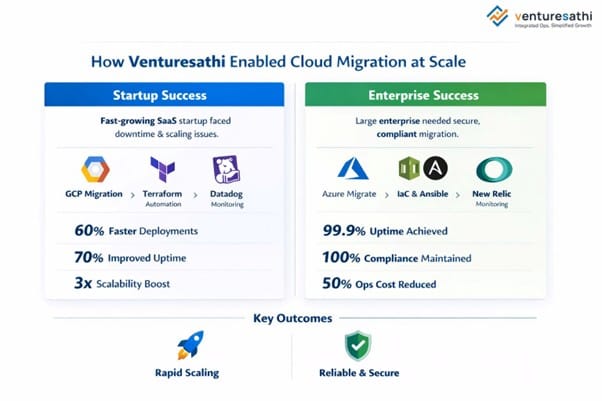
US Startup: Scaling Without Complexity
A fast-growing US-based SaaS startup faced downtime and performance issues due to limited on-premise infrastructure, impacting early customer experience and growth.
What Venturesathi did:
Venturesathi implemented a lean cloud migration strategy using Google Cloud Migrate for Compute Engine, automated infrastructure with Terraform, and enabled real-time monitoring via Datadog.
Result:
This led to 60% faster deployments, 70% improvement in uptime, and a 3x boost in scalability, enabling the startup to handle growth without infrastructure bottlenecks.
US Enterprise: Migrating with Control and Compliance
A large US enterprise needed to migrate legacy systems while ensuring zero disruption, strict compliance, and high system reliability.
What Venturesathi did:
Venturesathi designed a phased cloud migration roadmap using Azure Migrate, along with AWS CloudFormation and Ansible for standardized deployments, and New Relic for deep visibility.
Result:
The organization achieved 99.9% uptime, maintained 100% compliance, and reduced operational costs by 50%, while building a scalable and secure cloud environment.
Key Takeaway
Thus, Venturesathi aligned every cloud migration roadmap with business goals helping startups scale faster and enabling enterprises to migrate with control, compliance, and long-term efficiency.
Conclusion: Simplifying Operations with a Cloud Migration Roadmap
A well-defined cloud migration roadmap enables organizations to transition to the cloud with confidence and clarity. By addressing common challenges, following a structured cloud migration strategy, and implementing strong cloud security best practices, businesses can reduce risks and improve operational efficiency.
Therefore, cloud migration is not just about moving infrastructure, it is about building a scalable, agile, and future-ready operating model. For growing businesses, the ability to simplify operations while maintaining performance and security will be a key competitive advantage in 2026 and beyond.
Frequently Asked Questions (FAQs)
1. What are the different types of cloud migration strategies?
Businesses typically choose between rehosting (lift-and-shift), replatforming, refactoring, repurchasing, retiring, or retaining workloads based on complexity and goals within their cloud migration roadmap. Each approach varies in cost, effort, and long-term scalability impact.
2. How long does a cloud migration process take?
The timeline for a cloud migration strategy depends on infrastructure size, application complexity, and data volume. It can range from a few weeks for startups to several months for large enterprises, especially when phased migrations are involved.
3. What are the risks involved in cloud migration?
Common risks include data loss, downtime, security vulnerabilities, and compatibility issues. A structured cloud migration roadmap helps mitigate these risks through phased execution, testing, and proper backup strategies.
4. How do businesses calculate ROI from cloud migration?
ROI is measured by comparing reduced infrastructure costs, improved operational efficiency, and increased scalability against migration and cloud usage costs over time. Businesses should also factor in indirect gains like faster time-to-market and improved performance.
5. Which industries benefit the most from cloud migration?
Industries such as fintech, healthcare, e-commerce, and SaaS benefit significantly due to their need for scalability, data security, and real-time access. Cloud environments also help these sectors meet compliance requirements more efficiently.