Vendor Sprawl Is Increasing Your Burn Rate
Why Founders Must Consolidate CX + Dev + Ops
Startup operators today face a silent and expensive threat: vendor sprawl. According to a Crebos Online global trends report, growth-stage startups lose 20-30% of their monthly burn due to fragmented operational setups, where customer experience is outsourced to one vendor, development to another, and finance/back office to a third.
This fragmentation doesn’t just waste money — it drains founder bandwidth, slows decision-making, lowers product quality, and creates operational inconsistencies.
In this article, we will break down a harsh truth: whether you’re scaling a SaaS or a fintech company, multiple vendors will increase your burn rate faster than anything else. The solution? An integrated, unified CX + Dev + Ops model that reduces cost and boosts runway.
What Is Vendor Sprawl and Why It Hurts Startups
Vendor sprawl happens when startups work with multiple service partners across customer support, customer service, product development, QA, and back office. The problem? No one talks to each other.
This creates multiple billing cycles, duplicated overhead, misaligned SLAs, long feedback loops, and slower resolution cycles
A FounderOps survey found that founders spend nearly 25% of their weekly bandwidth managing 3–5 vendors — a costly distraction from product, sales, and GTM.
The Hidden Cost of Fragmented Ops
Founder Bandwidth Drain
SaaS founders become accidental project managers. This slows down innovation and pushes strategic work aside.
Slow Cross-Functional Communication
Let’s consider a scenario where Customer Experience agents report issues but due to fragmented ops the Dev vendor is unaware resulting in fixes getting delayed and increased customer churn risk.
Burn Rate Inflation
Fragmented vendors lead to duplicated processes as well as duplicated leadership overheads. This directly impacts the runway of the businesses.
Why Operations Consolidation Reduces Burn Rate by 20–40%
According to Bain & Company, startups can reduce operational costs by 28–45% by consolidating vendors. This is where outsourcing cost reduction, operational efficiency outsourcing, and consolidation play a massive role in lowering operational burn.
A unified operations partner eliminates duplicated expenses across:
Training Costs
Every vendor trains agents, developers, QAs, and back-office teams separately — meaning you pay multiple training bills for the same workflows.When you consolidate CX + Dev + Ops under one partner, training becomes shared, documented, and standardised — dramatically reducing onboarding time and spend.
Management Overhead
If a founder works with 3–5 vendors, each requires: a separate account manager, weekly reporting calls, SLA reviews, quality audits and escalations handling.
This is not just a cost issue — it consumes founder bandwidth, which is one of the most precious resources in a growth-stage startup.
Billing & Administrative Overheads
Multiple invoices, currencies, taxation layers, and payment cycles all create friction, delay, and unnecessary finance complexity. One integrated partner means one invoice, one approval, and no fragmented billing overhead.
Reporting & Insights
Each vendor sends reports formatted differently. Startups then spend valuable time reconciling CX data, development load, QA timelines, and back-office productivity.
Consolidation allows every function to sit in one analytics layer, enabling faster decision-making and operational clarity.
SLA Enforcement
When multiple vendors handle disconnected pieces of the customer journey, no one owns the SLA end-to-end. If customers complain, it becomes unclear whether the problem originated from support, product delays, or back-office failures. A consolidated partner takes total accountability. They own the SLA completely.
How Integrated CX + Dev + Ops Drives Operational Efficiency
Vendor consolidation is not just a financial decision — it is a performance multiplier that accelerates product improvement, customer experience, and operational resilience.
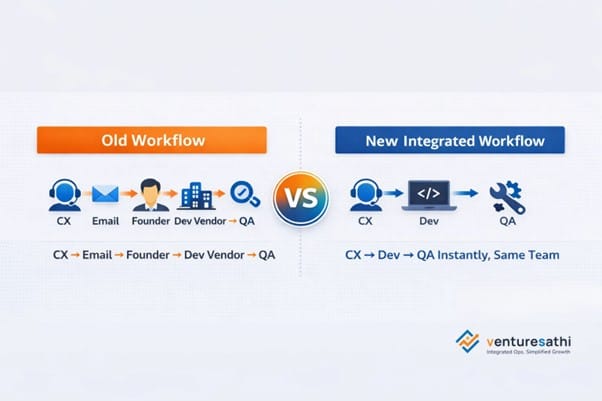
Faster Feedback Loops (CX to Dev to QA)
Support tickets usually contain deep product signals — bugs, user friction, failures in onboarding, and product crashes. With multiple vendors, these insights move slowly, through multiple layers of communication.
But with CX + Dev + Ops under one partner: This reduces the time to fix issues and improves customer satisfaction.
Improved Product Quality
When customer-facing teams and developers share the same processes, tools, and accountability structure, the product evolves continuously.
Streamlined Reporting
Instead of three dashboards, three vendors, and three interpretations of performance, founders get: one dashboard, one SLA, one escalation chain, and one accountability owner. This eliminates data silos and ensures decision-makers have a clear view of operational health.
30-Day Ramp Instead of 90–120 Days
Gartner reports that traditional enterprise BPO ramp times typically take 3–4 months.
Consolidated teams cut this dramatically because hiring, training, and workflows are unified under one playbook.
Venturesathi’s integrated CX + Dev + Ops model brings companies live in 30 days — a huge advantage for fast-scaling startups.
Vendor sprawl is a hidden tax on your startup. Integration is not just about efficiency, it’s about extending runway, and returning time to founders.
Case Example — Venturesathi’s Integrated Ops Helps SaaS Startup Cut Down Burn by 32%
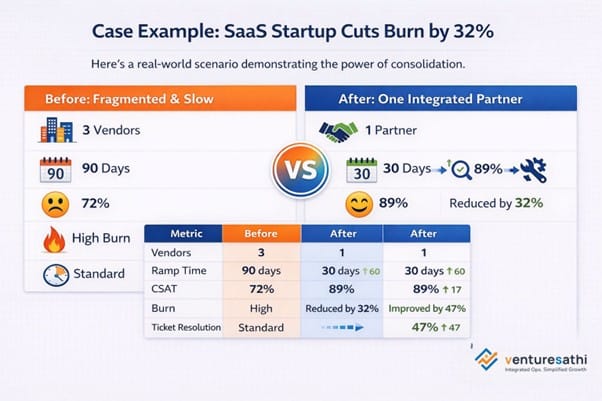
A fast-growing SaaS startup was struggling with fragmented operations spread across three different vendors: one for customer support, one for development, and another for back-office processes. Each team operated in silo, which created slow feedback loops, inconsistent reporting, and a heavy managerial burden on the founding team.
Because these functions were disconnected, every new update or process change required coordination across multiple agencies — leading to a 90-day ramp period, broken communication chains, and lagging customer satisfaction. Their CSAT hovered at 72%, and internal teams constantly dealt with duplicated work, missed handoffs, and unclear accountability. Most importantly, their operational burn remained high despite ongoing vendor payments.
After switching to Venturesathi as a single integrated ops partner, the startup unified CX, Dev, QA, and back-office workflows under one coordinated structure. With shared dashboards, unified leadership, and cross-functional squads, the entire system began functioning as one cohesive unit.
The impact was dramatic. Ramp time dropped from 90 days to 30 days, CSAT climbed to 89%, and ticket resolution efficiency increased by 47%. Most importantly, the startup saw a 32% reduction in operational burn — without increasing headcount. The efficiency gains came entirely from integration, not expansion.
This case highlights a critical truth: consolidation isn’t about cutting corners — it’s about removing friction, duplication, and delays that silently drain the runway. When teams operate as one, startups scale faster, run leaner, and deliver consistently better customer experiences.
Read more: Sterling Reduces Costs 62% in 6 Months – A Manufacturing Accounts Payable Automation Case Study
How to Transition to an Integrated Ops Model
Transitioning from a fragmented multi-vendor setup to a single integrated operations partner is one of the most effective ways to streamline execution and protect the runway. For founders managing rapid scale, this shift can unlock significant efficiency gains.
Step 1: Audit Your Current Burn
Start by reviewing where your operational dollars are going. Most startups discover they are unintentionally paying for the same layers multiple times — training, reporting, QA, management, and tool licenses often repeat across vendors. Identifying these hidden costs gives you the first clear picture of how much inefficiency exists in your current model.
Step 2: Identify Duplicated Overhead
Map out every vendor and list the functions they handle. Anywhere two or three vendors perform overlapping processes, you’re losing both money and time. These duplicated layers create bottlenecks that slow delivery, inflate burn, and drain founder bandwidth.
Step 3: Choose an Integrated Partner
Look for a partner that provides CX + Dev + Ops under one roof. This ensures you get streamlined execution without long-term lock-ins.
Step 4: Consolidate CX + Dev + Ops
Rebuild your operational backbone by unifying workflows, escalations, SLAs, and communication channels. When support, engineering, and back office teams work together, misalignment disappears and accountability becomes crystal clear.
Step 5: Go Live in 30 Days
Integrated partners like Venturesathi can activate fully unified operations. Within a month, most startups see smoother delivery, fewer escalations, and significantly reduced operational burn.
Key Takeaways
Vendor sprawl drains the runway through duplicated costs, slow coordination, and scattered accountability. By consolidating CX, Dev, and Ops under one integrated partner, startups unlock lower burn, faster delivery cycles, higher CSAT, and cleaner reporting — all while freeing up valuable founder bandwidth. This isn’t just a cost-saving move; it’s a strategic advantage that creates operational stability and extends the runway. To consolidate your operations under one Sathi, visit: www.venturesathi.com.
FAQs
Startups typically see a 20–40% reduction in operational burn when they replace multiple vendors with one integrated CX + Dev + Ops partner. This comes from eliminating duplicated overhead, faster ticket cycles, and centralized reporting.
No — integration actually improves quality, because workflows are aligned, escalations move instantly, and teams collaborate without vendor friction. Most companies see a CSAT boost after consolidation.
Integrated partners like Venturesathi offer a 30-day ramp. Unified onboarding, shared tools, and standardized SOPs enable rapid, low-friction execution.
Yes. Outsourcing to an integrated partner is one of the most cost-efficient ways to extend runway, especially for teams scaling CX, Dev, and Ops without increasing headcount.
By consolidating vendors and centralizing workflows, founders spend less time on vendor management, escalations, and operational fire-fighting. This frees bandwidth for product, growth, and fundraising.
Absolutely. When CX + Dev + QA work together under one partner, ticket resolution improves because escalations are handled internally instead of jumping across multiple vendors.