
The Role of AI in Modern Contact Centers
Artificial Intelligence
AI Contact Center
AI Customer Service
Introduction
The modern call center is no longer just a room full of agents answering calls — it has evolved into a digitally powered, insight-driven customer experience engine. Over the last few years, companies across industries have rapidly begun integrating AI into their call center workflows to solve long-standing problems like high call volume, inconsistent service quality, slow resolution times, and limited visibility into customer intent.
Adoption started with simple automations like chatbots and IVR enhancements but quickly expanded into more advanced use cases: real-time agent assistance, speech-to-text transcription, predictive analytics, and automated quality monitoring. Today, organizations are using AI not only to handle routine tasks but also to support agents, improve decision-making, and deliver faster, more consistent customer service across every interaction.
As a result, AI is becoming a core component of modern call center operations strengthening efficiency, improving customer experience, and empowering teams to do more with fewer resources.
How Companies Are Implementing AI in Call Center Workflows
Most AI contact centers didn’t jump straight into advanced AI. The journey typically started with basic automation—chatbots answering FAQs, upgraded IVR systems that could understand natural language instead of just keypad inputs.
But the real transformation began when organizations moved from post-call analytics to real-time capabilities. Instead of reviewing recordings days later, AI now listens to conversations as they happen, surfacing knowledge articles, flagging compliance risks, and even detecting when a customer is about to churn based on sentiment shifts.
A recent survey found that 87% of contact center leaders affirm conversational AI has reduced agents’ effort and costs, boosting agent efficiency by 65%. That’s not incremental improvement—it’s a fundamental shift in how work gets done.
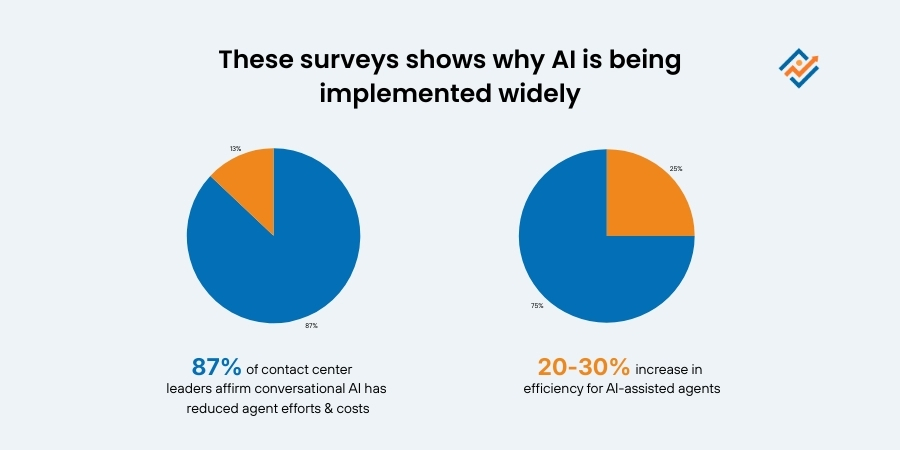
The acceleration is driven by three pressures converging at once: operational costs climbing (especially labor), customer expectations rising (instant, personalized service), and competition intensifying (where CX is the primary differentiator). Research shows a 20-30% increase in efficiency for AI-assisted agents, and with 93% of contact centers already using AI in some capacity, the question is no longer “should we adopt?” but “where should we deploy next?”
What’s particularly interesting is how AI adoption patterns reveal themselves. Companies don’t implement everything at once. They start with pain points—the processes that hurt the most. Maybe it’s a spike in call volume they can’t staff for, or a compliance audit that exposed gaps in quality monitoring. The technology gets proven in one area, then spreads laterally across the operation.
Where AI Is Being Implemented First
Self-Service Channels
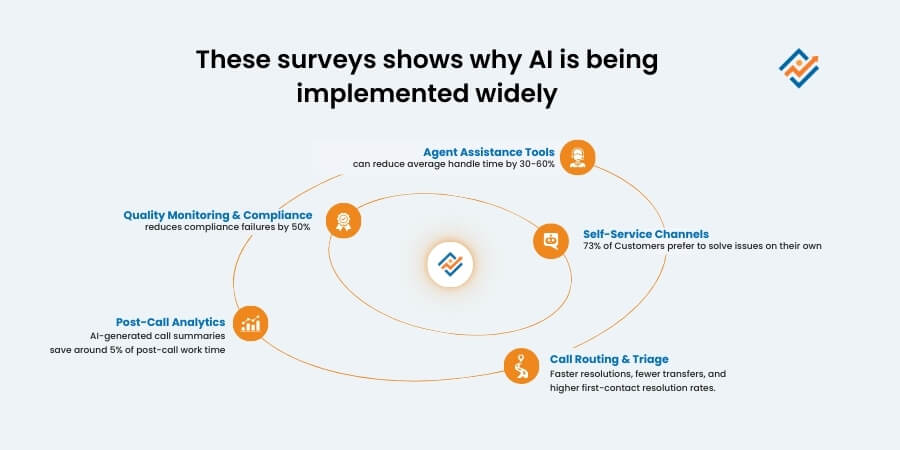
This is where most organizations begin. Chatbots handle password resets, order status checks, basic troubleshooting. Voicebots manage appointment scheduling, payment processing. 73% of customers prefer to solve issues on their own, so there’s actual demand here—not just cost savings.
The newer intelligent virtual agents (IVAs) go beyond simple decision trees. They understand context, maintain conversation history, and can complete multi-step transactions. When they can’t help, they route seamlessly to an agent with full context already transferred.
Call Routing & Triage
Traditional routing used static rules: press 1 for billing, press 2 for support. Modern AI-driven predictive routing matches customers with agents based on intent, sentiment, historical behavior, and likelihood of positive outcome—all before the conversation starts. No more “let me transfer you to someone who can help better.”
Intent detection analyzes the first few seconds of a call to understand what the customer needs, then routes accordingly. The result? Faster resolutions, fewer transfers, and higher first-contact resolution rates.
Agent Assistance Tools
This is where AI delivers the most immediate value for existing teams. During live calls, agents see real-time transcription, automatic knowledge article suggestions, compliance reminders, and even next-best-action prompts. One agent I spoke with described it as “having the best supervisor whispering perfect advice at exactly the right moment.”
AI voice systems can reduce average handle time by 30-60% for routine inquiries, but the real win is in agent confidence. New hires ramp up faster. Experienced agents handle edge cases more effectively. Everyone operates closer to peak performance.
Quality Monitoring & Compliance
Here’s where the math gets compelling. Manual QA teams typically review 1-3% of calls. AI reviews 100%. Automated monitoring of all interactions reduces compliance failures by 50% and provides complete audit trails.
Automated scorecards evaluate every conversation against your rubric. Policy violations get flagged instantly not weeks later during a random sample review. Sentiment tracking reveals patterns: which processes frustrate customers, which agents excel at de-escalation, where training gaps exist across the team.
Post-Call Analytics
After each interaction, AI generates summaries, extracts key data points, identifies trends, and updates the CRM work that used to consume 10-15% of an agent’s shift. AI-generated call summaries save around 5% of post-call work time, but more importantly, they’re consistent. No more variation in how different agents document the same issue.
The analytics layer spots patterns humans miss. Why did churn spike last Tuesday? Which product feature generates the most confusion? Are certain agent cohorts underperforming on specific call types? The answers surface automatically.
Outsource Smarter With Venturesathi AI-Driven CX
• Data-Driven Recommendations for CX Teams
• Scalable Support Across Every Channel
Major Roles AI Plays in Modern Call Center Solutions
At its core, AI serves seven distinct functions in AI contact centers:
Understanding customer intent across channels. Not just what customers say, but what they need. The system recognizes that “my internet isn’t working” might mean the modem needs resetting, the bill is overdue, or there’s a service outage—and routes accordingly.
Speeding up resolution with self-service. The majority of inquiries are routine. AI handles these instantly, 24/7, without wait times. Customers get faster service. Agents handle more interesting work.
Supporting agents during complex calls. Real-time assistance means agents never face a question they can’t answer. Knowledge, customer history, product details—everything surfaces automatically based on conversation context.
Improving accuracy in responses and troubleshooting. Humans forget steps, miss details, interpret policies differently. AI maintains perfect consistency. Every customer gets the same accurate information regardless of which agent they reach.
Enhancing quality assurance and coaching. Organizations using comprehensive analytics platforms identify optimization opportunities 40-50% faster than those relying on manual reporting. Coaching becomes data-driven, targeted, and continuous rather than periodic and subjective.
Providing predictive insights. Which customers are at risk of churning? Where should we expect volume spikes next week? Verizon used generative AI to prevent 100,000 customers from churning by identifying warning signs in conversation patterns before traditional metrics would flag issues.
Reducing operational load through automation. This goes beyond call deflection. It’s about eliminating repetitive work across the entire operation: data entry, reporting, schedule optimization, performance tracking. The administrative overhead that used to consume management time simply vanishes.
Daily Workflows: Before vs. After AI
The transformation shows most clearly in how daily work actually feels:
| Before AI | After AI |
|---|---|
| Agents manually searching through knowledge bases, putting customers on hold | Instant information retrieval with auto-suggested answers in real time |
| Long wait times as customers queue for the next available agent | Smart routing using intent, urgency & agent skill match |
| Supervisors manually reviewing limited call samples | Automated QA scoring every call with real-time flags |
| Agents handle all routine tasks like password resets & order tracking | Bots resolve repetitive tasks instantly; agents handle only complex cases |
| Limited visibility into sentiment until issues escalate | Real-time sentiment detection & alerts for supervisor intervention |
| Forecasting based on guesswork & historical patterns | Predictive forecasting with seasonal & trend-based accuracy |
The difference isn’t just efficiency—it’s the entire experience of working in an AI contact center. Agents feel supported rather than overwhelmed. Supervisors spend time coaching instead of scoring calls. Leaders make decisions based on complete data, not samples.
Benefits of AI in Modern Call Centers
Speed: Trendsetting teams using AI maintain response times under 20 seconds across messaging channels and resolve most queries in under 2 minutes. That’s not just faster—it’s a different category of service entirely.
Accuracy: Consistency across every interaction. No more variance between shifts, teams, or locations. One study found that AI can improve business efficiency by up to 40% and reduce operational costs by up to 30%.
Improved CSAT: Organizations implementing AI customer service report 15-25% improvement in satisfaction scores and 20-28% increase in customer retention rates. When customers get faster, more accurate help, they notice.
Efficiency: Support agents utilizing AI tools handle 13.8% more customer inquiries per hour without working harder. The technology amplifies capability.
Scalability: Handle volume spikes without panic hiring. During peak seasons or unexpected events, AI absorbs the overflow while maintaining service levels.
Agent morale: This one surprised me initially, but the data is consistent. 51% of employees say AI helps workers achieve a healthier work-life balance, and 81% believe AI improves their overall performance at work. Less repetitive work, better support, clearer coaching—agents actually prefer working with AI assistance.
Though one caveat: recent data shows 87% of agents report high stress levels, with over 50% facing daily burnout. This happens when AI implementation focuses purely on monitoring and metrics without considering agent experience. Real-time coaching can become constant surveillance if deployed without care. The technology is neutral outcomes depend entirely on how it’s implemented.
What Teams Should Adopt First
Not every organization needs every AI capability immediately. Start where you’ll see the fastest return:
Teams handling high call volume or repetitive queries should deploy self-service and intelligent routing first. AI can deflect 30-60% of routine inquiries, immediately reducing load.
Customer service teams struggling with inconsistent responses benefit most from agent assist tools. When every agent has the same knowledge at their fingertips, quality standardizes instantly.
QA teams reviewing a limited percentage of calls should implement automated quality monitoring. Going from sampling 2% to reviewing 100% changes what you can see and improve.
Supervisors managing large teams needing real-time oversight gain immediate value from live sentiment detection and escalation alerts. You can intervene before problems escalate rather than discovering issues during next week’s call review.
Teams with long onboarding cycles can use AI to accelerate training. New agents get real-time guidance, reducing the ramp time from months to weeks.
Organizations already using cloud-based contact center platforms have the easiest path—most modern CCaaS providers have AI capabilities built in or easily integrated.
A sensible adoption path: Chatbots → Agent Assist → Automated QA → Analytics → Predictive AI. Prove value at each stage before expanding.
Real-Life Examples of Use Cases
These aren’t hypotheticals these are patterns we see repeatedly:
A bot handling password resets or account updates: Customer authenticates via voice biometrics, bot resets password or updates billing info, entire interaction complete in under 60 seconds. No agent involvement needed.
AI routing customers to the right agent based on urgency: System detects elevated sentiment, identifies customer as high-value, notes issue complexity, and immediately routes to your most skilled available agent—skipping the queue entirely.
Live transcription helping agents focus on the conversation: Instead of typing notes while talking, agents stay present. The system captures everything, generates the summary, updates the CRM. Organizations report 60 seconds saved in call wrap-up time and 10% overall AHT improvement.
Sentiment detection triggering supervisor alerts: When a customer’s frustration peaks mid-call, the supervisor gets an alert and can join the call instantly to assist. Prevention, not damage control.
Automated post-call summaries reducing wrap-up time: What used to take 2-3 minutes of manual data entry happens instantly. Agents move to the next call immediately, or better yet, take an actual break between interactions.
AI recommending responses or knowledge articles: As the customer describes their issue, relevant solutions appear on the agent’s screen. “Oh yes, we just released a fix for that. Let me walk you through it…”
Quality monitoring detecting compliance violations instantly: Agent forgets the required disclosure? System flags it in real-time, prompts the correction. Compliance team sees trends: 20% of agents on the afternoon shift are rushing through disclosures. Coaching opportunity identified.
The Technology Shift: What Contact Centers Are Using Now
Traditional Stack
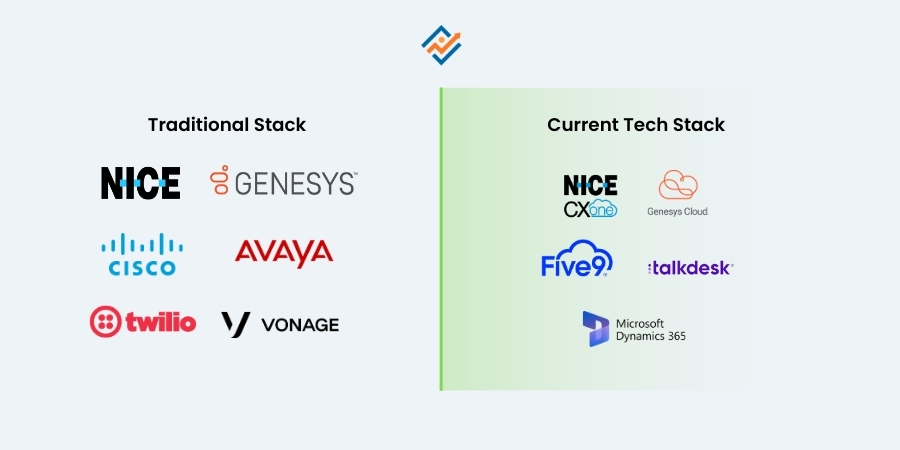
Most contact centers ran on established traditional platforms like NICE, Genesys, Avaya, Cisco, and communication layers from Twilio or Vonage. These were solid but largely reactive—routing calls, recording conversations, generating reports after the fact.
The Competitive Pressure: M&A and Consolidation
The shift to AI has triggered massive consolidation in the AI contact center industry. Companies are racing to acquire capabilities rather than build them, recognizing that customers want complete platforms, not cobbled-together point solutions.
Recent major moves include:
- Capacity’s acquisition spree: Eight acquisitions in less than two years, including Lucy (Answer Engine for internal teams), Envision (agent coaching and quality monitoring), and Linc (e-commerce CX automation). The company raised over $26 million in Series D funding to continue its “compound startup strategy.”
- Avaya acquired Edify in May 2024 to strengthen its cloud and AI capabilities, recognizing that on-premise heritage alone won’t compete in the CCaaS era.
- Five9 acquired Virtual Observer (formerly Coordinated Systems) to add workforce optimization to its platform, putting it on equal footing with competitors like Genesys and NICE who already had integrated WFM suites.
- Genesys is preparing for IPO (reportedly targeting $2 billion in funding), which would provide capital for further acquisitions and help it compete with public competitors like Five9 and NICE.
The CCaaS market grew from $6.7 billion in 2024 to $7.96 billion in 2025—an 18.7% CAGR—and is projected to reach $16.06 billion by 2029. AI is the primary driver. The conversational AI market specifically is expected to grow from $17.05 billion in 2025 to $49.8 billion by 2031, representing 192% growth.
Current Technology Stack: What’s Powering Modern Contact Centers
Today’s leading platforms look radically different from legacy systems. The modern stack typically includes:
Cloud-native CCaaS platforms: NICE CXone, Genesys Cloud, Five9, Amazon Connect, Talkdesk, and emerging players like Microsoft Dynamics 365 Contact Center (launched July 2024) dominate the market. According to recent market analysis, NICE, Genesys, and Amazon Connect lead by seat count, with Five9 maintaining the strongest U.S. market presence.
AI layer components:
- LLM flexibility: Five9’s GenAI Studio allows companies to plug in different large language models (OpenAI, Anthropic, Google) and customize prompts for specific use cases—recognizing that no single LLM is optimal for every task.
- Real-time transcription and NLU: Converting speech to text instantly, understanding intent, detecting sentiment.
- Knowledge management: AI-powered search across documentation, pulling relevant articles based on conversation context.
- Agent assist: Real-time suggestions, response recommendations, compliance reminders.
- Quality monitoring: Automated scoring, policy violation detection, coaching recommendations.
Workforce Engagement Management (WEM): Moving beyond basic scheduling to include AI-driven forecasting (like Verint’s TimeFlex Bot that assigns “FlexCoin” values to shift changes), performance analytics, and automated coaching.
Integration ecosystem: Modern platforms connect seamlessly with Salesforce, ServiceNow, Microsoft Dynamics, Zendesk, and other CRM systems. CTI now enables omnichannel experiences—voice, chat, email, social media, video—all in a unified agent desktop.
The call center AI market is projected to reach $7.08 billion by 2030, growing at 23.8% annually. But the more interesting story is how quickly the technology is democratizing. What required massive capital investment five years ago is now available in pay-as-you-go cloud packages accessible to SMBs.
Frequently Asked Questions
Which AI contact center tools should we implement first?
Start with chatbots for high-volume FAQs, then add agent assist tools, followed by automated QA, analytics, and finally predictive AI. Prove value at each stage before expanding.
How much does AI contact center software cost?
Costs vary widely based on features and scale. Cloud-based CCaaS platforms with AI capabilities typically range from $75-$300 per agent per month, making enterprise-grade AI accessible to businesses of all sizes.
Does AI work for small contact centers?
Yes. Modern cloud-based platforms offer pay-as-you-go pricing that makes AI accessible for teams of any size. Even small teams benefit from automated QA, agent assist, and basic chatbots.
How do you measure AI contact center success?
Track metrics like first-contact resolution rate, average handle time, CSAT scores, agent productivity, cost per contact, and automation rate. Compare before-and-after performance across these KPIs.
What’s the typical ROI timeline for AI contact center implementation?
Most organizations see measurable improvements within 3-6 months, with full ROI typically achieved within 12-18 months depending on deployment scope and use cases prioritized.
Final Thoughts
If 2024 was the year of AI hype, 2025 is the year of measurable value. The AI contact centers succeeding aren’t chasing every new capability—they’re solving specific problems with appropriate technology.
The winners understand that AI isn’t about replacing humans. 71% of Gen Z respondents believe live calls are the quickest and easiest way to reach customer care and explain their issues. People still want to talk to people for complex issues. What’s changed is that both the customer and the agent are supported by intelligence that makes that conversation more effective.
McKinsey research shows AI-powered contact centers can reduce operational costs by up to 30% while simultaneously improving customer satisfaction scores by 15-20%. That dual benefit—better service at lower cost—is what makes this transformation sustainable rather than just another cost-cutting exercise that degrades quality.
The question facing contact center leaders isn’t whether to adopt AI customer service, but how quickly you can deploy it thoughtfully. Because while you’re evaluating, your competitors are implementing. And the gap in customer experience grows every day.
Related Resources
Learn More About AI in Customer Service:
- Voice-Based GenAI in Customer Services – Explore how generative AI is transforming voice interactions
- Applications of Voice-Based GenAI in Customer Service – Practical use cases and implementation strategies
- AI vs. Human Agents in Customer Service: Finding the Right Balance – Understanding when to use AI and when humans are essential
- Will AI Replace BPOs? The Human-AI Hybrid Future of Customer Experience – The future of outsourcing in an AI-driven world
- How AI is Transforming Customer Experience Through Hyper-Personalization – Leveraging AI for personalized customer interactions
- 5 Ways You Can Adapt to AI in Contact Centers – Practical steps for implementing AI in your operations
Industry-Specific Contact Center Solutions:
- Technology’s Role in Modern Contact Center Outsourcing – How technology is reshaping the outsourcing landscape
- Top 05 Emerging Technological Trends in Contact Centers – Stay ahead of the curve with the latest innovations
- After Call Work (ACW): The Hidden Time-Sink in Contact Centers – How AI reduces post-call work time