RPA in Contact Centers:
How Robotic Process Automation Works with AI in 2025

What is RPA? The Basics Explained
Robotic Process Automation (RPA) is software that mimics human actions on computer systems to complete repetitive, rule-based tasks. Think of RPA bots as digital workers that log into applications, copy data, fill forms, and follow if-then rules all without human intervention.
How RPA Works
Unlike traditional software requiring deep API integration, RPA operates at the user interface level. Bots interact with applications exactly like humans clicking buttons, typing information, navigating between windows. This flexibility means no need to change existing systems.
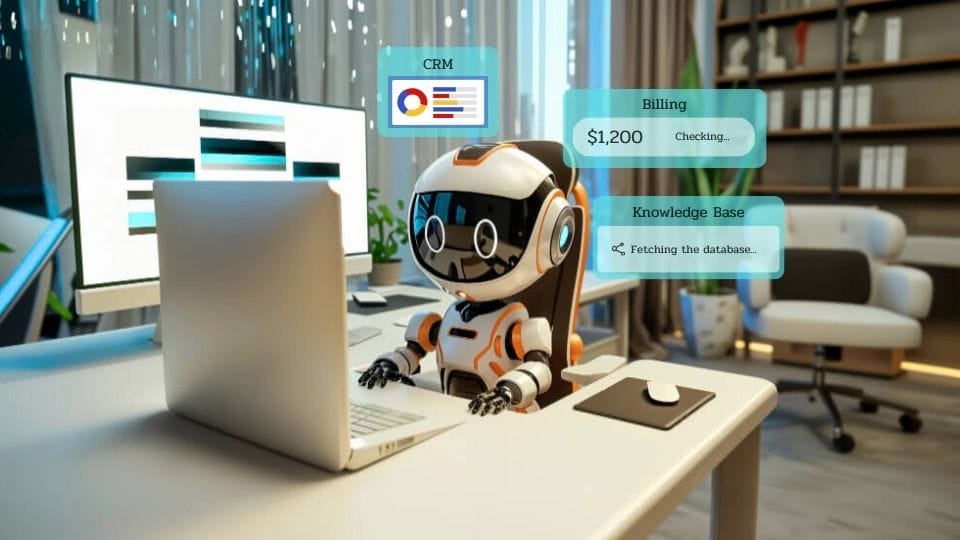
Example: When a customer calls about order status, an agent traditionally opens the CRM, searches for the customer, switches to order management, looks up the order, checks shipping in another system, then documents everything. An RPA bot executes this in 3 seconds while the agent greets the customer.
Introduction: Remember When Automation Was Just a Dream?
Cast your mind back to the early 2010s. Contact center agents were toggling between 8+ screens for a single customer query, and the idea of a “digital worker” handling repetitive tasks seemed like science fiction. RPA (Robotic Process Automation) was that buzzword everyone heard at conferences but few understood.
Back then, automating meant basic IVR systems that frustrated customers. “Press 1 for sales, press 2 for support” became the soundtrack of customer service nightmares. Fast forward to 2025, and RPA bots handle thousands of routine tasks instantly, AI predicts customer needs, and intelligent automation completes workflows that once required three departments and two days.
In this guide, you’ll understand what RPA really is, how it evolved to work with AI, and real-world applications transforming modern contact centers.

The RPA Revolution: From Hype to Necessity
Before 2020, RPA was experimental. Early adopters deployed basic bots for back-office data entry, but contact centers remained manual. The technology was limited early RPA tools operated on rigid rules and broke easily when systems changed.
When the pandemic hit, call volumes surged 300-800%. Within weeks, 76% of agents transitioned to remote work (versus 9% pre-pandemic). Organizations scrambled to deploy RPA to keep operations running. What would have taken 3-5 years happened in 3-5 months. The RPA market exploded from $1.57 billion in 2019 to a projected $13.74 billion by 2028.
The numbers tell the story: Healthcare contact centers saw a 700% increase in call volumes during March-April 2020. Within weeks, 76% of contact center agents transitioned to remote work, compared to just 9% pre-pandemic. Average customer tolerance for wait times dropped from 13 minutes to 8 minutes during peak pandemic stress, while agent attrition rates jumped to 45-65%, creating a staffing nightmare.
Organizations scrambled to deploy cloud-based solutions, chatbots, and RPA to keep operations running. What would have taken 3-5 years of careful planning happened in 3-5 months. The RPA market exploded from $1.57 billion in 2019 to a projected $13.74 billion by 2028, representing a compound annual growth rate of 27.1%. Conversational AI deployments increased by 250% between 2019 and 2021, and self-service resolution rates improved from 15-20% to 35-50% in mature implementations.
Post-COVID Reality Check
Organizations scrambled to deploy cloud-based solutions, chatbots, and RPA to keep operations running. What would have taken 3-5 years of careful planning happened in 3-5 months. The RPA market exploded from $1.57 billion in 2019 to a projected $13.74 billion by 2028, representing a compound annual growth rate of 27.1%. Conversational AI deployments increased by 250% between 2019 and 2021, and self-service resolution rates improved from 15-20% to 35-50% in mature implementations.
Where RPA Meets AI: The Intelligence Layer
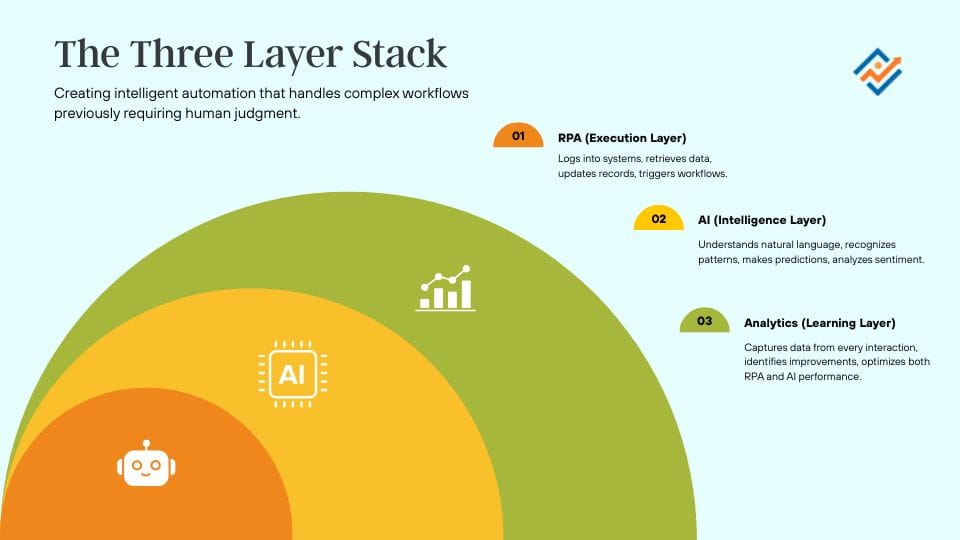
RPA provides the “hands” to execute tasks; AI provides the “brain” for decisions and learning.
The Three-Layer Stack
- RPA (Execution Layer) – Logs into systems, retrieves data, updates records, triggers workflows. Excels at speed and accuracy.
- AI (Intelligence Layer) – Understands natural language, recognizes patterns, makes predictions, analyzes sentiment. Adds decision-making RPA lacks.
- Analytics (Learning Layer) – Captures data from every interaction, identifies improvements, optimizes both RPA and AI performance.
Combined, they create intelligent automation that handles complex workflows previously requiring human judgment.
RPA + AI in Action
- RPA (Execution Layer) – Logs into systems, retrieves data, updates records, triggers workflows. Excels at speed and accuracy.
- AI (Intelligence Layer) – Understands natural language, recognizes patterns, makes predictions, analyzes sentiment. Adds decision-making RPA lacks.
- Analytics (Learning Layer) – Captures data from every interaction, identifies improvements, optimizes both RPA and AI performance.
This process dropped from 8-12 minutes to 3-4 minutes with better accuracy and satisfaction.
What RPA Actually Does: Real Applications
First Call Resolution (FCR)
RPA instantly aggregates information from multiple systems while the agent greets customers. AI analyzes thousands of cases to recommend optimal solutions. After calls, RPA documents everything automatically, creating a continuously improving knowledge base.
Impact: Organizations see 12-25% FCR improvements within 6 months. A major telecom increased FCR from 68% to 84%.
Compliance Automation
AI speech analytics monitors every call in real-time, detecting when agents deviate from required disclosures. RPA triggers alerts when compliance phrases are missed and documents exact timestamps for audits. RPA automatically masks credit card numbers, tokenizes social security numbers, and encrypts health information per HIPAA.
Impact: A healthcare insurer reduced compliance violations by 89% and cut audit preparation from 200 hours to 8 hours.
Sentiment Analysis
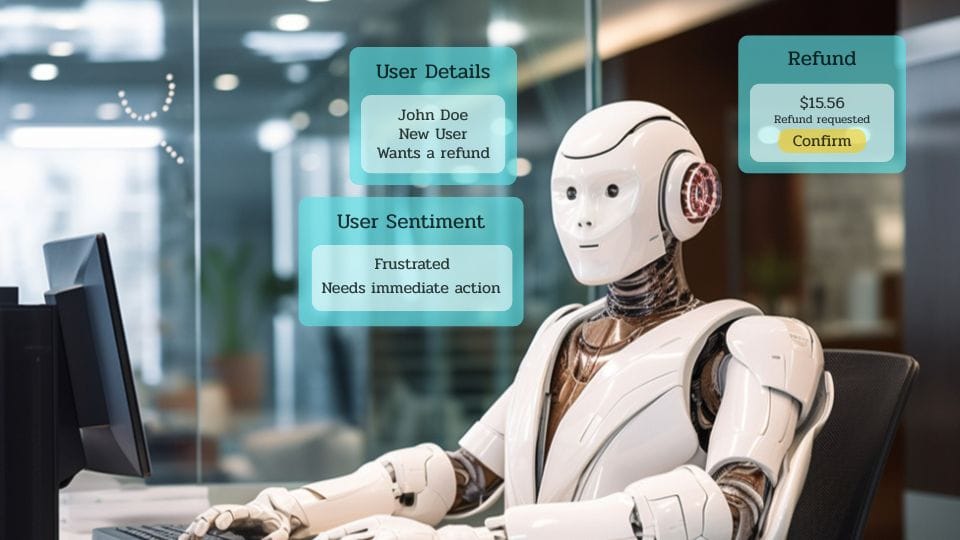
AI analyzes voice sentiment through tone, pitch, and stress indicators. For text channels, it evaluates emotions like anger or confusion. When sentiment drops, RPA instantly routes alerts to supervisors, displays recommendations to agents, and triggers escalation to specialized teams.
- RPA (Execution Layer) – Logs into systems, retrieves data, updates records, triggers workflows. Excels at speed and accuracy.
- AI (Intelligence Layer) – Understands natural language, recognizes patterns, makes predictions, analyzes sentiment. Adds decision-making RPA lacks.
- Analytics (Learning Layer) – Captures data from every interaction, identifies improvements, optimizes both RPA and AI performance.
This process dropped from 8-12 minutes to 3-4 minutes with better accuracy and satisfaction.
Predictive Analytics
AI predicts which customers will likely call in 48 hours and why. RPA executes proactive outreach: “We detected an order issue and already reshipped it” or “Your service expires in 14 days here’s a renewal offer.”
Impact: Organizations reduce inbound volume by 15-30% through proactive outreach.
The Real Benefits: Tangible Outcomes
Operational Efficiency
Average Handle Time drops 20-35% when RPA handles system navigation while AI provides guidance. For a 500-seat center at $40/hour per agent, 25% AHT reduction equals $13M annually.
After-call work transformation is dramatic. Traditional ACW takes 3-5 minutes; automated ACW takes 30-60 seconds. For 10,000 daily calls, reducing ACW by 3 minutes saves 500 hours daily returning 125 FTE-equivalent capacity.
Customer Experience
Mature RPA and AI implementations see Net Promoter Score improvements of 12-20 points. Customer Effort Score drops 30-40% through fewer transfers, less repetition, and faster resolution. Intelligent virtual agents provide 24/7 availability without 24/7 labor costs.
Strategic Impact
Even 2% churn reduction translates to millions in retained revenue. AI-driven offers improve conversion rates by 35-50% versus scripted tactics. Agent attrition drops 8-15 percentage points when automation eliminates tedious tasks, saving $10,000-$15,000 per agent retained.
RPA in 2025: Current State
RPA has matured from simple task automation to intelligent, adaptive systems. Current trends include hyperautomation (combining RPA, AI, ML, and analytics for end-to-end processes), low-code/no-code platforms enabling business users to build bots without programming, and cloud-native RPA that scales on-demand.
The goal isn’t replacing human agents but creating operations where humans and intelligent automation complement each other’s strengths.
Frequently Asked Questions
What’s the difference between RPA and AI in contact centers?
Can RPA work without AI?
What processes are best for RPA automation?
How long to see ROI from RPA?
Is RPA secure for sensitive customer data?
Conclusion
Robotic Process Automation has evolved from back-office tool to critical contact center component. The real magic happens when RPA’s execution capabilities combine with AI’s intelligence RPA provides speed and accuracy while AI adds decision-making and adaptability.
Key takeaways: 70% of implementations fail without proper strategy, but the successful 30% deliver transformational results by starting with clear outcomes and combining RPA with AI. The technology augments human capability so people focus on complex problem-solving and relationship-building.
Organizations winning with RPA understand what it really is, choose the right processes to automate, and view intelligent automation as strategic enablement.
Related Resources
Learn More About AI in Customer Service:
- The Role of AI in Modern Contact Centers – Explore how AI is reshaping modern contact centers
- 5 Ways You Can Adapt to AI in Contact Centers – Practical steps for implementing AI in your operations
- AI vs. Human Agents in Customer Service: Finding the Right Balance – Understanding when to use AI and when humans are essential
- Will AI Replace BPOs? The Human-AI Hybrid Future of Customer Experience – The future of outsourcing in an AI-driven world
- How AI is Transforming Customer Experience Through Hyper-Personalization – Leveraging AI for personalized customer interactions