7 Sentiment Analysis Techniques
That’ll Transform Your Contact Center in 2026
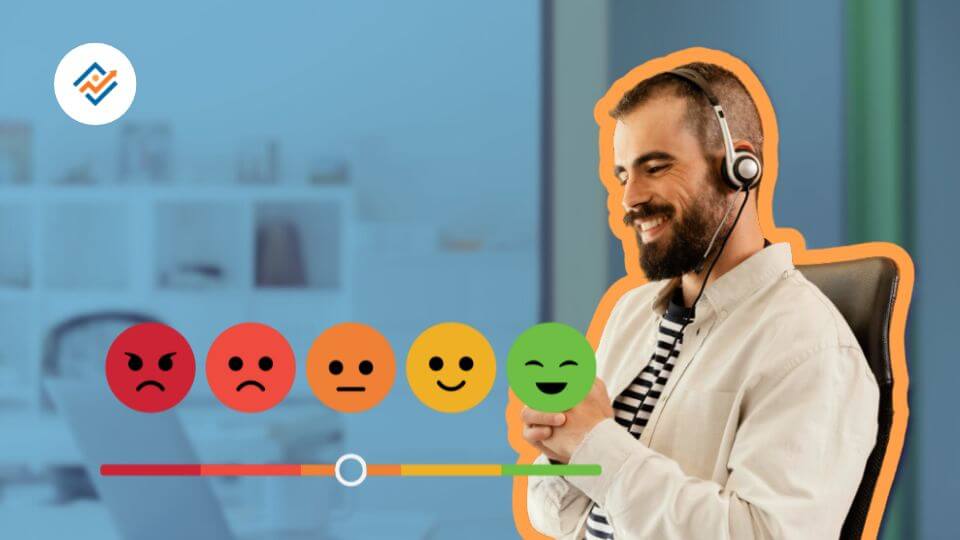
Let’s be honest after fifteen years of running contact centers, I’ve heard enough “how was your experience today?” surveys to make my eyes glaze over. The real kicker? Only a tiny fraction of customers actually respond to those things, and when they do, they’re either wildly happy or absolutely furious. No middle ground, no context, no actionable insights. But here’s where sentiment analysis techniques changed everything for me, and why they’re about to revolutionize your operation too.
What Is Sentiment Analysis?
Sentiment analysis is basically your contact center’s emotional intelligence system. It uses artificial intelligence, natural language processing (NLP), and machine learning to automatically read between the lines of customer conversations whether they’re happening over the phone, through chat, via email, or on social media.
Think of it as having a super-perceptive team member who can instantly tell you whether a customer is genuinely happy, secretly frustrated, or just being polite while internally screaming. Instead of manually reviewing calls one by one (which, let’s face it, nobody has time for), sentiment analysis tools scan every single interaction and categorize the emotional tone as positive, negative, or neutral. They pick up on keywords, phrases, voice patterns, and even the context around what’s being said.
The beauty? It happens automatically, at scale, across all your channels. Every. Single. Conversation.
Why Contact Centers Are Investing in Sentiment Analysis
You might be wondering, “Is this just another shiny tech trend?” Fair question. But the numbers tell a different story.
According to Nextiva’s latest contact center research, 70% of customer experience leaders are planning to integrate generative AI in the next two years, and by 2025, it’s estimated that AI will drive 95% of customer interactions. That’s not a maybe that’s a tidal wave.
Here’s why: A study found that 59% of all consumers felt companies had lost touch with the human element of customer experience. Ouch. But here’s the plot twist sentiment analysis actually helps us get that humanity back. By understanding emotions at scale, we can finally act on what customers actually feel, not just what they’re willing to tell us in a survey.
And if you need more convincing, research shows that after a positive emotional experience, customers are 15 times more likely to recommend a company. Fifteen times! That’s not a rounding error—that’s the difference between surviving and thriving.
The CMSwire report confirms that 96% of contact centers already view AI as a vital technology to help their operations. Translation? If you’re not exploring sentiment analysis techniques yet, you’re already behind.
7 Sentiment Analysis Techniques Every Contact Center Should Master
Not all sentiment analysis is created equal. Let me walk you through the seven core techniques that are actually making a difference in contact centers today.
1. Polarity-Based Sentiment Analysis
This is where everyone starts, and it’s still the workhorse of most operations. Polarity-based sentiment analysis categorizes text into three buckets: positive, negative, or neutral.
This technique uses Natural Language Processing to scan text for sentiment-bearing words and phrases. It relies on lexicons (dictionaries of words with pre-assigned sentiment scores) and calculates an overall polarity score. Words like “excellent” score +1.0, while “terrible” scores -1.0. The system averages these scores to determine overall sentiment, typically on a scale from -1 to +1.
The catch: This technique struggles with context. “This call was not bad” gets marked as negative because of the word “bad,” even though the customer meant it positively. Sarcasm is another killer “Oh great, another transfer” will probably get flagged as positive.
When to use it: Perfect for quick health checks across large volumes. Want to know if that new policy rollout is causing frustration? Polarity analysis will tell you within hours.
2. Emotion-Based Sentiment Analysis
While polarity tells you if a customer is happy or unhappy, emotion-based analysis tells you how they’re unhappy. Are they angry? Anxious? Disappointed? These distinctions matter.
This technique uses emotion models like Ekman’s six basic emotions (anger, disgust, fear, happiness, sadness, surprise) or Plutchik’s wheel (which adds trust and anticipation). Advanced systems use deep learning models trained on datasets labeled with specific emotions, looking for emotion-specific patterns word combinations, sentence structures, and punctuation patterns. Rapid-fire short sentences with exclamation marks signal anger. Questions without answers suggest confusion or anxiety.
Real talk: This is computationally heavier than polarity analysis but the payoff is huge. When you know a customer is anxious rather than angry, your agent can lead with reassurance instead of apologies. Different emotions need different de-escalation strategies.
When to use it: High-value interactions, complaint handling, retention calls, and agent trainingshowing agents exactly which emotional states they handle well and which ones trip them up.
3. Aspect-Based Sentiment Analysis (ABSA)
This is where sentiment analysis gets seriously useful for operational improvements. Instead of “customers are unhappy,” you get “customers love your agents but hate your hold times and find your IVR confusing.”
ABSA has two steps. First, it identifies “aspects” (specific topics mentioned) billing, product quality, agent helpfulness, etc. Second, it determines sentiment toward each aspect separately. Modern ABSA systems use dependency parsing (analyzing grammatical relationships) and attention mechanisms to correctly pair opinions with targets. In “Your agent was helpful, but I waited 45 minutes,” it extracts: Agent → Positive; Wait Time → Negative.
The power play: You might discover that 80% of negative sentiment relates to just 2-3 specific pain points. Now you know exactly where to invest resources.
When to use it: Process improvement initiatives, product feedback analysis, and anywhere you need granular insights. If you’re trying to get budget for a new initiative, ABSA gives you the precise data to make your case.
4. Intent-Based Sentiment Analysis
Sentiment tells you how customers feel. Intent tells you what they’re about to do. In contact centers, that’s often the difference between keeping and losing a customer.
Intent analysis uses NLP and machine learning to identify signals indicating future behavior. It looks for linguistic patterns suggesting purchase intent (“I’m looking to upgrade”), churn intent (“I’m thinking about switching”), or complaint intent (“I need to speak to a manager”). Advanced systems combine sentiment with contextual cues negative sentiment + “cancel” or “competitor” = high churn risk. Some platforms track “intent progression” throughout conversations.
The business impact: Intent analysis enables proactive interventions. When someone says “I’m not sure this is working for me,” it flags potential churn before they explicitly threaten to leave. Your supervisor can intervene in real-time.
When to use it: Retention programs, sales optimization, routing decisions, and personalization. If your contact center does anything beyond simple issue resolution, intent analysis has a role.
5. Fine-Grained Sentiment Analysis
Basic polarity gives you three options. Fine-grained sentiment gives you a spectrum—instead of “this customer is negative,” you get “this customer is slightly disappointed but not yet angry.”
Fine-grained analysis extends the scale into five or more categories: very positive, positive, neutral, negative, very negative. The technical implementation involves training ML models on datasets labeled with intensity levels. The models learn to distinguish between “good” and “absolutely outstanding,” or “not ideal” and “completely unacceptable.” Intensity modifiers like “very” or “extremely,” plus capitalization (TERRIBLE), punctuation (!!!), and repetition (sooo disappointed) influence scores.
Why it matters: The difference between “slightly negative” and “very negative” is often the difference between minor reassurance and a customer about to blow up on social media.
When to use it: Prioritization queues, escalation triggers, performance evaluation, and tracking improvement over time—seeing sentiment shift from negative to neutral to positive tells a story binary classification misses.
6. Multilingual Sentiment Analysis
If your contact center serves customers in multiple languages, this is non-negotiable. But sentiment doesn’t translate directly across languages.
Two main approaches exist. Cross-lingual methods translate everything to one language (usually English) then analyze faster but loses nuance. Native multilingual methods train separate models per language or use multilingual transformer models like mBERT that understand multiple languages natively. The second approach preserves cultural context better, mild dissatisfaction in Japanese might be extremely polite compared to direct German communication. Modern systems handle code-switching (mixing languages) and regional dialects.
The complications: Sarcasm, idioms, and cultural references are nightmares here. “It’s not rocket science” is clear in English but might translate literally in other languages, confusing the detector.
When to use it: Essential for global operations, but also valuable for diverse markets within one country. Ensure your tool was trained on appropriate language datanot just translated English models.
7. Real-Time Sentiment Analysis
This changes the game from reactive to proactive. Instead of analyzing sentiment after calls end, real-time analysis monitors emotional trajectories as conversations unfold.
Real-time systems process audio or text with minimal latency often just seconds behind live conversation. For voice, this means continuous speech-to-text transcription feeding into sentiment models that update every few seconds. The system tracks sentiment “streams” the emotional journey throughout the conversation visualized on live dashboards. When sentiment crosses predefined thresholds (stays negative 2+ minutes, drops sharply, fails to improve), the system triggers alerts.
The complications: Sarcasm, idioms, and cultural references are nightmares here. “It’s not rocket science” is clear in English but might translate literally in other languages, confusing the detector.
Want to know which sentiment analysis tools actually deliver results? We’ve tested dozens and narrowed it down to the platforms that are worth your investment.
Read our review: Top Sentiment Analysis Tools for Contact Centers
Real-World Use Cases
Let me share some scenarios where I’ve seen sentiment analysis techniques create massive impact:
Use Case 1: The Product Launch That Almost Flopped
A retail client launched a new online return process. Within 48 hours, sentiment analysis flagged a spike in frustration around “return label” and “confusing process.” They quickly discovered the return instructions were buried in the confirmation email.
A simple fix moving instructions to the top dropped negative sentiment by 60% within a week. Without sentiment analysis, they would’ve found out through quarterly NPS scores. Months too late.
Use Case 2: The Agent Who Became a Trainer
One agent consistently scored high on sentiment despite having longer handle times. Sentiment analysis revealed she was exceptional at de-escalating angry customers.
The contact center had been about to put her on a performance improvement plan for “slow” calls. Instead, they made her a trainer. Her techniques are now standard practice, and first-call resolution improved by 23%.
Use Case 3: Seasonal Staffing Optimization
An e-commerce contact center used historical sentiment data to predict customer frustration during Black Friday. They noticed that sentiment deteriorated sharply when wait times exceeded 7 minutes. Armed with this data, they hired temporary staff earlier than usual and adjusted schedules based on predicted peak times. Result? Their busiest season ever had their highest sentiment scores.
Use Case 4: Quality Monitoring Revolution
A BPO with 500+ agents was reviewing less than 1% of calls monthly. After implementing sentiment analysis, quality managers could focus exclusively on calls flagged as negative or trending downward. They increased effective QA coverage to 100% of problematic interactions while reducing listening time by 40%. Coach the issues that matter, ignore the calls that went perfectly fine.
Comparing Sentiment Analysis Techniques
| Technique | What It Does | Best Used For | Key Challenges | Accuracy Level |
|---|---|---|---|---|
| Polarity-Based | Classifies sentiment as positive, negative, or neutral | Quick overview of customer satisfaction trends; Dashboard metrics | Misses nuanced emotions; Can’t detect sarcasm well | 75–85% |
| Emotion-Based | Identifies specific emotions (joy, anger, fear, etc.) | Agent training; Understanding customer psychology; Complex issue resolution | Requires more sophisticated AI; Higher computational costs | 70–80% |
| Aspect-Based | Analyzes sentiment toward specific topics or features | Product development; Process improvement; Identifying friction points | Needs well-defined aspects; Can miss new issues not in training data | 80–90% |
| Intent-Based | Predicts customer’s next action or goal | Proactive retention; Upsell opportunities; Escalation prevention | Complex to implement; Requires extensive historical data | 65–75% |
| Fine-Grained | Provides sentiment on a detailed scale (very positive to very negative) | Detailed analysis; Tracking subtle sentiment shifts; A/B testing | More complex to interpret; Risk of over-analysis | 70–80% |
| Multilingual | Analyzes sentiment across different languages | Global operations; Multi-language support centers | Cultural context challenges; Language-specific idioms and sarcasm | 60–75% |
| Real-Time | Analyzes sentiment during live interactions | Live agent coaching; Immediate escalation; Critical customer situations | Requires fast processing; Higher technology costs | 70–85% |
Pro Tip: Most successful contact centers don’t rely on just one technique. Start with polarity-based to get your feet wet, then layer in emotion-based and real-time capabilities as you mature. Aspect-based analysis is your secret weapon for operational improvements.
Frequently Asked Questions
Q: How accurate is sentiment analysis really?
Modern AI-powered sentiment analysis typically achieves 75-90% accuracy, depending on the technique and quality of training data. That’s significantly better than the <5% of interactions traditional QA methods could cover. And here’s the thing even at 75% accuracy across 100% of calls, you’ll catch far more issues than reviewing 100% accurately on 2% of calls.
Q: Can sentiment analysis detect sarcasm?
A: Advanced emotion-based and contextual analysis techniques can detect sarcasm with moderate success (60-70% accuracy), but it remains one of the toughest challenges. The key is combining text analysis with voice tone analysis—sarcastic phrases usually have telltale acoustic signatures that betray the speaker’s true intent.
Q: What about customer privacy concerns?
A: Legitimate question. Sentiment analysis tools should be GDPR and CCPA compliant, working with anonymized data where possible. The analysis focuses on patterns and emotions, not personal identity. Always be transparent with customers that interactions may be recorded and analyzed for quality purposes—which most contact centers already disclose.
Q: How long does it take to implement?
A: If you’re using a third-party platform (which I strongly recommend over building in-house), you’re looking at 4-8 weeks for basic implementation. This includes data integration, model training on your specific interactions, and team training. Real-time analysis might take an additional 4-6 weeks depending on your tech stack.
Q: How does sentiment analysis handle industry-specific terminology?
A: Most platforms allow custom training on your specific vocabulary, acronyms, and jargon. You’ll feed it examples of your actual calls, and it learns that “CPT code error” in healthcare or “GL reconciliation” in finance carry specific sentiment implications in your context.
Q: What if our customer base speaks multiple languages?
A: Multilingual sentiment analysis has you covered, though accuracy varies by language. English, Spanish, French, and German have excellent support. Less common languages might require custom training. The good news is that most enterprise-grade platforms support 50+ languages out of the box.
Q: Will this replace my QA team?
A: No, it makes them superhuman. Instead of randomly sampling calls, your QA team focuses on the interactions that actually matter: the ones flagged for negative sentiment, the stellar performances worth replicating, and the edge cases where the AI isn’t sure. They go from auditors to strategic coaches.
The Bottom Line
Here’s what fifteen years in this business has taught me: Customer emotions are the single most predictive indicator of future behavior. Period. More than NPS, more than CSAT, more than any metric you’re currently tracking. And sentiment analysis techniques finally give us the ability to measure, understand, and act on those emotions at scale.
Is it perfect? No. Will it solve every problem? Absolutely not. But will it give you insights you simply cannot get any other way? Without question.
The contact centers winning in 2025 aren’t the ones with the most agents or the fanciest scripts they’re the ones who understand their customers’ emotions better than anyone else. Sentiment analysis techniques are how you get there.
Start with one technique. Prove the value. Then expand. Your future self (and your CFO) will thank you.
Related Resources
Learn More About AI in Customer Service:
- The Role of AI in Modern Contact Centers – Explore how AI is reshaping modern contact centers
- 5 Ways You Can Adapt to AI in Contact Centers – Practical steps for implementing AI in your operations
- AI vs. Human Agents in Customer Service: Finding the Right Balance – Understanding when to use AI and when humans are essential
- Will AI Replace BPOs? The Human-AI Hybrid Future of Customer Experience – The future of outsourcing in an AI-driven world
- How AI is Transforming Customer Experience Through Hyper-Personalization – Leveraging AI for personalized customer interactions
- RPA in Contact Centers – Understand how Robotic Process Automation works with AI in 2025