
Why Fintech Outsourcing Fails Without PCI DSS / GDPR Compliance
Fintech companies operate in one of the most high-stakes data environments in the world. Every transaction, login, verification step and customer interaction touches highly sensitive financial data. This is why PCI DSS compliant outsourcing and partnering with a GDPR compliant BPO for fintech is not just a best practice, it is a survival requirement.
The global Banking Financial Service Outsourcing (BFSI) market is projected to reach over $185 billion by 2030, with AI-driven outsourcing in fintech seeing a 57% year-over-year increase. Therefore, it’s needless to say that fintech COOs and operations leaders have increased their reliance on outsourcing to scale support, engineering, onboarding, collections, KYC, fraud monitoring, and back-office workflows. Outsourcing helps reduce costs and accelerate operational maturity. But it also introduces severe fintech outsourcing compliance risks if the vendor is not operating under the right security and regulatory frameworks.
Global regulators have tightened scrutiny, issuing significant fines for data mishandling. Beyond financial penalties, the damage to brand trust can be irreversible. In a sector where reputation drives adoption, secure outsourcing for fintech is a strategic decision that determines scalability, investor confidence, and customer retention.
This blog breaks down exactly why PCI DSS and GDPR compliance matter, why many outsourcing partners fail, and how COOs can safeguard their operations with a compliance-first outsourcing strategy.
Understanding PCI DSS & GDPR Compliant Outsourcing for Fintech
What PCI DSS Requires
For fintech companies that store, transmit, or process cardholder information, PCI DSS compliance is mandatory. When outsourcing support or back-office work, the vendor must meet the same security standards your organisation is held to.
A truly PCI DSS compliant outsourcing partner must demonstrate:
- Secure card-handling practices: This includes no card data stored locally, screens masked, and agents trained in zero-retention protocols.
- Encrypted systems: Data in motion and at rest must be encrypted with strong cipher suites.
- Restricted access controls: Only authorised agents can access payment systems, and every login must be authenticated, monitored, and logged.
The purpose is simple and that is to eliminate every possible point of failure where financial data can be intercepted or leaked.
GDPR Requirements for Financial Services
If your company operates in the EU or serves EU customers, GDPR applies even if your outsourcing partner is based outside the region. That means every outsourced process must meet strict GDPR compliance for financial services, including:
- Data minimization: This means only the necessary customer information is collected or processed.
- Right to be forgotten: Vendors must have processes to erase customer data upon request with full audit trails.
- Lawful processing protocols: Every piece of data handled by the BPO must be justified with legal purpose and documented.
Non-GDPR compliant outsourcing not only puts your business at risk but also makes you directly liable for regulatory action.
3 Reasons Why Most Outsourcing Vendors Fail Compliance
Most outsourcing vendors proudly market themselves as “secure,” “GDPR-ready,” or “PCI DSS aligned,” but when you scratch beneath the surface, the reality looks very different. Compliance is not a tagline, it’s an ecosystem of policies, controls, culture, and continuous audits. And this is exactly where the majority of traditional BPOs fall apart.
1. Weak or Outdated Security Setups
A surprising number of vendors still operate on unsecured networks, shared computers, and poorly segmented cloud environments. This means customer data flows across open systems that anyone with the right level of internal access or the wrong level of external intent can tap into.
Some BPOs still allow agents to log in from personal devices, shared Wi-Fi instead of isolated corporate networks, weak passwords or single-factor authentication, and outdated firewalls that have not been patched for years For fintech companies handling identity information, card data, account activity, and transaction logs, these setups are disasters waiting to happen.
2. No Encryption or Tokenization
Compliance failure often begins at the most basic level of unencrypted data movement. Many vendors still send logs, files, ticket summaries, or customer notes in plain text, meaning anyone intercepting the data can read it without any effort. Without tokenization, sensitive data such as card digits or account details can leak into internal systems where they should not exist.
This lack of encryption is not only a bad practice but also a direct violation of PCI DSS rules, and it creates massive vulnerabilities across workflows.
3. Lack of Certified Infrastructure
A vendor claiming to be “GDPR-friendly” is meaningless unless backed by rigorous infrastructure controls. And yet, this is where most outsourcing companies fail the hardest.
A GDPR compliant BPO for fintech must provide certified data centers, tracked access controls, documented breach protocols, annual audit logs, and data processing transparency. However, the reality is that most vendors cannot produce a single audit certificate. They operate on verbal assurances, outdated SOPs, and generic security decks made for sales calls.
The Result: Outsourcing Becomes a Risk Multiplier
When these gaps exist, outsourcing doesn’t reduce operational burden, it amplifies it. Instead of enabling scale, the vendor becomes a new risk surface, exposing your fintech platform to breaches, fines, and long-term customer distrust. This is why compliance must be the first filter not an afterthought.
Growth means nothing if customers don’t feel safe. Compliance-first outsourcing is how fintech companies scale without risking trust, data, or brand equity.
Top 4 Risks of Choosing a Non-Compliant BPO for Fintech Outsourcing
Fintech companies cannot afford to work with vendors who sort of meet compliance expectations. The consequences of choosing a non-compliant outsourcing partner are not small mistakes, they are existential threats.
1. Regulatory Fines That Can Derail a Business
GDPR’s penalty structure allows fines up to 4% of global annual revenue. On the other hand, PCI DSS violations trigger card network penalties, forced forensic audits, transaction-processing restrictions, and mandatory system overhauls. These outcomes can financially and operationally cripple a growing fintech brand.
2. Brand Reputation Damage That Is Nearly Impossible to Reverse
In fintech, trust is your currency. Customers may forgive a UI glitch or a delayed feature but they never forgive data mishandling. A single breach can destroy years of credibility and instantly damage investor confidence.
3. Customer Churn From Fear and Uncertainty
The moment users feel unsafe, they leave. Customer churn spikes dramatically after compliance failures because people integrate fintech tools into their daily financial lives. They need absolute assurance, not uncertainty.
4. Permanent Data Loss or Corruption
A non-compliant vendor often mishandles logs, transaction records, customer identifiers, and compliance tracking documentation. Data corruption or loss can disrupt reconciliation, create financial inaccuracies, and even attract regulatory intervention.
In short, the cost of non-compliance is far greater than the cost of choosing a secure outsourcing partner for your fintech company.
What Does PCI DSS Compliant Outsourcing Look Like?
A truly PCI DSS compliant outsourcing partner will look, feel, and operate differently from the average BPO. They are built for security from the ground up and can demonstrate compliance through infrastructure, culture, and documentation.
Certified Environments Built for Financial Security
A credible vendor has physical and digital environments specifically architected for payment security such as access-controlled floors with biometrics, segregated workstations that isolate financial processes, secure VPN tunnels for encrypted data transmission, and screen masking and session monitoring to prevent leakage so that nothing is left to chance.
Secure Workstations Designed to Eliminate Data Leaks
Workstations in a compliant outsourcing center are intentionally restrictive with USB ports disabled, external storage blocked, restricted browsing, no personal devices, and controlled login windows. These constraints ensure card data cannot be extracted, photographed, copied, or stored.
Audit-Ready Documentation That Proves Compliance
Compliance is not a one-time certificate, it is an ongoing governance. A mature outsourcing partner provides annual PCI DSS audit certifications, agent-level compliance training records, real-time incident response playbooks, data retention and deletion logs, and continuous vulnerability assessments. The bottom line? If a vendor cannot produce documentation, they are not compliant.
What GDPR-Compliance for Financial Services Outsourcing Entail?
Before onboarding any outsourcing partner, COOs must take a structured, checklist-driven approach to evaluating GDPR-compliant BPOs for fintech. GDPR is unforgiving, and in the high-velocity world of fintech, overlooking even one requirement can expose the company to massive fines, reputational loss, and long-term customer distrust. A detailed checklist prevents blind spots, removes assumptions, and ensures the outsourcing partner can support truly secure outsourcing for fintech operations.
Data Processing Agreements (DPA)
A Data Processing Agreement is the backbone of GDPR compliant outsourcing, and it’s non-negotiable. This legal document sets the ground rules for how customer data is processed, shared, protected, and governed. A strong DPA clearly defines:
- What type of data is being shared
- Why the vendor is processing it
- Which party holds responsibility for each stage
- How data will be safeguarded, audited, logged, and retained
Without a DPA in place, GDPR compliance collapses immediately. Many fintech outsourcing failures stem from vague, incomplete, or missing DPAs, and regulators don’t accept ignorance as an excuse. For COOs, ensuring the DPA is airtight is the first and most critical step in preventing fintech outsourcing compliance risks.
Strict Consent Mechanisms
Another pillar of GDPR is consent that is explicit, informed, purpose-bound consent. If your outsourcing vendor processes any customer data outside the approved consent parameters, your organization is already in violation.
A GDPR-compliant BPO must demonstrate clear consent capture workflows, mechanisms to limit processing only to approved data, and protocols to revoke, update, or track consent. Vendors that take a “just send us everything” approach are dangerous partners. For fintech companies handling sensitive financial data, strict consent boundaries ensure customer trust and regulatory compliance remain intact.
Incident Reporting Workflow (The 72-Hour Rule)
Under GDPR, businesses must detect, document, and report any data breach to authorities within 72 hours. This requires a high level of operational maturity, something that many traditional BPOs lack.
A compliant vendor must have a real-time incident tracking system, documented breach escalation workflows, a trained security team available 24/7, and the ability to provide detailed audit logs on demand. If a vendor cannot detect or communicate incidents promptly, fintech COOs are left exposed to huge fines and brand damage.
Data Transfer Safeguards
For fintech companies outsourcing offshore, cross-border data transfers introduce new layers of risk. GDPR requires strict safeguards to ensure customer data remains protected regardless of location.
Key safeguards include:
- Standard Contractual Clauses (SCCs) for international data transfers
- Fully encrypted file transfers (at rest and in motion)
- Proof of jurisdictional compliance within the country of operation
These controls ensure that even when fintech outsourcing happens across continents, GDPR protections stay fully intact.
Physical & Digital Security Controls
Fintech outsourcing compliance is not just about policies. The physical and digital environment must support security by design. A GDPR-compliant BPO environment typically includes CCTV monitoring with timestamp retention, biometric entry systems, restricted IP access, role-based access control (RBAC), segregated VLANs or dedicated networks, and zero-trust workstation configurations.
If any of these are missing, GDPR compliance is compromised. For COOs, validating the environment firsthand is essential. It’s important to remember that the BPO’s physical space is an extension of your own risk perimeter.
How COOs Can Evaluate Compliance
Most compliance failures occur because COOs assume the vendor has everything handled. But in fintech, passive oversight is dangerous. Compliance must be verified, not assumed. COOs should lead from the front, taking an active, structured approach to assessing whether a vendor can genuinely support PCI DSS compliant outsourcing and GDPR compliant outsourcing for fintech. Here’s how:
Ask for Certifications
Legitimate vendors don’t hesitate when asked for certifications, they present them immediately. COOs should request:
- PCI DSS Certification (essential for card-processing fintechs)
- SOC 2 Type II for security and operational maturity
- Documented GDPR processes and DPO details
Any delay, excuse, or resistance is an instant warning sign. Vendors who claim to be compliant but cannot produce documentation typically are not.
Run Independent Audits
Relying solely on a vendor’s internal compliance team is one of the biggest reasons fintech outsourcing compliance risks escalate. COOs should insist on independent validation before onboarding.
This means requesting for third-party penetration testing reports, external audit summaries, annual security findings, and remediation timelines. If a vendor hesitates or attempts to restrict access, that hesitation itself is a red flag. A secure, compliant outsourcing partner is always transparent.
Ensure Security Alignment With Your Internal Policies
Outsourcing never means outsourcing responsibility. Your compliance posture becomes only as strong as the weakest link in the ecosystem. COOs must verify alignment between internal and vendor policies across access control, device policy, data logging and monitoring, encryption standards, and data retention and deletion workflows.
If your fintech’s internal standards exceed the vendor’s capabilities, you inherit their vulnerabilities. Compliance alignment is not optional, it is the foundation of secure outsourcing for fintech operations.
Read more: HIRE Act 2025: How the 25% Outsourcing Tax Affects Companies
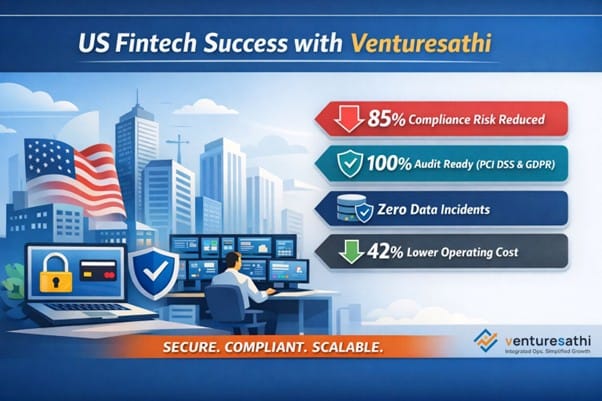
Case Study: How a US Fintech Cut Compliance Risk by 85% With Venturesathi
A US-based fintech needed to scale customer support and fraud operations but struggled to find a vendor with real PCI DSS and GDPR compliance. Most BPOs lacked segmentation, encryption, DPAs, or certified infrastructure, putting the fintech business at risk of fines and data exposure. They chose Venturesathi for its audit-ready systems, including:
- PCI DSS–aligned secure floors and VPN-segmented workstations
- GDPR-ready workflows with DPA, SCCs, and 72-hour incident reporting
- USB-disabled devices, biometric access, and role-based access control
Results After 4 months
- 85% reduction in compliance exposure
- 100% audit readiness
- Zero data incidents
- 42% lower operations cost
By choosing Venturesathi’s BFSI services, the business transformed its outsourcing from a compliance liability into a growth engine. With secure infrastructure, audit-ready documentation, and a compliance-first operating model, Venturesathi helped the US fintech scale confidently without risking regulatory penalties or brand trust.
Conclusion – Compliance First, Outsourcing Second
In fintech, compliance is not a checkbox, it is a competitive moat. The right outsourcing partner helps you scale confidently, accelerate customer support, and maintain regulatory integrity. The wrong one exposes you to catastrophic financial, legal, and operational risks.
For COOs, founders, and compliance teams, the principle is simple. Choose PCI DSS and GDPR compliance first. Choose outsourcing second. Only with a security-first approach can fintech companies scale operations without compromising trust.
Frequently Asked Questions (FAQs)
1. Why is GDPR compliance important when outsourcing fintech operations?
GDPR compliance is critical in fintech because vendors often handle sensitive financial and identity data. A non-compliant outsourcing partner can expose your company to regulatory fines, data breaches, and customer trust issues. Ensuring GDPR alignment protects both your customers and your business.
2. How do I know if my outsourcing vendor is truly PCI DSS compliant?
A genuinely PCI DSS compliant vendor will provide documented proof such as annual audit reports, certified environments, restricted workstations, and evidence of secure data handling processes. If a vendor cannot share certification documents, they are not compliant.
3. What are the risks of working with a non-compliant BPO in fintech?
Partnering with a non-compliant outsourcing vendor can lead to regulatory penalties, card network restrictions, data breaches, operational downtime, and irreversible brand damage. In fintech, compliance gaps directly impact customer retention and platform reputation.
4. What should a GDPR-compliant outsourcing agreement include?
A GDPR-compliant outsourcing contract must include a Data Processing Agreement (DPA), clear consent mechanisms, breach reporting obligations, data transfer safeguards, and well-defined roles for data protection. Without these, GDPR compliance cannot be validated.
5. How can COOs evaluate whether an outsourcing partner follows proper data security standards?
COOs should request certifications like PCI DSS and SOC 2 Type II, run independent audits, verify incident reporting workflows, and ensure alignment on access control, device usage, encryption, and data retention policies. Compliance must match your internal security posture.
6. Can offshore outsourcing still meet GDPR requirements?
Yes, offshore outsourcing can be fully GDPR-compliant if the vendor uses Standard Contractual Clauses (SCCs), encrypted data transfers, strict access controls, and verified security measures. Geography is not the problem, poor safeguards are.