
Outsourcing in Hybrid Teams: Future of Work Trends 2026
In 2026, hybrid work has established itself as the default, with an estimated 64% to 67% of companies adopting a hybrid model. Therefore, what began as a temporary solution has now evolved into a long-term workforce strategy. Leaders today are not struggling with whether to adopt hybrid models. The real challenge lies in how to scale operations, maintain productivity, and control costs in a distributed environment. This is where the future of work outsourcing becomes a strategic lever.
Without a structured approach to remote work outsourcing and hybrid support models, businesses often face:
- Lack of visibility across distributed teams
- Inconsistent service quality across geographies
- Rising operational costs due to inefficiencies
- Difficulty in scaling teams quickly
Without a structured approach to remote work outsourcing and hybrid support models, businesses often face:
Understanding The Future of Work Outsourcing & Remote Work Outsourcing
With the global IT outsourcing market predicted to grow from $565.2 billion in 2025 to $833.66 billion by 2033, outsourcing is no longer viewed as a back-office function or a cost-reduction tactic. It has become a strategic approach to building flexible, scalable operations that support hybrid teams.
Modern outsourced teams function as an extension of in-house teams. They work within shared tools, follow the same workflows, and are measured against common performance metrics. This shift has transformed outsourcing into a partnership model that enables organizations to improve execution speed, access specialized talent, and build long-term operational flexibility.
At the same time, remote work outsourcing has become essential for distributed environments. Hybrid teams often face challenges such as limited visibility, resource constraints, and scalability gaps. Outsourcing helps bridge these gaps by providing immediate access to skilled professionals who can support ongoing operations without long hiring cycles.
For example, businesses can:
- Scale customer support across time zones
- Manage backend operations during peak demand
- Expand content or operational capacity without increasing fixed costs
Read more: How Founders Should Think About Outsourcing in Their First 3 Years
Hybrid Support Models: The Backbone of Modern Workforces
Research shows hybrid workers are often more engaged due to having a balance between flexibility and human interaction at work, with 63% of high-growth companies adopting a “productivity anywhere” model, benefiting from reduced distractions and faster resolution times.
Therefore, modern organizations require a balance between internal control and external scalability. Instead of relying entirely on in-house teams or fully outsourcing operations, businesses are now combining both approaches to create a more efficient workforce.
What Hybrid Support Models Look Like in Practice
Hybrid support models integrate internal teams with outsourced specialists who work together within shared workflows and systems. For example, internal teams may focus on strategy, planning, and decision-making while outsourced teams may handle execution-heavy tasks such as customer support, data processing, or operational workflows. This structure allows organizations to maintain control over critical business functions while improving operational efficiency.
Combining In-House Teams with Outsourced Remote Specialists
One of the biggest advantages of hybrid support models is that they allow businesses to focus internal resources on high-value activities. Instead of spending time on repetitive operational tasks, internal teams can focus on strategy and innovation, customer experience improvements, business development, and product growth.
Outsourced teams, on the other hand, can handle routine and execution-heavy tasks efficiently. This creates a balanced workforce that is both productive and scalable.
How Hybrid Support Models Improve Productivity and Flexibility
Hybrid models improve productivity by reducing workload bottlenecks and improving execution speed. They also allow businesses to operate more flexibly.
For example:
- Teams can work across multiple time zones, enabling round-the-clock operations
- Businesses can scale operations quickly without long hiring cycles
- Workloads can be distributed more efficiently across teams
This flexibility is essential for companies that want to remain competitive in fast-changing markets.
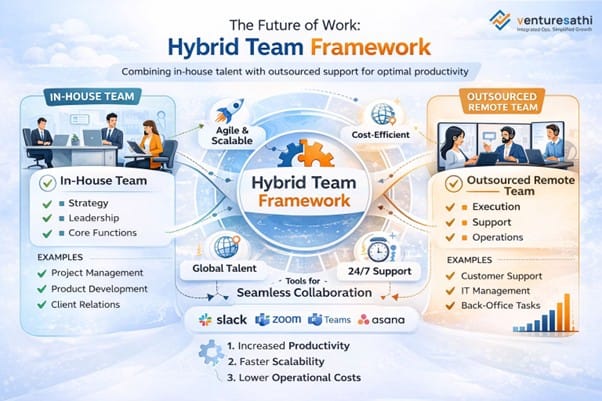
The future of work is not about choosing between in-house and outsourced teams, it’s about building hybrid ecosystems where both work seamlessly to drive speed, efficiency, and growth.
Top 4 Benefits of The Future of Work Outsourcing
To remain competitive, businesses need to operate with speed, flexibility, and cost efficiency. The future of work outsourcing helps organizations achieve all three while building scalable systems that support long-term growth.
1. Operational Flexibility for Hybrid Teams
One of the most significant benefits of outsourcing is cost optimization. Companies can reduce expenses related to office infrastructure, recruitment and onboarding, employee benefits, and training and development.
2. Cost Optimization Through Remote Work Outsourcing
One of the most significant benefits of outsourcing is cost optimization. Companies can reduce expenses related to office infrastructure, recruitment and onboarding, employee benefits, and training and development.
3. Faster Scaling of Business Operations
Outsourced teams allow organizations to expand operations without delays caused by recruitment cycles. This makes it easier for businesses to grow quickly while maintaining performance.
4. Improved Service Coverage Across Time Zones
Global outsourced teams make it possible for businesses to operate 24/7. This improves response times, enhances customer experience, and strengthens brand reputation.
3 Best Practices for Implementing The Future of Work Outsourcing
Successful outsourcing requires more than hiring external teams. It requires a structured approach that focuses on communication, performance, and long-term efficiency. Here’s how:
- 1. Build Clear Workflows for Remote Work Outsourcing Teams: Clearly defined workflows ensure that all team members understand their roles and responsibilities. This reduces confusion and improves execution.
- 2. Use Collaboration Tools to Support Hybrid Support Models: Shared platforms ensure consistency and transparency across teams. This helps organizations maintain control while improving productivity.
- 3. Establish Performance Metrics for Outsourced Teams: Tracking key metrics such as turnaround time, quality, and productivity helps businesses measure success and improve efficiency.
Read more: Top Call Centers in USA (2026): Best BPO Companies for Customer Support & Outsourcing
Top Industries Adopting The Future of Work Outsourcing
Outsourcing is no longer limited to a few sectors. It is being widely adopted across industries that require scalability and operational efficiency such as:
SaaS and Technology Companies
SaaS companies are among the biggest adopters of future of work outsourcing. With rapid growth and global customer bases, they rely heavily on outsourced teams for customer support, technical assistance, onboarding, and content operations.
Hybrid models allow SaaS companies to maintain product control internally while scaling support and operations externally. This ensures faster response times, improved user experience, and the ability to handle growth without overburdening internal teams.
Customer Support and Back-Office Operations
Customer support and back-office functions are naturally suited for remote work outsourcing due to their process-driven nature. Businesses use outsourcing to manage high-volume tasks such as ticket handling, data processing, order management, and documentation.
The key advantage here is consistency and scalability. Outsourced teams can handle fluctuating workloads efficiently while maintaining service quality through standardized workflows and performance metrics.
Healthcare and Financial Services
Highly regulated industries like healthcare and financial services are increasingly adopting outsourcing, but with a strong focus on compliance and data security.
In these sectors, outsourcing is used for operational support functions such as claims processing, patient support, documentation, and financial operations. Hybrid support models help these industries balance compliance with efficiency by keeping sensitive functions in-house while outsourcing structured, non-core operations.
E-commerce and Retail
E-commerce businesses use outsourcing extensively to manage seasonal demand spikes, especially during sales and festive periods. Functions like customer support, order processing, inventory updates, and returns management are often outsourced.
This allows businesses to scale operations quickly without long-term hiring commitments, ensuring both cost efficiency and consistent customer experience.
Case Study: Building High-Performance Hybrid Teams with Venturesathi
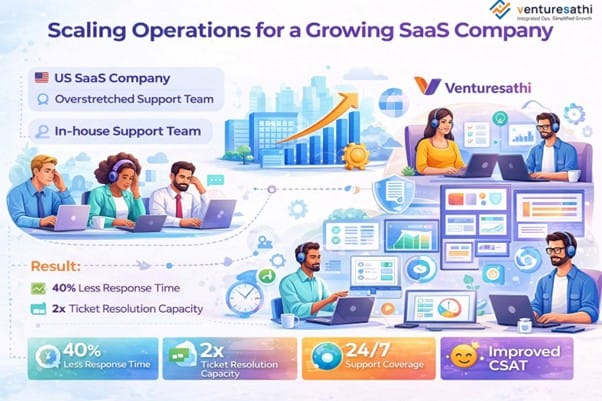
A US-based mid-sized SaaS company struggled to manage rising customer support volumes while maintaining quality across time zones. Their in-house team was overstretched, and hiring locally was slow and expensive.
What Venturesathi did:
Venturesathi implemented a structured remote work outsourcing model by integrating an external support team into existing workflows. Clear SOPs, shared dashboards, and performance metrics were established to ensure alignment with internal teams.
Result:
– Improved CSAT due to faster and consistent service
– 40% reduction in response time
– 2x improvement in ticket resolution capacity
– 24/7 support coverage without increasing fixed costs
Key Takeaway
When executed correctly, hybrid support models do not just reduce costs, they improve speed, scalability, and overall operational performance, making them a core part of the future of work outsourcing strategy.
Conclusion: Preparing for the Future of Work with Outsourcing
US Startup: Scaling Without Complexity
The shift to hybrid work is redefining how businesses operate, scale, and compete. Organizations that embrace the future of work outsourcing can build flexible, efficient, and high-performing teams that adapt quickly to changing market conditions.
By leveraging remote work outsourcing and structured hybrid support models, businesses can overcome operational challenges and create a scalable foundation for long-term growth. Therefore, in 2026 and beyond, outsourcing is no longer just a cost-saving strategy. It is a strategic advantage that enables businesses to build resilient, future-ready organizations.
Frequently Asked Questions (FAQs)
1. How do you onboard remote outsourcing teams effectively?
Effective onboarding for remote work outsourcing requires structured training, clear documentation, and access to collaboration tools. Businesses should also assign onboarding managers to ensure alignment with workflows and expectations.
2. What roles are best suited for the future of work outsourcing?
Roles such as customer support, back-office operations, data processing, and technical support are ideal for the future of work outsourcing. These functions benefit from scalability and standardized processes.
3. How do companies ensure data security in remote work outsourcing?
Organizations should implement secure access controls, encrypted systems, and compliance-driven processes. Following strict governance ensures that hybrid support models remain secure and reliable.
4. How can businesses scale remote outsourcing teams quickly?
To scale remote work outsourcing, companies should build flexible contracts, maintain a pre-vetted talent pool, and use standardized workflows. This allows rapid team expansion without operational disruption.
5. What is the difference between outsourcing and staff augmentation?
Outsourcing involves delegating entire processes to external teams, while staff augmentation adds external talent to existing teams. Both models support the future of work outsourcing but serve different operational needs.