Top Metrics Every Contact Centre Must Track And Why They Matter
Modern contact centres have evolved far beyond traditional phone queues. Today, they operate as AI-powered customer experience engines, where every interaction is optimized through data, analytics, and automation. According to a Gartner report, organisations using AI in contact centers have reduced Average Handle Time (AHT) by 18-25 minutes per interaction and improved Customer Satisfaction (CSAT) scores by 12–18%. These are benchmarks that no high-performing team can afford to ignore.
But AI alone is not enough. What truly drives operational excellence is the ability to measure the right metrics, analyse them consistently, and use AI-driven insights to elevate every stage of the customer journey. This is where businesses often struggle. Either they measure too little, measure the wrong things, or fail to connect their metrics with action.
In this blog, we will break down the most important metrics every contact centre must track, and how emerging technologies such as AI customer support, AI call center automation, conversational AI, and AI chatbots make those metrics stronger and more predictable.
Why Metrics Matter in AI-Driven Contact Centres
Metrics are the backbone of every high-performing support organisation. When you understand the right numbers, you understand everything from productivity and efficiency to customer satisfaction, and team performance. Moreover, as more companies adopt AI in contact centers, the importance of these metrics dramatically increases.
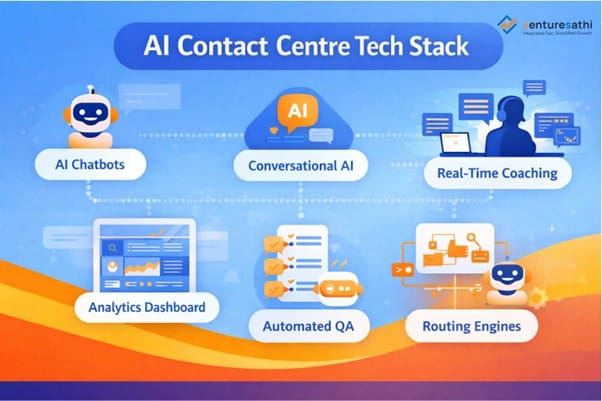
Modern AI tools now feed live insights directly into dashboards, enabling teams to make faster, more precise decisions. Features such as real-time AI customer support prompts, sentiment detection, automated routing, and agent assist technologies mean that every metric becomes more actionable.
- AI offers real-time coaching that improves call quality in real-time.
- AI call center automation reduces manual workload, freeing agents to focus on complex issues.
- Conversational AI captures intent, sentiment, and friction points instantly.
- AI chatbots benefits include round-the-clock availability and consistent service quality.
The future of support is not AI replacing humans. It is humans powered by intelligent AI systems.
Top 10 Metrics Every Contact Centre Must Track
Below are the 10 essential metrics that every business must consistently monitor.
1. Customer Satisfaction Score (CSAT)
CSAT is the most widely recognised indicator of how customers feel after an interaction. When combined with AI in contact centers, CSAT becomes even more powerful because conversational AI can analyse tone, sentiment, and friction before an after-call feedback or survey is even sent.
2.Net Promoter Score (NPS)
NPS measures long-term customer loyalty by asking whether a customer would recommend your brand. It helps organisations understand customer advocacy, brand perception, and repeat business potential. AI customer support systems can detect recurring issues impacting NPS long before they escalate.
3. Average Handle Time (AHT)
AHT indicates the average time an agent spends resolving a customer’s issue, including talk time, hold time, and wrap-up. AI call center automation dramatically reduces AHT by generating automatic summaries, real-time knowledge suggestions, and after-call work automation.
3. Average Handle Time (AHT)
AHT indicates the average time an agent spends resolving a customer’s issue, including talk time, hold time, and wrap-up. AI call center automation dramatically reduces AHT by generating automatic summaries, real-time knowledge suggestions, and after-call work automation.
4. First Contact Resolution (FCR)
Widely regarded as the most important customer service metric worldwide, FCR tracks the percentage of issues resolved in the first interaction. High FCR means customers get solutions without unnecessary transfers, callbacks, or escalations. AI in contact centers boosts FCR by providing live decision support, automated workflows, and instant knowledge retrieval.
5. Service Level (SL)
Service level measures the percentage of calls or chats answered within a predefined threshold, often within 20 or 30 seconds. It reflects how effectively a team manages volume, staffing, and peak-time demand. With conversational AI routing, contact centres can meet their SL targets even during peak volume.
6. Abandonment Rate
This tracks how many customers disconnect before connecting with an agent. High abandonment rates usually indicate long wait times, staffing gaps, or poor routing logic. AI chatbots benefits include providing immediate assistance that reduces abandonment dramatically.
7. SLA Achievement
Service Level Agreement (SLA) achievement measures how consistently the support team meets its contractual response or resolution commitments. For B2B and enterprise clients, this metric directly impacts trust and retention. AI in contact centers ensures compliance by predicting SLA breaches before they occur.
8. Quality Score
Quality scores evaluate the accuracy, professionalism, empathy, and compliance of each customer interaction. Quality assurance teams review a percentage of interactions to maintain consistency and reinforce performance standards. AI customer support tools assist agents in real-time, significantly improving quality across all channels.
9. Ticket Backlog
Ticket backlog represents unresolved or aging queries that remain open beyond their expected timelines. A high backlog typically signals process inefficiencies, staffing shortages, or poor workflow prioritization. AI call center automation clears backlogs by streamlining repetitive tasks and triaging issues intelligently.
10. Average Speed of Answer(ASA)
ASA tracks how long it takes for agents to answer incoming calls or chats. It is closely related to customer patience, overall experience, and perceived support availability. Conversational AI and AI chatbots reduce ASA by offering instant responses, even when agent availability is limited.
Read more: How AI Chatbots Will Transform Customer Service in 2026
How AI Enhances Contact Centre Metrics
AI is no longer a futuristic add-on. It is now the operating system behind efficient contact centres. From reducing workloads to improving decision-making, AI accelerates every major support metric.
AI Reduces AHT
AI in contact centers dramatically lowers handling time by offering real-time support to agents. Tools like automated summaries, instant knowledge recommendations, and context-aware prompts help agents find answers faster without searching through multiple systems.
AI customer support platforms also automate routine workflows such as identity verification, ticket tagging, and summarization, thus allowing agents to focus on problem-solving rather than administrative tasks.
AI Improves First Contact Resolution
Intelligent systems pull relevant customer history, past interaction context, and knowledge base articles instantly. This helps agents deliver complete and accurate resolutions in a single conversation, directly boosting FCR.
AI call center automation further supports this by auto-triggering workflows like refunds, follow-up emails, or account actions, thus eliminating human delays.
AI Enables Predictive and Skill-Based Routing
One of the biggest advantages of AI in contact centers is its ability to route customers to the best-matched agent. Routing is based not just on availability but on skills, historical success, sentiment, and issue complexity.
This predictive routing improves CSAT, reduces wait time, and prevents unnecessary escalations.
AI Chatbots Improve Availability
AI chatbots’ benefits go far beyond simple query handling. Modern conversational AI can resolve repetitive questions instantly, ensuring 24/7 global availability. This significantly reduces abandonment rates and ticket backlog.
When bots escalate to humans, they also pass complete context, thus shortening resolution time and reducing customer frustration.
Conversational AI Speeds Up Query Resolution
Conversational AI understands intent, sentiment, and urgency. It guides customers through multi-step resolutions, verifies details, and provides tailored responses. This ensures faster, more accurate support and stronger customer engagement across live chat, voice, and messaging.
Read more: Will AI Replace Call Center Agents or Make Them Better?
The Future of AI-Driven Support
The world of customer service is moving rapidly toward intelligent automation. As contact centres become more complex, tracking the right metrics becomes non-negotiable. AI amplifies every vital performance indicator from AHT and FCR to CSAT and service levels, thus freeing up human agents to focus on deeper customer engagement.
FAQs
AI in contact centers improves CX by reducing waiting times, enhancing accuracy, predicting customer needs, and offering 24/7 AI customer support.
Yes. AI call center automation reduces manual workloads, speeds up resolutions, and lowers staffing costs by automating repetitive processes.
AI chatbots benefits include instant responses, reduced backlog, lower abandonment rates, and improved first response time.
No. Conversational AI supports agents by handling simple queries and leaving complex issues to humans, thus improving efficiency and customer satisfaction.
Start small with AI customer support tools like knowledge assistants and chatbots, then scale to predictive routing, sentiment AI, and workflow automation.