
How AI Is Transforming Contact Centres in 2026
The AI customer service sector is expected to hit $4.1 billion by 2027 proving that the contact centre landscape has changed a lot in the last few years and is expected to grow further in the future. Brands that once relied on manual, agent-driven phone support are now shifting to AI-powered contact centers as a core part of their customer experience strategy. What started as experimentation with chatbots has grown into a full transformation where AI customer support is no longer optional, it’s becoming mandatory in 2026.
This blog explores how contact centres have evolved over the decades, what core AI technologies are reshaping the industry, and why AI call center automation is becoming the operating system for modern support.
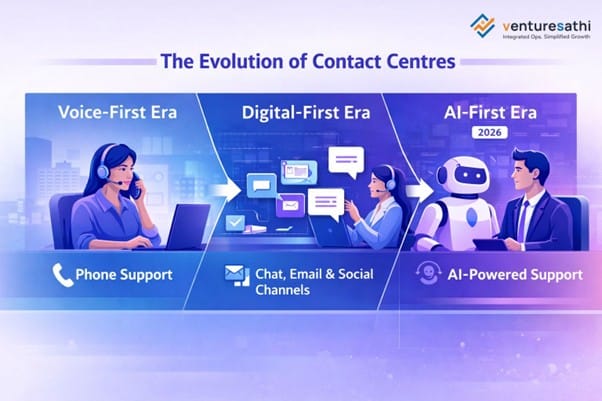
The Evolution of Contact Centres
The journey of contact centres has moved through three major phases:
1. Voice-First Era
Support was dominated by phone calls and human agents. While personal, it was slow and unscalable.
2. Digital-First Era
Brands introduced chat, email, social channels, and self-service. However, the experience still relied heavily on human effort.
3. AI-First Era (2026)
We are now in a world where AI in contact centers is the primary layer that powers every support workflow, from routing and triaging to resolution and analytics.
Automation is the new operating layer, integrating with CRMs, ticketing systems, and knowledge bases to deliver consistently high-quality support. Instead of replacing agents, AI elevates them by handling repetitive tasks while humans can focus on complex emotional or strategic interactions.
4 Core AI Technologies Transforming Contact Centres
1. Conversational AI in Support
Modern conversational AI in support goes far beyond traditional chatbots. With advanced Natural Language Understanding (NLU) and contextual memory, conversational AI can understand semantic intent, recall previous conversations, interpret tone and sentiment, and hand off to agents seamlessly. Instead of rigid scripts, these AI systems mimic natural conversations, bringing human-level intelligence to every customer touchpoint.
Predictive AI for Routing & Workflows
Predictive AI evaluates customer intent, history, mood, and complexity to assign each interaction to the agent most likely to succeed. This results in higher first-contact resolution (FCR), reduced escalations, more efficient agent workload distribution, and faster customer outcomes. Predictive routing is becoming a standard part of enterprise-grade AI customer support ecosystems.
AI Call Center Automation
AI call center automation streamlines operations through the following methods:
Automated Summaries
After a call or chat, AI instantly generates accurate summaries including reason codes and next steps, thus saving agents valuable time.
Auto-Tagging
AI automatically categorizes tickets based on intent and sentiment, improving analytics accuracy.
Workflow Orchestration
AI triggers workflows such as approvals, refunds, CRM updates, or escalations without manual intervention.
With AI handling these workflows, agents get more time to focus on customer satisfaction rather than administrative tasks.
AI Chatbots Benefits
AI chatbots have matured significantly in 2026, delivering 24/7 support availability, instant triaging and self-service, lower cost per contact, higher accuracy due to contextual learning, and scalability during volume spikes. The biggest shift? AI agents can now resolve a significant percentage of queries end-to-end without human handoff.
4 Key Benefits of AI in Contact Centers
Reduced AHT & Faster Resolution
One of the biggest advantages of AI in contact centers is how dramatically it reduces Average Handle Time (AHT). Instead of agents scrambling through tabs, documents, or outdated knowledge bases, AI steps in with real-time guidance. It serves up suggested responses, relevant knowledge snippets, and automated actions the moment an inquiry comes in.
This cuts down on on-call friction, removes the need for manual searching, and helps agents get straight to the solution instead of spending time figuring out how to solve it. The result is simple, customers get faster answers, and agents feel more confident and efficient in every interaction.
Improved FCR & CSAT
AI customer support excels at improving First Contact Resolution (FCR) and boosting Customer Satisfaction (CSAT). By analyzing customer history, sentiment, and behavior, AI gives agents a richer, more complete picture of the customer’s issue before they even speak.
That means replies are more accurate, more relevant, and personalized and not generic scripts. Predictive insights help agents anticipate needs or recommend next steps without guesswork. With every interaction becoming more context-aware and consistent, both FCR and CSAT naturally climb.
Lower Operational Costs
A major reason brands adopt AI call center automation is to reduce operational costs without sacrificing quality. AI takes over repetitive, manual tasks that do not require human judgment such as basic L1 support, triaging, data tagging, or routine back-office processes.
As these tasks get automated, companies can operate with smaller frontline teams, or better yet, redeploy agents to strategic roles. QA and audit workloads also drop because AI auto-generates summaries, tags conversations, and flags anomalies with precision. Overall, support operations become leaner, faster, and far more cost-efficient.
Enhanced Agent Productivity
In today’s AI-first contact center, agents are no longer bogged down by copy-paste work or endless data entry. AI in contact centers takes care of note-taking, case tagging, knowledge lookup, and even drafting responses.
That frees agents to focus on what actually matters which includes complex conversations, high-value customer moments, and creative problem-solving. When low-value work disappears, agent morale improves, performance rises, burnout reduces, and retention naturally increases.
Read more: Top Metrics Every Contact Centre Must Track And Why They Matter
How Conversational AI Elevates Customer Experience
Modern conversational AI in support reshapes customer experience across every channel including chat, email, phone, social, and self-service.
Context Continuity
One of the biggest frustrations customers face is repeating themselves. Conversational AI eliminates that barrier completely. It remembers past interactions, previous issues, and customer preferences even when conversations happen across different channels. That continuity makes the experience feel seamless and respectful of the customer’s time, significantly reducing effort.
Tone & Sentiment Analysis
If your knowledge base differs by channel, customers will receive inconsistent answers.
A centralised, updated knowledge base ensures standardised messaging, accurate information, and faster, more confident responses.
Intelligent Routing and Personalisation
Today’s AI customer support systems can detect frustration, urgency, confusion, or satisfaction in real time. Sentiment cues help AI modify the tone of automated responses or push the conversation to a human when sensitivity is required.
This ensures customers always receive the right kind of support meaning empathetic when needed, quick when appropriate, and proactive when issues start escalating.
Personalized Replies
With the help of interaction history and behavioral data, conversational AI crafts responses tailored to each customer’s unique profile. It can recommend the most relevant solution, personalize the tone, and even predict what the customer might need next. This level of personalization builds trust, reduces resolution time, and makes the entire experience feel more human even when AI is doing heavy-lifting.
Key Real-World Use Cases & Metrics of AI in Customer Support
Many organisations that have implemented AI in contact centers report dramatic real-world outcomes. Here are some use cases and key statistics of AI enhancing customer experience:
- Contact centres using real-time agent assist tools and AI recommendations have seen Average Handle Time (AHT) drop by around 30–50%, freeing up agents to focus on higher-value conversations rather than manual lookups and repetitive tasks.
- Advanced conversational AI in support systems can autonomously resolve a large portion of routine queries, with many deployments handling the bulk of basic tickets before human intervention is even needed.
- Customer satisfaction also tends to improve with brands reporting CSAT increases of 25% or more once AI-driven context and personalised responses are in place, reducing friction and repeat contacts.
- In addition, AI chatbots’ benefits include significant ticket deflection, where virtual assistants and self-service bots handle a large share of incoming inquiries, preventing them from ever reaching human agents.
- On the operational side, organisations leveraging AI call center automation have seen substantial cost savings, often up to 50% reduction in operational cost per contact by automating repetitive work and optimising staffing levels.
The Future of AI in Contact Centers
The next wave of AI in contact centers is not just about automation, it’s about redefining how customer support operates at its core. As organisations evolve toward AI-first service models, three major shifts will reshape the industry.
Hyper-Personalized Support
The future of customer experience lies in hyper-personalization powered by AI. Instead of generic responses, AI will understand a customer’s preferences, history, tone, and even behavioral patterns to deliver highly personalised solutions in real time. Think of it as moving from “one-size-fits-all” support to micro-personalization, where every interaction feels tailor-made.
AI-Led Workforce
Contact centers are steadily transitioning to an AI-led workforce, where virtual agents handle most frontline, high-volume queries. These AI agents will take care of FAQs, troubleshooting, order status, billing updates, and other routine conversations with near-human accuracy. But, human agents will not disappear, they’ll shift into specialist roles, managing escalations, complex problem-solving, and high-value interactions that require empathy, judgment, or negotiation.
Real-Time Knowledge Engines
Static knowledge bases are becoming obsolete. The next generation of AI knowledge engines will update themselves continuously by learning from every ticket, call, and customer conversation. These real-time engines will suggest the best answers instantly, identify emerging issues, improve accuracy with every interaction, and reduce dependency on manual documentation.
The Human and AI Partnership
The future is not about choosing between AI or humans. It’s about AI and humans working together to create the most efficient, scalable, and customer-centric support ecosystem ever designed. AI will handle the heavy lifting, while humans focus on doing what they do best that is empathy, connection, and complex decision-making.
Read more: Will AI Replace Call Center Agents or Make Them Better?
Closing Thoughts
AI in contact centers is not a trend, it’s the foundation of modern customer experience. From conversational AI to predictive routing and automation, AI enables faster support, lower costs, and happier customers. Brands that adopt AI by 2026 will gain a competitive edge, while those who do not risk falling behind.
Frequently Asked Questions (FAQs)
No. AI will not replace human agents in contact centers. Instead, AI in contact centers acts as an augmentation layer, taking over repetitive, low-value tasks such as data entry, summarisation, and triaging. Human agents continue to lead complex, emotional, and high-stakes customer conversations where empathy and judgment matter most.
The biggest advantages of AI customer support include significantly reduced AHT, improved FCR, and smarter predictive routing. Brands also see better personalization, higher CSAT, and major cost savings through AI call center automation that eliminates manual workload and accelerates resolutions.
Yes. Conversational AI in support is far more advanced than old rule-based chatbots. It understands intent, sentiment, context, and multi-turn conversations, making interactions feel natural and human-like. This leads to better engagement, higher accuracy, and stronger AI chatbots benefits across every touchpoint.
Implementing AI customer support is now easier than ever. Modern AI platforms integrate seamlessly with CRMs, helpdesks, IVRs, telephony systems, and ticketing tools. Most organizations can deploy AI in contact centers within a few weeks, with minimal disruption to existing workflows.
No. AI call center automation is now widely used by SMBs, startups, and mid-market companies. Smaller teams adopt AI to scale without hiring large support teams, reduce cost per contact, and improve customer experience with conversational AI and intelligent automation.