24/7 Customer Support Strategy: Building Always-On Support Without Breaking the Bank
Modern SaaS businesses operate in a world where customers expect instant responses regardless of time zone. Whether a user logs in from New York at midnight or Singapore during business hours, they expect reliable assistance. This shift in expectations has made a 24/7 customer support strategy a critical component of successful global SaaS operations.
However, building always-on support internally can quickly become expensive and operationally complex. Hiring round-the-clock teams, maintaining quality standards, and managing multiple shifts can significantly increase operational costs.Therefore, 73% of US businesses have already included back-office teams offshore that have access to smarter models for delivering cost-effective 24/7 support. By combining outsourced teams, automation, and structured quality monitoring, growing SaaS companies are providing continuous support without overextending their budgets.
Why 24/7 Customer Support Strategy Is Critical for Global SaaS Businesses
A well-designed 24/7 customer support strategy directly impacts customer experience, retention, and brand reputation. For SaaS companies serving global audiences, round-the-clock support is no longer optional due to the following reasons:
Rising Customer Expectations
Customer expectations have evolved dramatically in the digital era. Users now expect real-time assistance through chat, email, or helpdesk systems. Long response times can quickly lead to frustration, negative reviews, or even churn.
For SaaS businesses that rely on recurring subscriptions, every interaction matters. A quick and helpful response can turn a frustrated user into a loyal advocate.This is why many companies are investing in automated customer support, knowledge bases, and scalable service models to ensure consistent responsiveness.
Global Users Across Time Zones
SaaS platforms rarely operate within a single geography. A product launched in one market often gains traction internationally within months. Without a global 24/7 customer support strategy, companies risk leaving international customers without assistance for long periods of time. This creates a fragmented user experience.
Hence, businesses that successfully implement cost-effective 24/7 support ensure that customers receive help whenever they need it, regardless of location.
The Challenges of Running 24/7 Customer Support In-House
While always-on support sounds ideal, running a fully internal support operation can be extremely demanding for growing companies. Here’s how:
High Staffing Costs
Providing round-the-clock support requires multiple shifts, larger support teams, and additional management oversight. For many startups and mid-sized SaaS businesses, hiring enough agents to cover 24-hour support can significantly increase payroll costs. Benefits, training, and infrastructure expenses add further complexity. This is why many organizations begin to explore outsource customer service models as they scale.
Rough Cost Comparison: In-House vs Outsourced vs Automated Support
| Support Model | Est. Monthly Cost (10k–15k tickets) | Key Cost Drivers | Scalability |
|---|---|---|---|
| Fully In-House Support Team | $60,000 – $120,000 | Salaries, benefits, infrastructure, management | Limited — requires new hires |
| Outsourced Customer Service Team | $25,000 – $50,000 | Vendor fees, onboarding, management | High — teams scale quickly |
| Automated Support & Small Team | $10,000 – $30,000 | Automation tools, chatbot setup, minimal agents | Very High — automation handles volume |
Note: Costs vary based on ticket volume, complexity, and support channels.
This comparison illustrates why many SaaS companies adopt cost-effective 24/7 support models that combine outsourcing and automation instead of relying entirely on internal teams.
Burnout and Operational Complexity
Once the startup begins generating consistent revenue, operational demands increase. Customer inquiries become more frequent, marketing campaigns require consistent execution, and administrative processes become more complex.
At this stage, outsourcing for early stage startups can help support growth without dramatically increasing payroll expenses. Typical outsourcing functions during this stage include customer support, marketing operations, and content production.
A strong 24/7 customer support strategy isn’t about hiring bigger teams. It’s about combining automation, global support teams, and smart outsourcing to deliver reliable support without increasing costs
Cost-Effective 24/7 Customer Support Models for Growing Companies
Fortunately, businesses do not need to choose between high costs and poor customer experience. Several models allow companies to build cost-effective 24/7 support while maintaining quality.
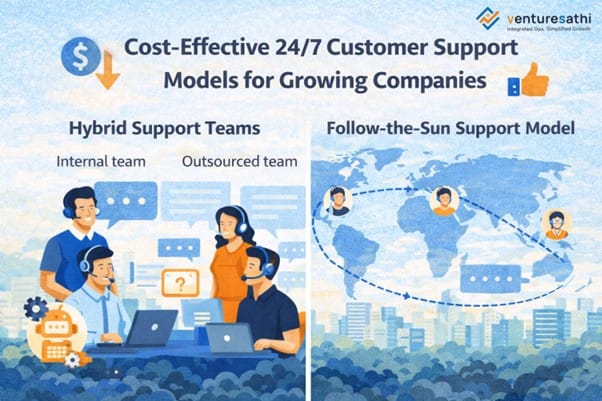
1. Hybrid Support Teams
A hybrid support model combines internal teams with outsourced support professionals. In this model:
- Core internal teams handle complex product issues and strategic accounts.
- External teams manage routine tickets and off-hour support requests.
- Automation tools resolve simple inquiries automatically.
This hybrid approach allows businesses to maintain expertise internally while scaling support capacity efficiently.
Example: A 3-Phase Hybrid Support Rollout
Many SaaS companies adopt hybrid support gradually rather than switching overnight. A typical rollout may look like this:
Phase 1: Internal Team Combined With Basic Automation
During the early stage, the internal support team manages most tickets while chatbots and helpdesk automation resolve basic queries like password resets or account setup.
Phase 2: Outsourced Off-Hour Support
As ticket volume grows, companies outsource evening or weekend support while the internal team continues handling complex product issues.
Phase 3: Full Hybrid Model
Eventually, outsourced teams manage routine queries and global coverage, automation handles repetitive tickets, and internal specialists focus on high-value customer interactions.
This phased approach allows companies to build a cost-effective 24/7 support structure without disrupting existing operations.
Example of a Follow-the-Sun Support Structure
A typical follow-the-sun support model may distribute teams across three regions:
| Region | Time Zone | Support Shift |
|---|---|---|
| North America | EST / PST | 8 AM – 5 PM local support |
| Europe | GMT / CET | 8 AM – 5 PM regional support |
| Asia-Pacific | IST / SGT | 8 AM – 5 PM regional support |
This means when the North American team finishes their workday, the European team takes over. Later, the Asia-Pacific team continues support coverage. This seamless transition allows companies to maintain a continuous 24/7 customer support strategy without requiring overnight shifts in a single location.
How to Outsource Customer Service for Scalable 24/7 Coverage
For many SaaS companies, the most practical way to deliver round-the-clock support is to outsource customer service. Outsourcing enables companies to expand support capacity quickly without investing heavily in infrastructure or hiring.
Benefits of Outsourced Customer Service Teams
When implemented strategically, outsourced support offers several advantages:
- Reduced operational costs: External teams often operate in cost-efficient regions.
- Scalable workforce: Support teams can expand or contract based on demand.
- Global availability: Outsourcing partners can provide coverage across time zones.
- Specialized expertise: Experienced support professionals bring established processes and tools.
By leveraging outsourcing, companies can create a scalable cost-effective 24/7 support system while maintaining high service standards.
Choosing the Right Partner for Global Support
Not all outsourcing providers deliver the same level of quality. Selecting the right partner is critical to the success of your 24/7 customer support strategy.
When evaluating outsourcing partners, companies should consider domain expertise in SaaS and digital products, strong onboarding and training processes, robust support infrastructure and helpdesk tools, clear communication and reporting systems, and understanding of the company’s brand voice, product features, and customer expectations.
Read more: Omnichannel CX Strategy: An Imperative for Global Brands
Using Automated Customer Support to Reduce Costs
Automation is another powerful component of a modern 24/7 customer support strategy. When implemented correctly, automation can significantly reduce operational costs. Here’s how:
AI Chatbots and Self-Service Portals
AI-powered chatbots can resolve common questions instantly without human intervention. Popular customer support platforms such as Intercom, Zendesk, and Freshdesk provide integrated chatbot capabilities, automated workflows, and self-service portals. These tools allow businesses to automate responses for queries such as password resets, account setup instructions, subscription questions, and basic troubleshooting.
Self-service portals and chatbot systems enable companies to provide immediate assistance while reducing ticket volume for support agents. This makes automated customer support an essential tool for scaling modern support operations.
Knowledge Bases and Ticket Automation
A well-structured knowledge base allows users to solve problems independently. Articles, FAQs, and product guides help customers find answers quickly without contacting support. In addition, ticket automation systems can categorize and route incoming requests automatically. Together, these tools make it easier to deliver cost-effective 24/7 support while improving response times.
Combining Automation and Human Support for the Best CX
Automation alone cannot deliver a great customer experience. The most effective 24/7 customer support strategy combines technology with human expertise.
When Automation Works Best
Automation performs well for repetitive and predictable queries. Examples include, account management requests, password recovery, basic troubleshooting steps, and product documentation access. In these scenarios, automated customer support provides instant responses while freeing up human agents for complex issues.
When Human Support Is Essential
Certain interactions require empathy, contextual understanding, and problem-solving. Human agents are essential for complex technical issues, billing disputes or account escalations, sensitive customer situations, and strategic customer success conversations.
By combining automation with skilled support agents, companies can build a balanced 24/7 customer support strategy that prioritizes both efficiency and customer satisfaction.
Read more: How AI Chatbots Will Transform Customer Service in 2026
Quality Control and CSAT Monitoring in a 24/7 Customer Support Strategy
Delivering round-the-clock support is only effective if service quality remains consistent. This is where structured quality control and CSAT monitoring become critical. Companies implementing cost-effective 24/7 support should establish clear performance metrics and monitoring systems.
Key quality assurance practices include:
- Regular ticket audits to evaluate agent responses
- Call and chat reviews to assess communication quality
- CSAT (Customer Satisfaction) surveys after each support interaction
- Agent coaching and feedback programs
CSAT scores provide valuable insights into how customers perceive support quality. Monitoring these metrics across different shifts helps companies identify performance gaps and maintain consistent service standards.
Therefore, by integrating quality control and CSAT monitoring into the support process, organizations can ensure that their 24/7 customer support strategy delivers both speed and quality.
Read more: How Venturesathi Enhanced Customer Experience for a 3PL Provider
Conclusion: Building a Cost-Effective 24/7 Customer Support Strategy
As SaaS companies expand globally, providing reliable customer support around the clock becomes essential. However, maintaining a large internal support team can be both expensive and operationally complex.
The most effective 24/7 customer support strategy combines multiple approaches including outsourced support teams, intelligent automation, and strong quality monitoring systems. By integrating automated customer support, implementing hybrid support models, and leveraging experienced partners to outsource customer service, businesses can deliver exceptional customer experiences without inflating operational costs.
Companies that invest in scalable support infrastructure today will be better positioned to build lasting customer relationships and sustain long-term growth. Vendors like Venturesathi help SaaS businesses design and implement scalable support operations by combining operational expertise, outsourcing capabilities, and technology-driven workflows tailored for growing companies.
Frequently Asked Questions (FAQs)
A 24/7 customer support strategy ensures that customers can access help at any time through live agents, automation tools, or self-service resources. It combines human support, automated customer support, and global team coverage to maintain consistent service availability.
Businesses can achieve cost-effective 24/7 support by combining automation, outsourced teams, and hybrid support models. This approach reduces staffing costs while maintaining continuous service coverage.
Companies typically outsource customer service when ticket volumes grow or when they expand into global markets. Outsourcing allows businesses to scale support operations quickly without increasing internal hiring.
Automated customer support tools such as chatbots, knowledge bases, and ticket automation resolve repetitive queries instantly. This reduces agent workload and allows support teams to focus on complex issues.
A strong 24/7 customer support strategy typically includes helpdesk software, AI chatbots, ticket automation, and knowledge bases. These tools enable automated customer support while helping support teams manage requests efficiently across multiple time zones.
Businesses can maintain quality when they outsource customer service by implementing clear training programs, regular ticket audits, and CSAT monitoring. Strong quality control processes ensure that cost-effective 24/7 support does not compromise the customer experience.