
Why Single-Service BPOs
No Longer Work for SaaS in 2026
The demand for integrated BPO services is experiencing rapid growth with the global market projected to reach USD 491.15 billion by 2030. Therefore, In the early days of outsourcing, where many SaaS startups relied on single-service vendors to handle isolated operational needs such as customer support, data processing, or development assistance is no longer the norm. Today’s SaaS companies operate across multiple systems, time zones, and customer touchpoints.
This shift is why many founders are now looking beyond fragmented outsourcing models and choosing integrated BPO services delivered by an integrated operations partner. Instead of managing multiple vendors, SaaS companies increasingly prefer a single partner capable of delivering CX Dev back office outsourcing under one operational framework. This model not only reduces operational complexity but also improves speed, collaboration, and scalability.
Why SaaS Companies Are Moving Toward an Integrated Operations Partner
Modern SaaS companies require seamless coordination between customer experience, development support, and back-office operations. Customer feedback collected by support teams needs to reach product teams quickly. Billing and operational insights must flow into growth strategies. This level of integration becomes difficult when multiple vendors operate independently.
An integrated operations partner brings these capabilities together within one ecosystem. Instead of siloed vendors managing different functions, integrated teams collaborate across CX, development, and back-office operations. The result is faster communication, better alignment, and smoother operational execution.
For many SaaS companies, this approach also accelerates innovation. When support insights inform development priorities and operational analytics inform product decisions, the entire organization becomes more responsive to customer needs.
How Fragmented Outsourcing Slows Down SaaS Growth
Fragmented outsourcing introduces coordination overhead that can quietly slow down a fast-moving SaaS company. When customer support, engineering support, and operational tasks are handled by separate vendors, communication delays are inevitable. Issues get escalated across multiple teams, and accountability becomes unclear.
For founders and operators, managing these fragmented relationships consumes valuable time that could otherwise be spent on product innovation or growth strategy. Over time, operational inefficiencies accumulate and create friction across the organization.
This is precisely why SaaS operations outsourcing is shifting toward integrated models where a single partner manages multiple operational functions cohesively.
Many SaaS founders eventually discover that operational complexity grows faster than product complexity. Partnering with an integrated operations provider allows them to focus on innovation while experienced teams handle the operational engine behind the business.
The Limitations of Traditional Single-Service and Multi-Service BPO Models
While outsourcing itself remains a powerful strategy, the traditional structures of outsourcing vendors often struggle to meet the evolving needs of SaaS companies. Here’s how:
Operational Silos Created by Single-Service Vendors
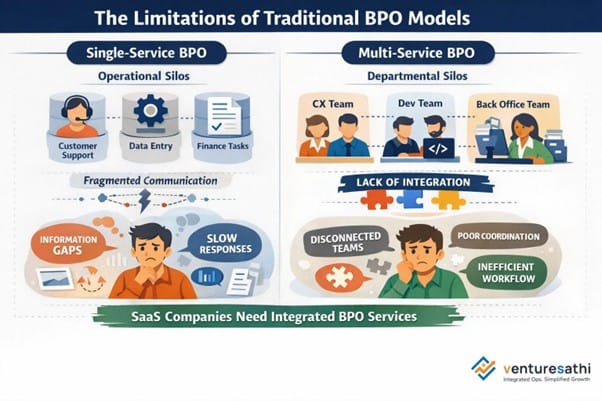
Single-service outsourcing vendors typically specialize in a narrow operational function such as customer support or data entry. While this expertise can be valuable, it often creates operational silos. Each vendor focuses only on their assigned task, without full visibility into the broader business workflow.
For SaaS companies, this fragmented approach limits operational agility. Customer complaints might reach support teams but never reach product teams quickly enough. Data processed in the back office may not feed into analytics systems efficiently.
These silos reduce operational efficiency and create gaps in communication, ultimately affecting customer experience and internal productivity.
The Lack of True Ops Integration in Multi-Service BPOs
At first glance, multi-service BPO providers may appear to solve this problem by offering several services under one organization. However, traditional multi-service BPO models often operate in departmental silos internally. CX teams, development teams, and operational teams may exist under the same vendor but function independently. Without true operational integration, SaaS companies still face coordination challenges. Simply offering multiple services is not the same as delivering them through a unified operational model.
What SaaS companies increasingly need is not just a multi-service BPO, but an integrated BPO services provider capable of aligning multiple functions around shared outcomes.
Why Are SaaS Companies Prioritizing CX, Dev, and Back Office Outsourcing Together?
SaaS companies are fundamentally product-driven businesses, but operational excellence plays a major role in delivering a consistent user experience. The customer journey spans multiple functions, from product usage and onboarding to billing and technical support.
This is why the industry is witnessing a growing shift toward CX Dev back office outsourcing.
The Rise of CX Dev Back Office Outsourcing
CX Dev back office outsourcing refers to a model where customer experience operations, development support, and back-office functions are managed by integrated teams. This structure allows operational insights to flow across departments in real time.
For example, customer support teams can quickly share recurring product issues with development teams. Back-office data teams can analyze customer behavior and feed insights into growth strategies. Development support teams can collaborate with customer success teams to improve onboarding flows.
When these functions operate together under an integrated framework, SaaS companies gain faster feedback loops and better operational visibility.
Aligning Product, Customer Experience, and Operations
Alignment across product development, customer experience, and operational processes is essential for SaaS success. A friction point in onboarding can affect activation rates. A billing issue can impact customer retention. A delayed product fix can increase support tickets.
An integrated outsourcing model ensures that all these functions remain connected. Instead of working in isolation, teams collaborate around shared performance metrics such as customer satisfaction, resolution time, and operational efficiency.
This alignment ultimately leads to better customer outcomes and stronger business performance.
Vendor Consolidation for Startups: Simplifying the SaaS Operations Stack
Managing multiple operational vendors can become overwhelming for startup founders and early-stage teams. Vendor contracts, performance monitoring, and cross-vendor communication require ongoing attention.
As a result, vendor consolidation for startups is becoming an increasingly common strategy.
Key benefit of Vendor Consolidation for Startups
Vendor consolidation allows startups to simplify their operational infrastructure by partnering with fewer providers. Instead of coordinating multiple service vendors, founders can work with a single integrated operations partner capable of delivering multiple operational functions.
This approach reduces management overhead and improves accountability. With fewer vendors involved, operational performance becomes easier to track and optimize. For startups operating with limited resources, vendor consolidation can also accelerate execution by removing unnecessary coordination layers.
Reducing Coordination Costs and Operational Friction
Every additional vendor relationship introduces coordination costs. Meetings, reporting structures, communication workflows, and performance reviews must all be managed effectively.
By consolidating vendors into a single integrated BPO services provider, startups reduce these operational burdens. Teams spend less time managing vendors and more time focusing on product innovation and customer growth.
This streamlined structure also improves response times when operational issues arise, ensuring that SaaS companies maintain agility during critical growth phases.
Read more: BPOs vs Freelancers vs Hiring In-House: The Best Model For Startup Outsourcing in 2026
How an Integrated Operations Partner Supports SaaS Scale-Ups
As SaaS companies transition from startup to scale-up stage, operational complexity increases dramatically. Customer bases grow, product features expand, and global markets introduce new operational challenges.
SaaS Operations Outsourcing for High-Growth Companies
For high-growth companies, SaaS operations outsourcing becomes a strategic lever rather than a tactical cost-saving measure. By partnering with an integrated operations partner, scale-ups gain access to specialized operational expertise without the need to build large internal teams.
Integrated partners provide operational infrastructure across customer support, development assistance, data operations, and administrative processes. This allows SaaS companies to scale efficiently while maintaining operational quality.
Why Outsourcing for Scale-Up Companies Requires Integrated Teams
Outsourcing for scale-up companies must prioritize operational alignment. At this stage, even minor inefficiencies can impact customer experience and growth metrics.
Integrated teams ensure that operational workflows remain synchronized. Support teams can collaborate with development teams to address technical issues quickly. Operational data can inform product and marketing decisions.
This collaborative structure enables scale-ups to maintain operational stability while continuing to innovate.
What to Look for in an Integrated BPO Services Provider
Choosing the right outsourcing partner is a critical decision for SaaS founders. Not all outsourcing vendors are equipped to support integrated operational models.
1. Technology Integration Capabilities
A strong integrated BPO services provider must have the ability to integrate seamlessly with the SaaS company’s technology stack. This includes CRM systems, customer support platforms, analytics tools, and product management systems.
Technology integration ensures that operational data flows smoothly between teams, enabling better decision-making and faster response times.
2. Cross-Functional Operational Expertise
An effective integrated operations partner should possess expertise across multiple operational domains, including customer experience, development support, and back-office operations.
Cross-functional expertise allows the partner to design workflows that connect these functions effectively. Instead of operating in silos, teams collaborate around shared objectives and performance metrics.
Scalability for SaaS Growth Stages
Finally, the outsourcing partner must be capable of scaling alongside the SaaS company. Early-stage startups require lean operational support, while scale-ups need robust infrastructure capable of handling larger volumes of customers and data.
Read more: How to Extend Your Startup Runway by 4–6 Months Through Integrated Ops
Conclusion: The Future of SaaS Outsourcing Is Integrated
Modern SaaS companies operate in complex environments where customer experience, product development, and operational efficiency must work together seamlessly. In this context, relying on isolated outsourcing vendors can slow down growth and create unnecessary friction.
By embracing CX Dev back office outsourcing delivered through integrated BPO services, SaaS companies gain operational alignment, faster feedback loops, and improved scalability. For founders and operators, partnering with an integrated operations partner simplifies vendor management while strengthening operational performance.
As the SaaS industry continues to evolve, integrated outsourcing models will play an increasingly important role in helping startups and scale-ups build resilient, efficient, and customer-centric operations.
Frequently Asked Questions (FAQs)
An integrated operations partner is an outsourcing provider that manages multiple operational functions such as customer experience, development support, and back-office operations within a unified framework. This model ensures seamless collaboration across different operational teams.
SaaS companies are adopting integrated BPO services to reduce operational silos, improve communication between teams, and simplify vendor management. Integrated models enable faster decision-making and better alignment across business functions.
CX Dev back office outsourcing allows SaaS companies to manage customer support, development assistance, and operational tasks through integrated teams. This improves operational efficiency and ensures that customer insights inform product and business decisions.
Vendor consolidation for startups refers to reducing the number of outsourcing vendors by partnering with a single provider capable of delivering multiple services. This simplifies operational management and reduces coordination costs.
An integrated BPO services model brings customer experience, development support, and back-office functions under one operational framework. By working with an integrated operations partner, SaaS companies reduce operational silos, improve communication, and scale operations faster through streamlined SaaS operations outsourcing.
CX Dev back office outsourcing helps scale-up SaaS companies eliminate vendor silos and improve coordination between teams. By consolidating multiple functions with one integrated operations partner, companies reduce complexity and create a more efficient model for outsourcing for scale-up companies.