
The 30-Day Ramp Framework:
How SaaS Startups Can Scale Ops Fast
Every SaaS startup eventually hits a point where growth becomes a double-edged sword. On one side lies increased sign-ups, revenue spikes, and product adoption. On the other side sits the operational reality of support tickets piling up, response times slipping, and customers growing impatient. In a subscription-driven world where every interaction shapes churn, the ability to scale customer support fast is not only operational hygiene but also a strategic advantage.
Over 55% of startups fail in the US due to operational inefficiencies such as a lack of structure, process, or execution discipline.This is exactly why high-growth SaaS companies are increasingly turning to a 30-day outsourcing setup. Instead of spending months onboarding new support teams, training them, and bringing them up to speed, this framework allows founders to bring an external team to full productivity in just one month.
This blog breaks down the entire process in detail including the philosophy behind the model, the weekly structure, the operational milestones, and the optimisation mechanisms that make it scalable. If you are looking for a ready-to-implement ramp roadmap that supports startup scaling operations, you will find everything you need here.
Why Do SaaS Startups Need a 30-Day Ramp Framework?
SaaS companies do not scale in smooth or predictable curves. They grow in sharp spikes often triggered by launches, marketing campaigns, seasonal surges, or funding announcements. The product and engineering teams can usually handle these surges with sprint cycles, but customer support does not have the luxury of delayed timelines. If ticket queues explode today, customers expect solutions today.
This mismatch creates pressure. Founders end up answering tickets. Product managers get pulled into customer escalations. Teams work late nights to keep up with SLAs. This is why creating a fast support setup becomes so crucial.
A sustainable support engine must be able to absorb volume shocks without breaking. Traditional hiring timelines from sourcing, interviewing, onboarding, and training are far too slow for this environment. By the time a new hire is productive, the startup has already lost customers or reputation.
A well-built 30-day outsourcing setup solves this bottleneck. It provides a predictable and repeatable framework that companies can deploy any time when ticket volumes begin to outpace capacity. Instead of reacting to crises, founders can proactively design support operations that scale as fast as the product.
SaaS growth is never linear but support operations can be. The biggest mistake founders make is assuming support will ‘catch up’ on its own. It won’t. A structured 30-day ramp framework gives you the operational predictability you need for your growing business.
What Is the 30-Day Outsourcing Setup?
At its core, the 30-day outsourcing setup is a structured, time-bound framework designed to rapidly onboard and ramp an external support team while maintaining high quality. It brings clarity, consistency, and operational control to what is usually an unpredictable process.
A Fast, Repeatable Framework for Scaling Support
The 30-day model creates a system where every new agent follows the same steps, receives the same training, hits the same milestones, and is measured against the same outcomes. This standardisation is what makes the process scalable. It ensures that whether you add five agents or fifty, your operational quality remains consistent.
By treating ramp time the same way engineering treats sprints, the framework brings discipline and predictability into the support function, something most startups desperately lack.
Why 30 Days Is the Optimal Ramp Period?
30 days strikes the sweet spot between speed and depth. A shorter 7–14 day onboarding may look attractive, but it almost always leads to rushed training, overwhelmed agents, and poor customer experience. In contrast, a three-month timeline is simply too slow for a high-growth SaaS environment.
A 30-day timeline gives agents enough time to learn the product, practice handling tickets, and gradually build confidence without being thrown into the deep end. It allows trainers to correct mistakes early, reinforce knowledge, and ensure the entire team is aligned on tone, workflows, and product behaviour. The result is a team that is fast, competent, and ready for real-world complexity.
Read more: Best BPO Companies for Customer Support & Outsourcing
Day 1-10: Foundations of Quick Outsourcing Integration
The first 10 days of the 30-day outsourcing setup focus on building the operational foundation. Without this foundation, scale becomes chaotic and unsustainable. During this phase, SaaS companies define the expectations, documentation, workflows, and tone that shape the entire customer experience.
Setting SLAs, SOPs and Support Workflows
Every high-performing support organisation is built on clear definitions. This includes service-level agreements, escalation policies, ticket categories, routing logic, and customer communication guidelines. During the first ten days, the internal team and the outsourced partner synchronise on these expectations.
This clarity ensures that support agents know how quickly they must respond, when to escalate an issue, who owns each type of ticket, and what tone or empathy style the brand expects. Without this alignment, support becomes inconsistent which is a major risk for SaaS companies where customer trust is fragile.
Training Assets and Playbooks
The next stage involves creating the training library that agents will use during the ramp period. This includes product walkthroughs, feature explainers, troubleshooting guides, macros, and documentation for edge cases. SaaS products evolve constantly, so the training approach must be agile enough to accommodate rapid updates.
Instead of lengthy handbooks, the emphasis is on clarity and relevance. Agents need actionable resources that mirror real customer scenarios. This is what drastically reduces ramp time and improves productivity.
Building a Real-Time Knowledge Base
A dynamic knowledge base is the heart of the first 10 days. SaaS products change weekly, which means static documents become outdated fast. A real-time, searchable knowledge base is essential for quick onboarding and long-term accuracy.
During this phase, teams structure content into bite-sized modules that agents can reference during live tickets. This reduces dependency on trainers and ensures agents always have up-to-date answers, especially during feature changes or product rollouts.
Day 11-20: The Support Team Ramp-Up Phase
The second phase of the 30-day outsourcing setup shifts from theory to practice. Agents begin interacting with real workflows, shadowing experienced reps, and slowly taking ownership of supervised tickets. The goal is to build confidence and accuracy without overwhelming them.
Rapid Skills Training for SaaS
During Days 11–20, agents go through focused sessions that mirror real-world SaaS support environments. This includes micro-learning around product features, troubleshooting steps, customer behaviour patterns, CRM usage, and helpdesk navigation. SaaS tickets often require deep product understanding, so the focus here is on bridging the gap between theory and application.
This stage is where agents begin recognising patterns such as common bugs, repetitive queries, and product-specific confusion points. Once this pattern recognition develops, ramp time accelerates dramatically.
Shadowing & Supervised Tickets
Shadowing is one of the most effective ramp-time accelerators. New agents listen to real calls, observe chat handling techniques, and watch senior reps navigate tricky situations. This real-world exposure helps them understand the tone, empathy, and resolution style expected by the SaaS brand.
After observing, agents begin responding to tickets under supervision. Feedback is immediate, constructive, and continuous. This supervised stage builds accuracy and confidence while preventing incorrect resolutions from reaching customers.
Micro-Learning for Faster Ramp-Up
Micro-learning is one of the most underrated aspects of rapid outsourcing onboarding. Instead of information overload, agents receive small, focused modules that build on each other. Daily feedback loops allow trainers to correct mistakes instantly. This improves retention, reduces cognitive fatigue, and significantly speeds up the overall ramp period.
Day 21-30: Full Go-Live & Optimization
The final phase of the 30-day outsourcing setup is where agents transition to fully live customer interactions. By this time, they are equipped with knowledge, confidence, and workflow familiarity.
Handling Live Tickets
In this stage, agents take ownership of full live ticket volumes. QA oversight continues daily, ensuring accuracy remains consistent. Managers review performance indicators, identify knowledge gaps, and provide targeted coaching. This is the stabilisation period where the team matures into a fully functioning support engine.
Performance Dashboards
SaaS companies rely heavily on data, and support operations are no different. During this stage, dashboards begin tracking metrics such as average handling time, first response time, CSAT scores, and accuracy. Workload distribution becomes clearer, and quality trends become visible. This data-driven approach allows founders to make informed decisions about staffing, training, and process improvements.
Weekly Optimization Loops
Optimization loops begin in Week 4 and continue indefinitely. These loops identify bottlenecks, update macros, refine escalations, and optimise workflows. As SaaS products evolve, these loops ensure the support team evolves with them. This prevents stagnation and keeps performance consistent even as ticket complexity increases.
Read more: Why Contact Centres Fail at Scale
Common Mistakes During Outsourcing Setup
Many SaaS startups underestimate the nuances of support operations and fall into preventable traps. Over-documentation, for example, overwhelms agents and slows down ramp time. Unrealistic go-live expectations push teams into panic mode, resulting in poor customer experience. Weak communication protocols lead to misalignment, duplicated work, and broken workflows.
Avoiding these mistakes is critical to achieving a smooth and predictable ramp.
Benefits of the 30-Day Ramp Framework for SaaS
A 30-day outsourcing setup provides a foundation that scales with the company. Customer response times improve dramatically because the team is ready to handle volume. Costs reduce because ramp time is shortened and accuracy increases and most importantly, customer experience strengthens, which directly reduces churn and improves lifetime value.
Therefore, the biggest advantage is operational predictability. Customer support stops being a fire to extinguish and becomes a structured function that scales smoothly as the company grows.
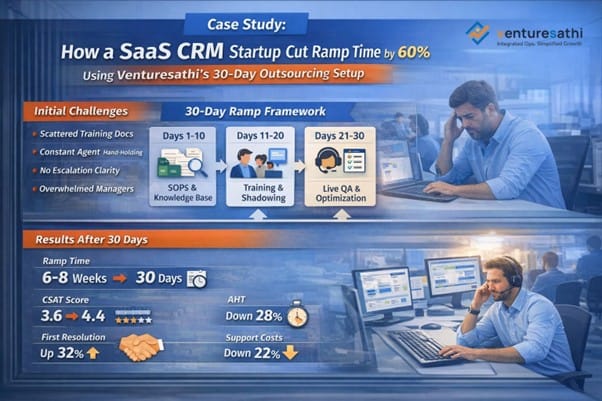
Case Study: How a SaaS CRM Startup Cut Ramp Time by 60% Using Venturesathi’s 30-Day Outsourcing Setup
A mid-stage B2B SaaS CRM platform company with a team size of 40-50 employees faced the challenge of support tickets spiking by 3.5x after a new product release. Their internal support team was overwhelmed, onboarding new agents took 6–8 weeks, and CSAT had fallen to 3.6/5.
Therefore, the biggest advantage is operational predictability. Customer support stops being a fire to extinguish and becomes a structured function that scales smoothly as the company grows.
What Went Wrong Initially
- Training content was scattered across Notion, Gmail, Slack.
- New agents required constant hand-holding.
- Zero clarity on escalations or ticket ownership.
- Managers were firefighting instead of coaching.
They needed quick outsourcing integration that did not compromise quality.
How our 30-Day Ramp Framework Helped
- Day 1-10: Venturesathi built clear SOPs, revamped ticket workflows, and created a real-time knowledge base that agents could search during calls and chats.’
- Day 11-20: New agents entered a structured ramp-up phase with micro-learning modules, ticket simulations, shadowing senior reps and tool training across their CRM and helpdesk.
- Day 21–30: Agents went fully live under QA supervision. Daily standups identified issues instantly, allowing rapid optimization.
Results After 30 Days
- Ramp time reduced from 6–8 weeks to 30 days
- CSAT improved from 3.6 to 4.4
- AHT dropped by 28%
- First-contact resolution increased by 32%
- Support cost per ticket decreased by 22%
Explore Venturesathi’s Services | Read Customer Success Stories
Scale Customer Support Fast, Without Chaos
Customer support is one of the most underestimated growth levers in early-stage SaaS, yet it directly influences retention, word-of-mouth, and long-term customer value. As startups scale, ticket volumes surge, product complexity increases, and customer expectations shift rapidly, making it nearly impossible to rely on unstructured onboarding or scattered processes.
A proven 30-day outsourcing setup gives SaaS founders what they need most which is speed, clarity, and operational predictability. With a structured ramp blueprint, startups can scale customer support fast, avoid last-minute firefighting, and build a customer experience function that grows smoothly with the business. This kind of operational maturity is what separates chaotic support teams from scalable, consistent ones. And it’s exactly why companies turn to partners who understand the rhythm of SaaS growth.
At Venturesathi, we help startups adopt rapid outsourcing onboarding frameworks, build high-performing support teams, and integrate processes that stay resilient as you scale. Whether you’re preparing for a product launch, a funding milestone, or simply want tighter support operations, having a trusted process and a trusted partner makes all the difference.
Frequently Asked Questions (FAQs)
1. What is a 30-day outsourcing setup for SaaS startups?
A 30-day outsourcing setup is a structured onboarding and training framework that helps SaaS startups scale customer support fast with predictable milestones, rapid agent ramp-up, and quick outsourcing integration.
2. How does the 30-day ramp framework help scale customer support fast?
The framework standardizes SLAs, workflows, product training, and QA processes so teams become support-ready in under a month, reducing ramp time and improving response quality.
3. Is rapid outsourcing onboarding risky for early-stage SaaS startups?
Not when implemented properly. A fast but structured onboarding model reduces risk by providing clear SOPs, micro-learning, supervised ticket handling, and performance monitoring from day one.
4. What do SaaS startups need before starting a support team ramp-up?
You need defined workflows, ticket categories, SLAs, tone guidelines, and training assets. These help ensure quick outsourcing integration without misalignment or delays.
5. How do I know if my SaaS product is ready for outsourced support?
If you have repeatable support queries, clearly defined processes, and a growing ticket volume, you’re ready to begin a 30-day outsourcing setup for scalable support operations.
6. How much does it cost to scale customer support with outsourcing?
Outsourcing typically reduces operational costs while enabling faster support team ramp-up. With the 30-day ramp framework, startups see lower onboarding costs, faster productivity, and predictable staffing.